There are only two teams left standing after another intriguing NHL season, and the Chicago Blackhawks face Tampa Bay Lightning in the prestigious Stanley Cup Final with the first game taking place on Wednesday 4 June. Ahead of this series we have been asking you to tell us why ice hockey is the sport closest to your heart. From north England to northern points of Canada and the US here are some of your stories.
David: ‘That team was my one and only true sporting love.’
Between 1987 and 1991 David was an avid supporter of the Durham Wasps. During those years they were the pre-eminent force in British ice hockey. David introduced his father George to the sport and they watched the games in matching blue and yellow Durham Wasps jackets at the Riverside Rink in Durham, a venue David describes as a glorified shed. “The capacity of the rink was 2700, but there were thousands more than that packed in on a regular basis. Literally creaking at the joints, the place hummed and thundered to the sound of metal on ice, stick on puck and fist on face.”
The Riverside Rink in Durham was built by John Frederick James Smith, a former Mayor of both Darlington and Durham, who saw the increasing use of refrigerators threaten his ice factory on the River Wear in the 1930s. The Canadian airmen stationed nearby during the second world war are credited with bringing ice hockey to the region.
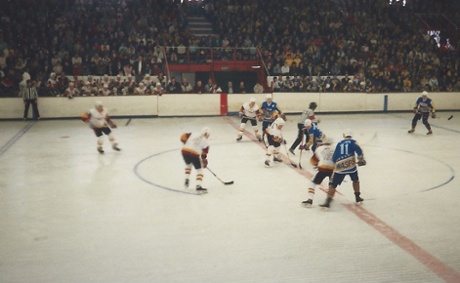
But by the early nineties the rink was in a poor physical state, and succumbed to the new, higher standards introduced by national governing body Ice Hockey UK. New emerging teams like Cardiff Devils and Sheffield Steelers had big modern facilities and large sponsors that Durham simply could not match, and as the team eventually moved to Newcastle, the crowds refused to follow resulting in the team folding permanently in 2011. David thinks what made the Durham Wasps and the ice rink so special was the amateurish, innocent way it was run. “I remember plastic bags full of turnstile cash being carried along the corridors under the stands. The ice cleaner was the laughing stock of the league, ironically branded with Cadbury’s ‘Go’, it often stopped.”
The ice rink was also such a key part of many young peoples lives in Durham. Being the only real recreational facility there was in the area, the Saturday skating sessions and ice discos ever Wednesday gave young locals a great opportunity to strike up long lasting friendships and companionships. David has never supported any other team since the demise of the Durham Wasps. “The Wasps, the rink and my dad are all now gone. What was seemingly so permanent is no longer there, but for a few years, they all came together in a heady tale of local success and family togetherness. I miss them all.”
Laura Peterson: ‘He suggested that if the Flames win the game we should name our son after the goal scorer.’
Laura Peterson and her family live in a small isolated town in northern Canada called Fort Smith. In 2004 Laura was expecting her second child with husband George who is an avid Calgary Flames fan. The Flames were on an improbable march through the Stanley Cup play-offs at the time. “When the due date approached, we all travelled to Yellowknife where there were better health care facilities. May son was born on the evening of 3 June, while the Flames were playing the Tampa Bay Lightning in Game 5 of the Stanley Cup play-offs.”

But Laura and George had not yet decided what to name their newborn son, and as the play-off game had gone into sudden death overtime, George suggested they name him after the potential Flames match winner. “The Flames duly won the game but the goal scorer was Oleg Saprykin. I am not a die-hard Flames fan, so we chose the name Niklas instead. But perhaps we disrupted the Flames play-off karma. They did not win the Stanley Cup that year.”

Lily Weed: ‘We have long, dark winters so winter activities are important.’
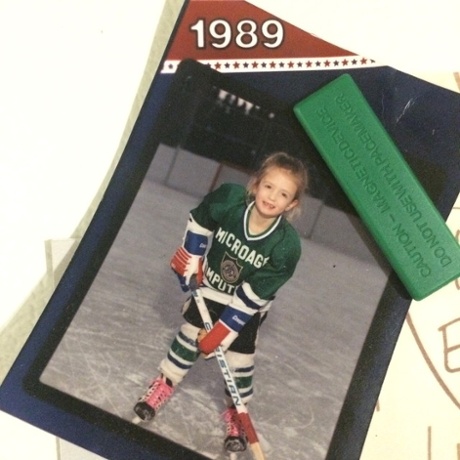
Lily Weed grew up in Anchorage, Alaska. She recently discovered an old photo of herself playing ice hockey and it stirred up childhood memories from the local ice rink. “I played ice hockey from the age of three to about seven. My older brother played through high school and is still playing in two different adult recreational leagues. My younger brother also played the game when he was younger.” Lily played for teams in both the Boys and Girls Club league. All the coaches were parent volunteers and the whole league had a strong community feel to it. “I think there was another girl on my team for at least one of the seasons, but it was mostly boys at the time. My parents’ stories always put me as the most focused on the team, but most of my memories are of running wild around the rink with the other younger siblings while my older brother played. I think my parents enjoyed the social aspect of talking to other parents at the games.”
Lily’s dad is an attorney and represented many of the players on the University of Alaska, Anchorage hockey team. “The players taught youth camps and kept the games and practice fun. I think they were the main reason I have such positive memories from when I played.” While hockey is not suck a big part of her life now, Lily points out that the game is important to many fellow Alaskans. “As well as indoor ice rinks there are outside rinks at most public schools and in some public parks. Ice is regularly cleared of snow on the local ponds too. We have long, dark winters so winter activities are important.” Lily’s older brother is still as committed to the sport as ever. “He even named his cat Gretzky.”
Faye Andrews: ‘Ask any hockey player to attend a social event at the weekend between the months of September and May, and the response you will get is “I can’t, I’ve got hockey...”
Faye Andrews grew up in Greater Manchester in a normal working class family. She first started playing hockey at the age of 5, when her mum needed to keep Faye occupied for a couple of hours on Saturdays. The local ice rink was in Devonshire Road, Altrincham. It opened in 1960 and was the home to both the Altrincham Aces and Trafford Metros ice hockey teams, but was sold for housing development in March 2003 after 43 years. Faye played in every age group until the rink closed, and continued her junior career at the next closest rink in Flintshire, North Wales.
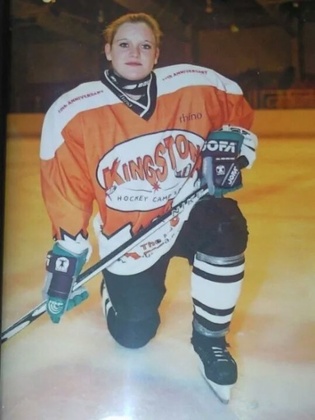
There were only about 5 girls that Faye knew about whilst playing junior hockey growing up. She thinks that limited ice time was definitely one of the main reasons for the low number of girls signing up to play. “I joined the girls team at Altrincham when I was 14, and the only ice time the rink would give us was from 00:30am until 02:00am on a Friday night/Saturday morning. Understandably my parents didn’t want to sit in a freezing cold ice rink until 2am on a Friday night and so I had to arrange my own transport there and back each week if I wanted to play. And my parents were used to driving me all over to hockey matches and practice, so I can’t imagine anyone new to the sport willing to make that kind of sacrifice.” Faye still thinks that challenging time slots on the ice are an obstacle for women’s ice hockey. “My current team Guildford Lightning train at 11:30pm until 1am on a Friday night, and because of this it is difficult to attract female youth prospects to the team from the Junior set up at Guildford.”

Funding is also a huge challenge for women’s hockey, and the sport is currently wholly funded by the players themselves. “Unless a team is lucky enough to secure sponsorship, all costs are covered by the players. This can mean that the sport can be inaccessible to young girls and women from lower income area’s or from single parent families, as well as those in full-time education or unemployed.” Faye herself spends around £200 pounds per month on the sport, including monthly subs and fuel costs to games and practice. “I know there are girls who pay more and travel further just for a chance to play the sport they love.” The problem of funding goes all the way up to the national level, but Faye does think that women’s hockey is on the right track in other areas. “There are now dedicated national team age groups and leagues at junior level for girls to join, whereas when I was first starting out you either had to join a boys’ team or not play at all.”
Faye regards herself as very lucky to have discovered ice hockey at a young age, and the sport has had a lasting impact on her life. “Ice hockey has enabled me to travel to places in the world that I never would have been able to visit otherwise, playing teams from North America, Scandinavia and the Baltic States. I have made lifelong friends. I met my husband, who plays as a netminder, at a Sheffield hockey tournament five years ago. It taught me many valuable lessons as a child such as work ethic, discipline, commitment and team spirit and these are values I have carried with me into adulthood.”
You can still share your own ice hockey photos and memories on GuardianWitness