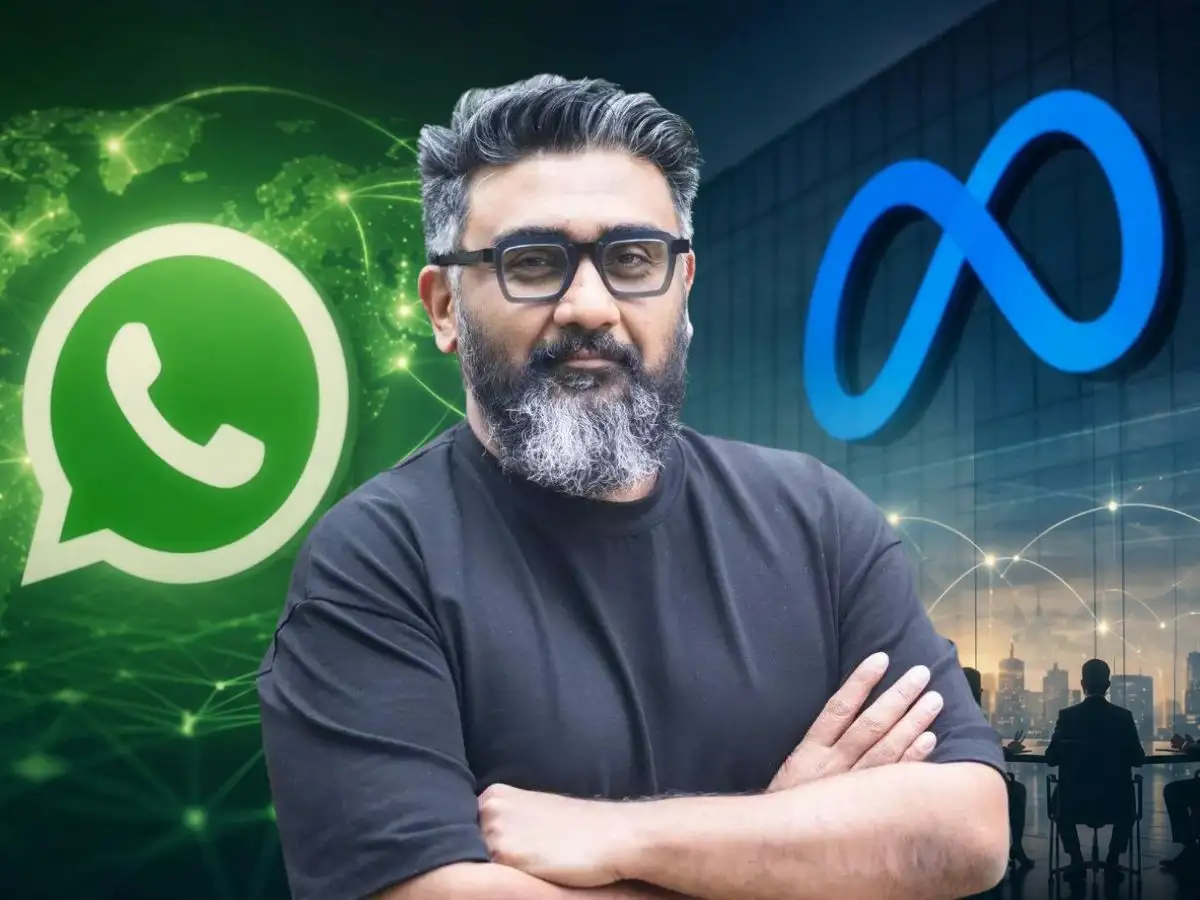
Kunal Shah's reported appointment to a top leadership role at WhatsApp will reignite a familiar conversation in the technology world. For more than a decade, Silicon Valley's most influential companies have repeatedly turned to Indian-origin executives when leadership positions open up. From Google and Microsoft to Adobe and IBM, the list is now long enough to no longer be dismissed as coincidence.
Yet Shah's elevation stands out even within this broader trend, giving an unexpected twist to Silicon Valley's India pipeline. Unlike many Indian-origin executives who rose through the ranks of large US corporations, Shah arrives with the credentials of a founder who built and scaled businesses in India's intensely competitive startup ecosystem. Meta is not merely hiring a manager but appears to be betting on an entrepreneur who has spent years understanding consumer behaviour, digital payments, product adoption, and platform economics in one of the world's most dynamic internet markets.
Also Read: Meet Kunal Shah, serial entrepreneur and Meta's pick to lead WhatsApp
The expectation from Shah is likely to extend far beyond operational oversight. WhatsApp is at the core of Meta's ambitions in commerce, payments, and business messaging. While the platform dominates personal communication across much of the world, its monetisation potential remains only partially realised. The next phase is expected to involve turning WhatsApp into a deeper commercial platform without undermining the simplicity that made it successful. Shah's experience building consumer internet products and navigating India's rapidly evolving digital economy could prove valuable in that effort.
His appointment is more than another HR decision. It offers a fresh lens to examine why Indian talent continues to find its way into the highest levels of global technology companies.
The Indian presence is no longer an exception
There was a time when the discussion around Indian success in Silicon Valley revolved around a handful of superstar CEOs. Sundar Pichai at Google, Satya Nadella at Microsoft, Shantanu Narayen at Adobe, and Arvind Krishna at IBM became the most visible symbols of Indian-origin leadership in global technology.
What is changing now is the depth of the bench. A new generation has begun to occupy influential positions across the industry. At Tesla, Vaibhav Taneja serves as chief financial officer. At Apple, Sabih Khan oversees one of the world's most complex supply chains as senior vice president of operations. At Uber, Balaji Krishnamurthy leads engineering for mobility and supply. At Anthropic, Rahul Patil serves as chief technology officer. At OpenAI, Srinivas Narayanan is among the senior leaders helping build and scale the company's infrastructure. Cisco's AI and networking efforts are being shaped by executives such as Sachin Katti. Rubrik's technology organisation is led by figures such as Arvind Nithrakashyap, while executives like Praveen Naga have emerged in important product and engineering leadership roles.
Also Read: Kunal Shah is WhatsApp CEO as Meta leads $900 million financing in Cred
The significance of this list lies in its diversity. These leaders are spread across artificial intelligence, cloud computing, mobility, enterprise software, hardware, and cybersecurity. They are not clustered within a handful of legacy technology firms. Many occupy positions that traditionally serve as stepping stones to the chief executive's office. The pattern increasingly resembles a pipeline rather than a collection of isolated success stories.
The selection effect?
One often-cited reason Indians have performed well in Silicon Valley is that those who arrive there are already part of an unusually selective group. The journey from India to top engineering schools, global technology firms, and senior leadership positions involves multiple layers of competition. Individuals who make it through that process tend to possess strong technical foundations and high levels of ambition. By the time they enter the leadership track, they have already survived filters that remove a large proportion of candidates. This idea is not that Indian professionals are inherently better managers than others, but that the cohort being observed in Silicon Valley is not representative of India as a whole. It is a highly screened group that has accumulated educational, professional, and cultural advantages over many years.
Why Big Tech likes Indian managers
The rise of Indian-origin executives has often been linked to a particular style of leadership. Many of them did not build their reputations as celebrity founders. Instead, they spent years inside large organisations, learning how products are built, how teams operate, and how complex companies make decisions. They developed expertise in managing stakeholders across different functions and geographies. They learned how to navigate corporate structures without becoming trapped by them.
Also Read: Kunal Shah's WhatsApp appointment underscores India's expanding Big Tech footprint
This profile turns out to be valuable in mature technology companies. The largest technology firms today are less like startups and more like multinational institutions. Running them requires patience, consensus-building, and operational discipline. Investors, regulators, governments, and employees all exert influence on major decisions. Leaders who can align large groups often gain an advantage over those who rely solely on vision or charisma.
That partly explains why several Indian-origin executives have flourished within established technology companies. They mastered the internal mechanics of these organisations long before they reached the top.
Kunal Shah's hiring sets a new example
Shah's story diverges from this standard pattern. He is not primarily known as a corporate executive who spent two decades climbing the ladder at a US technology giant. He is known as a founder, specifically one based in India. His reputation was built through entrepreneurship, first with FreeCharge and later with CRED. He spent years making product bets, raising capital, understanding consumer psychology, and competing in India's fast-moving digital market.
Those experiences cultivate a different set of instincts. Founders often operate with incomplete information and compressed timelines. They make decisions without the institutional support systems available inside large corporations. They are forced to think about customer acquisition, monetisation, and product-market fit at the same time. Success depends on recognising opportunities before they become obvious. If Meta is indeed turning to Shah for a major WhatsApp leadership role, it may indicate an interest in those entrepreneurial instincts as much as his managerial abilities.
Shah's appointment gives a fresh twist to Silicon Valley's India story. Big Tech is coming not just for talent now but also for homegrown founders who sharpened their instincts in a fiercely competitive Indian startup sector.
The India startup ecosystem as a leadership factory
India's startup ecosystem has changed dramatically over the past decade. A generation ago, many of the country's brightest technology professionals aspired to join multinational corporations. Today, many choose to build companies of their own. Some succeed, many fail; yet the process itself produces founders and operators who learn how to scale businesses, manage capital, and compete in unforgiving markets.
The list of founders who have emerged from this ecosystem is substantial. Bhavish Aggarwal built Ola into one of India's largest mobility platforms before expanding into electric vehicles. Deepinder Goyal transformed Zomato from a restaurant discovery service into a publicly listed food delivery giant. Vijay Shekhar Sharma helped make Paytm one of the most recognisable names in India's digital payments revolution. Nithin Kamath turned Zerodha into the country's largest retail brokerage without relying on venture capital funding. Kunal Bahl and Rohit Bansal built Snapdeal during the early years of Indian ecommerce. Kunal Shah himself built FreeCharge and later CRED, creating products that reached millions of consumers while operating in highly competitive markets.
What makes these founders particularly interesting is the environment in which they operate. India forces entrepreneurs to navigate enormous digital scale, intense competition, and consumers who are often extremely price-sensitive. Products must appeal to users spread across different languages, income levels, and digital habits. Companies frequently battle global rivals too. Founders who survive and thrive in such an environment develop instincts that are difficult to teach in business schools or corporate training programmes. They learn how customers behave, how markets evolve, and how businesses can adapt under pressure. That experience may increasingly attract the attention of global technology companies looking for leaders capable of navigating uncertain and rapidly changing markets.
A new trend or an exception?
It would be premature to declare Shah's appointment the beginning of a new era. One case does not establish a trend. Most Indian-origin leaders who currently occupy top positions in Silicon Valley still followed the traditional path of rising through large organisations over many years. The evidence supporting that model remains far stronger than the evidence for a founder-driven pathway.
Yet Shah's move is interesting precisely because it introduces a new possibility. If more Indian founders eventually find their way into senior leadership roles at global technology companies, analysts may need to revise some of their assumptions about why Indians succeed in Silicon Valley. The explanation may no longer rest primarily on managerial endurance and corporate experience. It may increasingly involve entrepreneurial exposure, market intuition, and the ability to operate in highly competitive digital ecosystems.
Shah's appointment suggests that Silicon Valley's appetite for Indian talent may be expanding beyond engineers and professional managers. For the first time, one of the world's most influential technology platforms appears willing to place a significant bet on an Indian founder shaped by the country's startup economy. If that becomes a pattern, the next chapter of Silicon Valley's India story could look very different from the one that came before.