On the 10th anniversary of the Great East Japan Earthquake and tsunami on Thursday, the central government held its final memorial service at the National Theatre in Tokyo.
At 2:46 p.m., the time the quake struck on March 11, 2011, the Emperor and Empress, Prime Minister Yoshihide Suga, the heads of the Diet and the Supreme Court, and representatives of the bereaved families led a moment of silence.
Prayers were also offered elsewhere in Japan throughout the day.
The disaster that mainly devastated northeast Japan left 22,200 people dead or missing, including disaster-related deaths, the deadliest catastrophe in the nation since the end of World War II.
Attending the ceremony for the first time, the Emperor made an address expressing his sympathy for the bereaved families and those who are unable to return to their homes.
"It is a matter of great importance, I believe, that we all keep ourselves united, and everlastingly maintain the will to stand by the afflicted people so that the progress of the reconstruction will steadily bear fruit from now onwards in order to help all of them regain their peaceful daily lives in less than no time without leaving even a single soul behind in this difficult situation," the Emperor said.
Suga also delivered remarks, saying: "We will continue to provide seamless support to the disaster victims. We will do our utmost to ensure the full-fledged recovery and revitalization of Fukushima and to put the finishing touches on the reconstruction of northeast Japan."
He added, "We must not let the valuable lessons learned from the great sacrifices in the disaster fade away, and I pledge once again to build a nation that is resilient to disasters."
-- Ceremonies in Tohoku
From early in the morning on the Tohoku coasts along the Pacific Ocean or in cities and towns that have been reconstructed, people were seen joining hands quietly in remembrance of the family members and friends who were killed by the disaster.
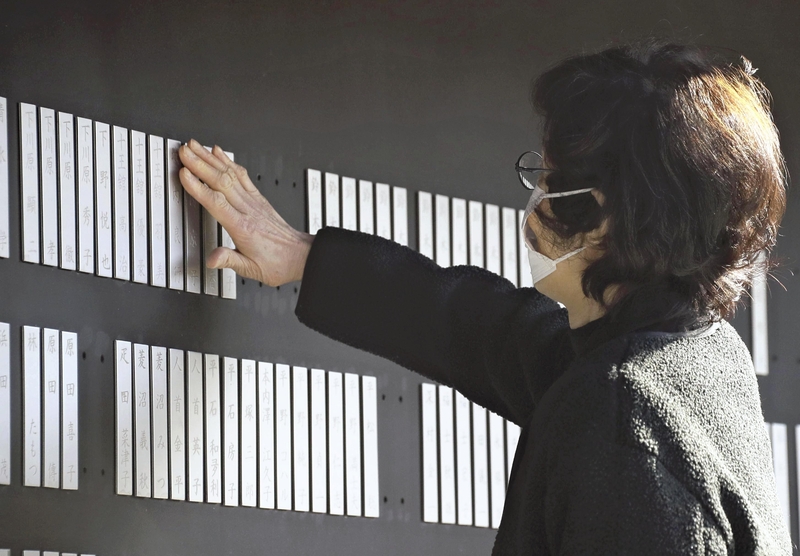
An 80-year-old woman gently caressed a nameplate on the memorial monument at Kamaishi Memorial Park in the Unosumai district of Kamaishi, Iwate Prefecture. In this district alone, 580 people died or went missing in the disaster.
"Dear, we finally rebuilt our house at the end of last year," she said to her late husband, who was 80 when he died in the tsunami. "It took a long time to rebuild it, but 10 years went by so quickly."
On the day of the disaster, her husband went out in his car, which was swallowed up by a muddy current. The tsunami also destroyed their house, where the couple and their three children resided. The woman said she survived by escaping to higher ground.
Whenever she sees an elderly couple shopping at the supermarket, she remembers her husband carrying heavy bags for her, she said. At the end of last year, her house was rebuilt on a hill near the memorial park.
"I wanted to build a house where my husband and I can have a peaceful day," she said.
Her children live in Yokohama and elsewhere, and they decided not to come to their hometown this year because of the pandemic, so she visited the site alone.
"When the coronavirus is contained, I want to invite my great-grandchildren to my new house and tell them about my memories of my husband," she said.
The disaster killed 831 people in Minami-Sanriku, Miyagi Prefecture. In the early morning, people were seen bringing flowers to the town's memorial park, which opened in full last autumn. The park retains the red steel frame of the town's former disaster prevention center where 43 people, including town officials, died from the tsunami.
A 70-year-old man who lost his friend, a town government employee, placed flowers on the stand in front of the center.
"I prayed for the victims telling them that I would live on their behalf, cherishing my life that had been saved," the man said. "A new 10 years will begin. The people of the town must share their wisdom and create a new town."
In Namie, Fukushima Prefecture, people who lost family members and friends gathered at a cemetery in the town, where about 180 people were killed or went missing due to the tsunami. All the remaining townspeople had been ordered to evacuate due to the accident at Tokyo Electric Power Company Holdings, Inc.'s Fukushima No. 1 nuclear power plant.
A 68-year-old man lost his second daughter, then 24, and a grandchild, then 4, as well as his house near the coast.
"Please watch over me," the man said to their grave.
The man said he was at work at the time of the earthquake, and the two were found dead. The experience made him long think why he could not help them. Ten years later, he said he was able to sort out his feelings a little.
"I can't forget 3/11," he said, "but I have to live a positive life."
Captions
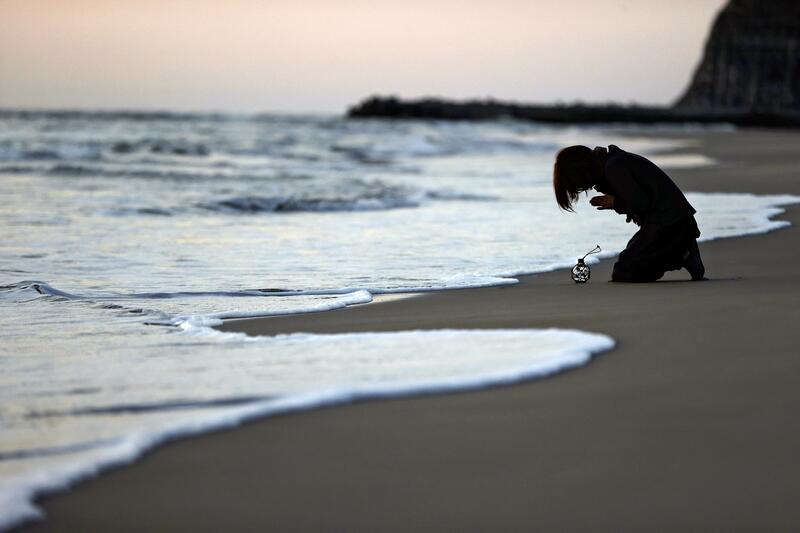
A woman prays on her knees in Iwaki, Fukushima Prefecture, before 6 a.m. Thursday. "There's no end to the disaster," she said.
Students from a junior high school in Nagaoka, Niigata Prefecture, on their school excursion pay their respects in front of the former disaster prevention center in Minami-Sanriku, Miyagi Prefecture, at 9:40 a.m. on Thursday.
A woman caresses a nameplate on a monument at Kamaishi Memorial Park in Kamaishi, Iwate Prefecture, just after 8:30 a.m. on Thursday.
Read more from The Japan News at https://japannews.yomiuri.co.jp/