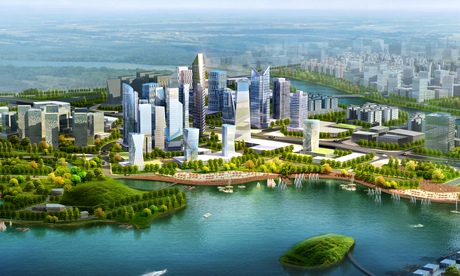
More than a century after they originated in Britain as an alternative to crowded, unhealthy city centres, garden cities are enjoying a resurgence of interest, not just in the UK but around the world – and nowhere more so than in China.
The world’s first garden city was developed in Letchworth to overcome the pollution and squalor of Victorian industrial cities. China’s rapid industrialisation is doing in 15 years what it took the UK 150 years to achieve, and development has brought similar problems of pollution and ill-health.
The Chinese government is now committing vast resources to sustainable development and seeking to apply the lessons of the past to manage urbanisation, albeit with own adaptations.
As a representative of Letchworth Garden City on a trade and investment mission to China, I was able to see first-hand how the garden city ideals are being applied in China, where the principles of well-planned, sustainable communities with a good balance of jobs, homes and open space support the need for low-carbon development.
One proposed garden city on the outskirts of Chengdu, China’s fourth-biggest city and home to 14 million people, is a world away from Letchworth’s cottages. Here, clusters of skyscrapers emerge from leafy avenues, and a monorail swoops through trees. The sheer scale of the development is striking, with 13 new residential zones, specialist employment areas covering everything from electronics to modern agriculture, and major infrastructure projects, including a central park inspired by New York. Work began in 2011, and in October Tianfu was granted state-level new area status, bringing substantial government support. The area is due to be completed in 2030.
Similar projects are planned all over China. In Jiangsu province, London-based Wei Yang is coordinating garden city planning, having already created two plans for Hunan province. Three more are planned in Chongqing.
Each country that has taken on the garden city concept has adapted the key principles to its own particular needs, demands and culture. But one striking difference is the higher density of garden cities in China, reflecting its urban culture; Tianfu will have a population of 2 million (Letchworth’s is just 33,000).
Tianfu will have high-rise flats in the city centre (though far more open space than downtown Chengdu), but the low-rise, low-density areas common to garden cities in the UK are seen only in pockets. In one suburban residential zone, there are family homes with allotments. There is also easy access to local leisure facilities, including an international sports stadium, artificial lake and picturesque riverside development.
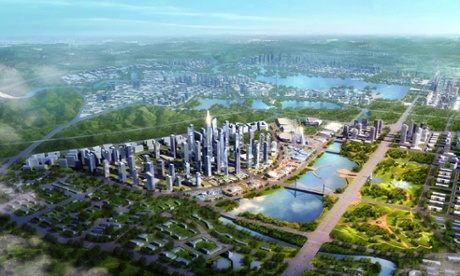
Although it may not be the garden city envisaged by Letchworth founder Ebenezer Howard, Tianfu is preferable to the urban sprawl found in other fast-growing economies, and promises improved air quality, less traffic and better health for residents. The master plan incorporates protected open land on the edge of the city, which is intended to restrict development like the UK’s greenbelt. Public transport is well-planned, such as the extension of metro services to provide easier access to central Chengdu.
However, the Chinese version does vary considerably to the UK model on land ownership. In Letchworth, the land is held in trust for the good of the community and profits are reinvested in a community services. This has not been the case in Tianfu, where land is owned by the government, which has responsibility for its upkeep. However, experiments in other areas suggest this may change in future.
Historically, garden cities have been developed on every continent and the resurgence of interest recognises their potential role in sustainable development. It’s this global popularity that inspired our plans to open an international garden cities institute in Letchworth in 2015 to bring together experiences from international garden cities and facilitate a greater understanding of modern interpretations to advocate a new phase of their development across the world.
We’ve already had interest from the Czech Republic, France, Canada, the US and, of course, China. Garden cities are continuing to go global.
Read more:
- Can garden cities and new towns work in the 21st century?
-
Britain’s housing crisis: are garden cities the answer?
-
The garden city movement: from Ebenezer to Ebbsfleet
-
The planning chief who says garden cities can solve the housing crisis
- Here’s how the government’s garden cities initiative could work
David Ames is head of heritage and strategic planning for Letchworth Garden City Heritage Foundation