In 2005, I became CEO of a charity providing childcare in a local borough by running nurseries for very low prices. The charity was funded by fees, donations and grants. It was a curious hotchpotch and I was uncomfortable with a model I felt was not only unsustainable in the long term, but also unlikely to change attitudes or affect radical change.
I was convinced we had to reconfigure the way we operated and develop a more effective social business model. Our memorandum required us to promote the care, upbringing and preserve the health of children outside the home, particularly those working in London. We were expected to promote and train people to ensure the quality and best possible care was disseminated.
In this I saw the basis of a social enterprise; a business which could interweave all those expectations. I was pleased to have such an option as I believed that the purpose of a charity is to crack the problem it was set up to resolve and therefore make itself redundant.
I was advocating the end of charity, because as Nic Frances writes in his book The End of Charity – Time for Social Enterprise, it is not driving change. "Charity and welfare support the status quo. The gap between rich and poor is getting wider, with dire consequences at both ends of the spectrum. We are all more alienated; we are all more frightened. We have to find solutions that make a difference. It is about justice, and justice is bigger than ideology."
Sadly, that remains true for many children. I wanted to ensure we built a business that provided good nurseries for children from poor families with support services built in, and which was staffed by local people who could re-invest in the economy. I also intended to provide the best training for young local people, including those who had become NEETs (not in education, employment or training); the second entry to poverty and a fast track to welfarism.
Good-quality childcare costs money, however, and we needed to establish a business model that enabled parents from poor backgrounds to access a community nursery based on the principle of social mix and enhanced cultural and social capital.
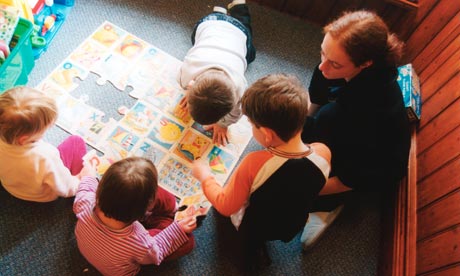
Research clearly indicated that children from all backgrounds going to nurseries, learning and playing together are better for the community. It's an idea that shapes our vision of a new type of community parenting that enables people of all ages to support local children from different roles and perspectives.
Put simply, we want local people to feel that their streets are safe for children, whether they live in the council block or the gentrified Victorian terrace.
We planned a re-brand in 2009, and I needed the right team, with a shared vision to help shape and embed the principles of innovation, original thinking and creativity. This allowed us to have many interesting conversations with staff who were anxious about the business. They did not want to be associated with a childcare organisation that could be seen to be making profit from children.
I wanted our staff to see that there was a clear space in the market in which we could do things differently and so we needed a more sustainable approach. I could not see how we could progress without engaging the market and building a consumer base that "got us".
The message that we were building a future for London's children resonated well. We grew by 200% and today as recession is hitting the poorest very hard and the situation is stark for children, we need to grow again.
Staff understand that we can reduce child poverty in the short and long term. They also are much more aware of the increased poverty they are seeing how it's linked to lifelong success. More recently, Ofsted found that the chances of children from poor and disadvantaged backgrounds accessing the lowest quality childcare remained high. This creates a double disadvantage, as we know that children from disadvantaged backgrounds would be damaged by low-quality childcare.
Staff want to do something about this. Using a business model to do this quicker and more reliably appeals to them, but there is still a tendency to see success in terms of how many free places we offer. The concept of social value at every level of the business is a concept that is taking time to embed.
The riots and the rebellion of young people against the life we offer is a wakeup call. It places a duty on us to do things differently with much more of an eye on how decisions we make impact on the next generation.
I want the London Early Years Foundation model to be developed, extended and shaped by that thinking and a strong recognition that we have to prepare a generation of children and parents for a world we have yet to imagine. The African proverb that we need a village to rear a child remains true. Let's test a workable, sustainable social business model which weaves the strands of complex communities into the shape of a community nursery.
June O'Sullivan is chief executive of The London Early Years Foundation
This content is brought to you by Guardian Professional. To join the social enterprise network, click here.