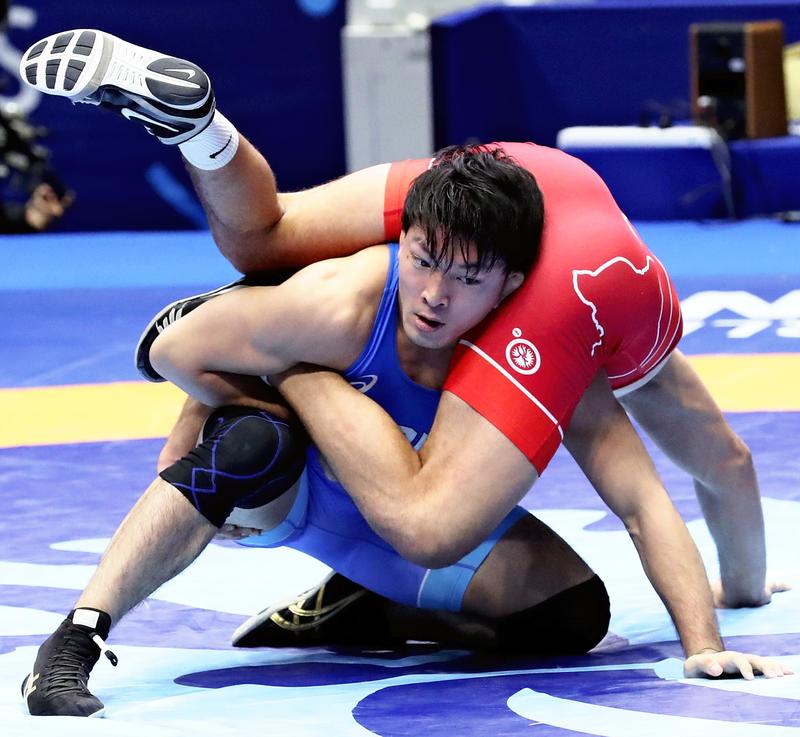
Freestyle wrestler Sosuke Takatani has been working hard on his training as well as doing research -- even going so far as to write his master's thesis on the training required for the upper weight classes.
Japan is expected to put together a rush on medals in wrestling at the Tokyo Olympics, but the men in the heavier weight divisions have stuggled.
And the 31-year-old national team member and two-time Olympian will make his challenge in the 86-kilogram division.
"Upper weight bouts are the most spectacular in the sport. I want to prove that even the Japanese can win in these classes," Takatani said.
There are a combined total of 18 divisions in the Olympics in men's and women's wrestling. Japan has yet to earn spots at the Tokyo Games in 10 of them, many of which are in the men's heavier weight classes.
While competing as an athlete for a company, Takatani entered graduate school at the University of Tsukuba in 2018 and completed his studies in the spring.
He wrote his master's thesis on the impact of weight training on changing the competitiveness psychologically in wrestling.
Takatani concluded in this thesis that training with barbells and other equipment is helpful, even for the top athletes at the national championships, to improve such psychological test scores as in the area of concentration, while helping them develop maximum muscle strength.
His thesis also pointed out the challenges the Japanese heavyweight athletes face.
Many of the experienced national team wrestlers and coaches are in the lightweight divisions of the sport, and it is why their development regimen consists mainly of running and body weight training such as push-ups.
Wrestlers in the heavier weight divisions can't keep up with this, and they "experience feelings that resemble giving up" during practices, he said in the paper.
On the other hand, there is still limited interest in weight training among the Japanese wrestlers, although it is effective in increasing muscle mass, according Takatani's work. It is probably because losing weight is a priority in the lightweight divisions.
Takatani himself competed in the 74-kilogram class at the 2012 London and the 2016 Rio de Janeiro Olympics. The upcoming Tokyo Games are a big challenge for him as he has moved up in weight.
"I have to manage my weaknesses and build myself up physically to compete on the world stage," Takatani said.
Although he cannot now pair up with a practice partner because of the pandemic, he continues to train hard on his own to make a breakthrough as a heavyweight.
Kaori Yamaguchi, a judoka and professor at the university, taught Takatani at graduate school and has high hopes for him.
"He has the ability to calmly analyze issues," said Yamaguchi, the bronze medalist in the women's 52-kilogram division at the Seoul Olympics in 1988, when women's judo was still a demonstration sport.
"Now that things aren't going as planned, I'm sure the things he has learned will come to life."
Japan's all-time Olympic medal medal tally in men's wrestling is 53, including 21 golds. However, when it comes to divisions 80 kilograms and above, the national team has only earned three -- Akira Ota, who won silver medals in the freestyle 90-kilogram division in 1984 at Los Angeles and at the 1988 Seoul Games, and Hideyuki Nagashima, who took home a silver in the freestyle 82-kilogram division in 1984, showing the number of medals is highly imbalanced among weight classes.
"Japanese athletes are, on average, small by nature, so there are not many who can compete in the heavyweight division," said Ota, now a professor at Waseda University.
Ota himself has proven that even such a Japanese athlete can get strong results.
Moving up in a weight class ahead of the Los Angeles Games was a turning point for him. At the time, he stood 180 centimeters and competed at 82 kilograms. He thought he would inevitably be overwhelmed by the power of foreign wrestlers, Ota recollected.
"I figured that I could not change my height, so I'd better put on some muscle and move up in weight class."
His strategy was initially to lose weight and stay in the lighter classes to take advantage of his height and reach. He changed his mind and achieved medal status.
According to Ota, the biggest factor that separates wins and losses in wrestling is skill.
"With that in mind, if you move up in classes, you feel like you are pairing up with slower-moving opponents, and it's easier to wrestle," Ota said.
And he sent words of encouragement to Takatani, who hopes to follow in his footsteps and try to qualify for the Olympics in the spring next year.
"Takatani's skill is certain. All that's left is for him to learn new techniques that make him victorious. Other martial arts such as sumo and judo can also be used as a reference to come up with new techniques."
Read more from The Japan News at https://japannews.yomiuri.co.jp/