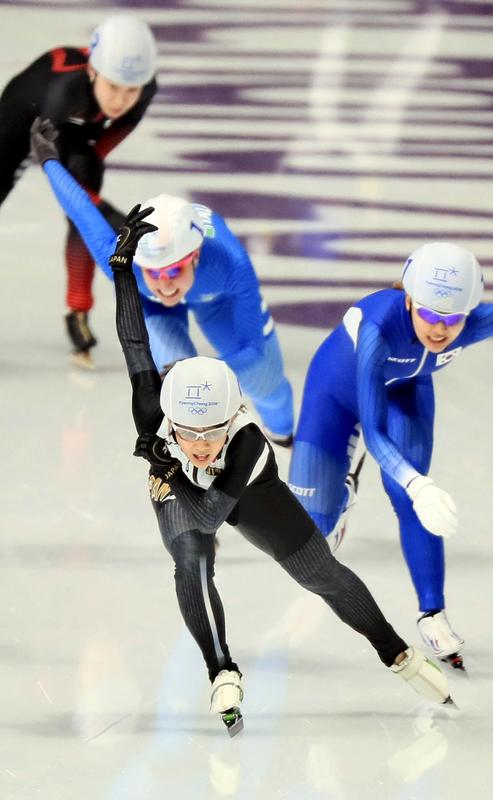
GANGNEUNG -- Sometimes it's better to work smart than work hard. Nana Takagi proved that in the women's speed skating mass start at the Pyeongchang Games on Saturday.
The 25-year-old Takagi conserved her energy by skating in the middle of the pack for much of her semifinal race and again in the final, before finally surging in the homestretch to win the gold medal at the Gangeung Oval.
She became the first woman to win the event, one of several introduced at the Pyeongchang Games. Kim Bo Reum of South Korea finished second, followed by Dutch skater Irene Schouten.
"I'm so happy to stand on top of the podium on the biggest stage," Takagi said after the race. "I think I showed that there's also Nana, not just Miho," she added, referring to her well-known younger sister, who has won three medals at Pyeongchang, including the team pursuit gold that the siblings shared.
Mass start is a 16-lap, 6,400-meter race in which competitors start simultaneously without designated inner or outer lanes. The ranking is determined by a point-based system. The three leading skaters after every four laps earn 5, 3 and 1 point respectively, with the first three to cross the finish line winning 60, 40 and 20 points.
The intermediate points do not influence the medal standings in the final, as the points earned at the finish line exceed those that can be earned during the race. However, the intermediate points play a crucial role in the semifinals, where only the top eight skaters in each group advance to the final.
Takagi took full advantage of the system in the semifinals. After collecting five points in the first intermediate sprint -- enough to progress to the final -- she slowed down in a bid to save energy and settled into the middle of the pack. Many skaters were breathing hard at the end of the race, but Takagi's breathing was normal, as if she had just finished a warm-up.
"Getting five points is enough to make the final, so I thought I'd go for it when I had the chance," Takagi said at a press conference Sunday. "I managed to get the five points in the first intermediate sprint, so afterward I focused on keeping my legs fresh by placing myself behind other skaters [for drafting]."
She displayed her shrewdness again in the final, as she stayed in the middle of the pack from the get-go, right behind Schouten. Takagi broke from the pack with several others toward the end, and passed Schouten in the final curve. She crossed the finish line 0.12 seconds ahead of Kim.
At Sunday's press conference, Takgai revealed that she had aimed to win the race in the home stretch with her sprinting ability. "Everything went just the way I planned," she said.
Takagi, who was 12th in the 5,000 meters, said skaters need to "use their brain" in mass start. "Of course technique and stamina are important, but the ability to decide one's position and read the flow of the race also plays a key role," she said.
One of the spectators cheering Takagi on was Kokichi Goto from Tomigusuku, Okinawa Prefecture. "My heart pounded hard at the end of the race," said Goto, 53. "It was a long contest, and I enjoyed how each skater tried to manage their race."
Read more from The Japan News at https://japannews.yomiuri.co.jp/