This year marks the 60th anniversary of the signing of the revised Japan-U.S. Security Treaty, whose true worth is being tested as China continues its military provocations. In this series, The Yomiuri Shimbun examines issues the alliance will face in the years ahead.
The Ground Self-Defense Force is considering holding its first large-scale training exercise in about 35 years in 2021, as it prepares for a contingency directly affecting Japan. About 140,000 personnel -- almost the entire GSDF -- would participate in the exercise, which will involve moving and deploying tanks and other equipment and is designed to iron out shortcomings in the force's readiness.
The SDF has held a training exercise on this scale only once before. In 1985, at the height of the Cold War, SDF personnel conducted drills in Hokkaido and elsewhere in an operation that simulated an invasion by the former Soviet Union. Next year's training exercise is premised on a crisis erupting in the Nansei Islands -- a location undoubtedly selected with China in mind.
Concerns have been prompted by China's repeated provocations, such as frequent intrusions into Japanese territorial waters around the Senkaku Islands in Okinawa Prefecture. However, the Japanese government is even more closely watching the prospect of a contingency engulfing Taiwan.
This year, China has been stepping up its military provocations toward Taiwan. At least 49 Chinese fighter jets and other aircraft have crossed the median line in the Taiwan Strait and made forays into the Taiwan side. The United States has pushed back by taking steps including selling antiship missiles to Taipei. Tensions in the region are at their highest since the Taiwan Strait crisis in the mid-1990s.
"An unintentional incident could be unavoidable," Defense Minister Nobuo Kishi said on a TV program aired in late October. Kishi indicated that the SDF needs to be prepared for any contingency.
This sense of urgency within the government apparently stems from the possibility that should a contingency involving Taiwan break out, the geographically close Senkakus and other islands in the Nansei chain also could be targeted for invasion.
"If signs of a Taiwan contingency appear, SDF units should promptly be dispatched to the Nansei Islands. I was acutely aware of this during my time in service," a former GSDF senior officer said.
-- China to overtake U.S.?
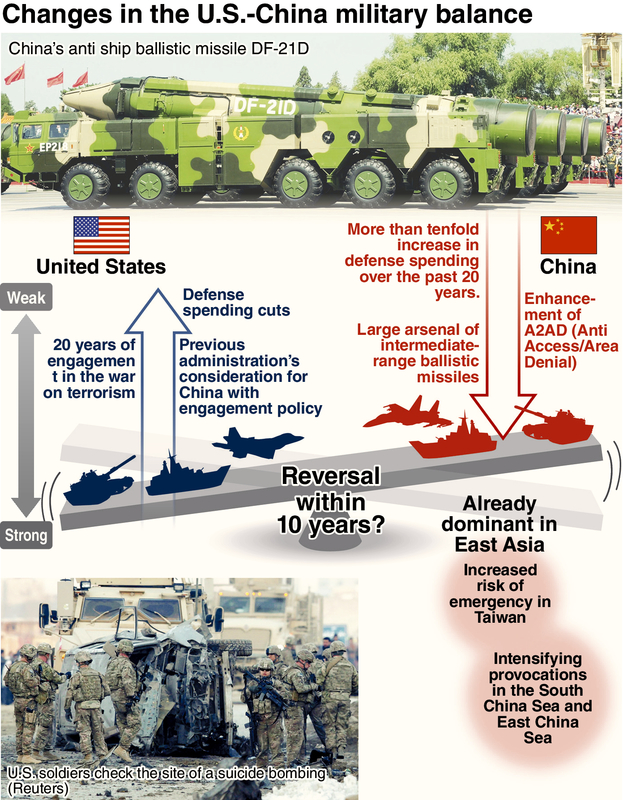
With the U.S. economy severely damaged by the novel coronavirus pandemic, the Japanese and U.S. governments are seriously concerned about a situation in which the military power of the U.S. and China reverses within a decade, and Beijing succumbs to the temptation of military adventurism.
Before the pandemic struck, some analysts claimed China's military power would match that of the United States by around 2035. However, recent developments have forced that timeline to be significantly brought forward.
In fact, if conflict such as a Taiwan contingency were to break out in East Asia, China's military capabilities in the region would surpass that of the U.S. military even now. China is equipped with a massive arsenal of medium-range ballistic missiles that make it possible to precisely strike the U.S. fleet and U.S. military bases in Japan. An aircraft carrier strike group and other core elements of the U.S. forces would not easily be able to approach the region.
"A contingency involving Taiwan is an 'away game' for the U.S. military," a senior Japanese government official told The Yomiuri Shimbun. "In U.S. war games conducted to simulate a Chinese invasion of Taiwan, the U.S. military always loses."
"For nearly two decades, the United States concentrated on fighting violent extremist organizations in low-intensity conflicts," then U.S. Defense Secretary Mark Esper said in an address in September. According to Esper, the last decade has been a time of strategic decline for the U.S. military due to dramatic cuts in defense spending. Reorganizing U.S. military forces and reviewing strategies to focus attention on the "great power competition" with China was necessary, he said in the address.
This is a crucial moment for the Japan-U.S. alliance, as it faces questions over whether it can continue playing its role as a cornerstone of peace and stability in the Asia-Pacific region.
Read more from The Japan News at https://japannews.yomiuri.co.jp/