KYOTO -- Aristocrats serving in the Imperial court in Kyoto were called kuge (court nobles). Unfortunately, the kuge lost political and military power in the Middle Ages. (I'm not a descendant of a kuge family, but Kyoto residents like me are generally sympathetic to the kuge of the past.)
Buke, or military aristocrats, took control of politics and the military. Where did they come from?
I probably need to explain to readers, especially those who are familiar with the teaching of Japanese history: In the past, Japanese history textbooks would say that the country's buke government dates back to 1192, when Minamoto no Yoritomo established the Kamakura shogunate government in Kamakura, in what is now Kanagawa Prefecture.
However, according to Yukihiko Seki, a professor of Japanese medieval history at Nihon University, a widely accepted theory today is that the country's first military government was the Taira clan government established by Taira no Kiyomori, who was active in Kyoto, prior to the Kamakura government.
In the past, many Japanese people believed that the Heian period (794 to the late 12th century) was the longest peaceful period in Japan and that capital punishment was not carried out for many years.
However, in the final days of the Heian period, kuge court nobles in Kyoto became corrupt and left rural areas impoverished. Under these circumstances, local samurai warriors in undeveloped eastern regions rose up. They were originally rich, powerful farmers, and overthrew the government in Kyoto that was dominated by aristocrats by setting up Yoritomo, who had been expelled from Kyoto, as a leader. The Taira clan is recognized as being aristocrats.
What people tend to forget is the fact that the Minamoto clan is a family of noble birth descended from an emperor, the same as the Taira clan, and the Minamoto clan were also aristocrats even though their social status was low.
As represented by the Minamoto and Taira clans, some lower-ranking aristocrats brought military forces together in regional areas they dominated, and turned into military aristocrats.
With such aristocrats having competed with each other in Kyoto, Taira no Kiyomori, the leader of the Taira clan who built up military strength in Ise (now southern Mie Prefecture) gradually established a government under a military dictatorship. This took place from the 1160s to the 1170s.
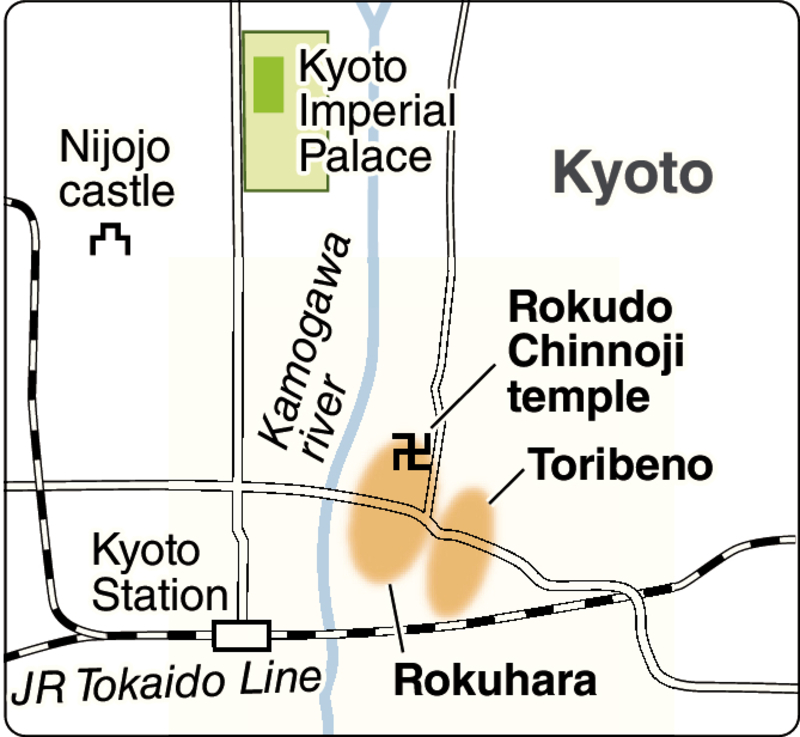
The Taira government is also known as the Rokuhara government because in Rokuhara, eastern Kyoto, there were several thousand houses belonging to members of the Taira clan.
The Rokuhara district was located in a difficult place. That is to say, the district was on the way to Toribeno, one of three large open-air graves that existed in the suburbs of Kyoto at that time, and therefore was considered a boundary between this world and the next.
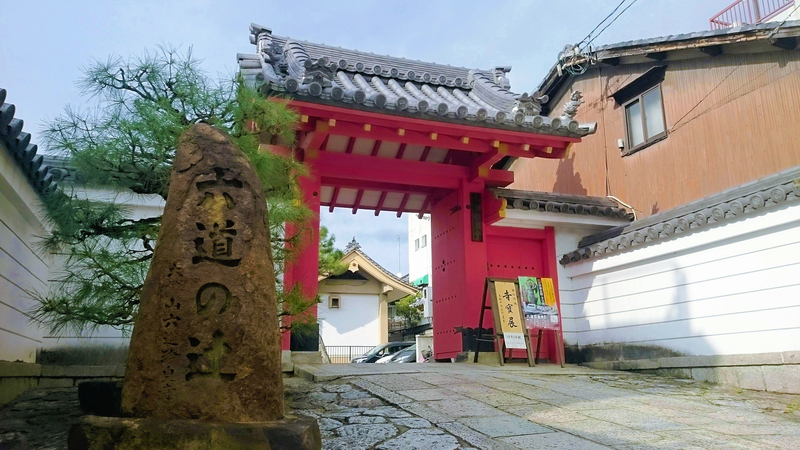
In front of the Rokudo Chinnoji temple located in the Rokuhara district, there is a surviving stone monument bearing the words "Rokudo no Tsuji" (literally "Crossroads of six posthumous worlds"). That means that the other world exists beyond there, or outside Kyoto.
Rokudo is a Buddhist term meaning six posthumous worlds. Human beings are believed to repeat their lives after death and live in any one of these worlds. The most horrible is jigokudo (hell). I will talk about this topic in another column in the future.
The Taira clan lived in the district for two reasons. First, since Kyoto was a planned city, large plots were occupied by high-ranking aristocrats, and there was no adequate place in the city for the rapidly growing Taira clan. Second, the Rokuhara district was located near the starting point of a kaido route leading to Ise and eastern regions from Kyoto.
The Taira government did not last long. Forces of the Minamoto clan that departed from an eastern region more distant than Ise advanced into Kyoto and the Taira clan fled to the west.
There is a Japanese term "Miyako-ochi," which means fleeing from the capital to regional areas. Later, Miyako-ochi came to represent the Taira clan.
Read more from The Japan News at https://japannews.yomiuri.co.jp/