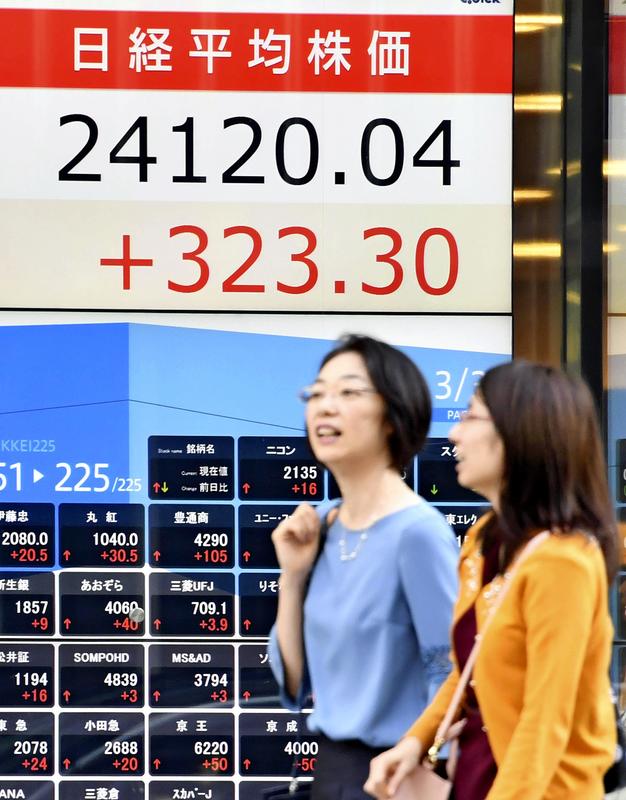
The Nikkei stock average on Friday briefly touched its highest level for the first time since November 1991.
Robust domestic economic indicators combined with a weaker yen against the dollar on exchange markets pushed the Japanese benchmark index to its highest level in 26 years 10 months. However, not everything is rosy: Many causes for concern over the market's prospects in the months ahead are lurking, including sluggishness of emerging economies and intensifying U.S.-China trade friction.
The recent surge in stock prices sent spirits soaring in the dealing room at Nomura Securities Co. in Tokyo's Otemachi district. "Things are going well today," and other positive comments, are frequently heard among the stock dealers there. The dealers have been busily handling the deluge of telephone calls from customers placing purchase orders.
Up 1,500 points in 2 weeks
The Nikkei index's recent surge started Sept. 13. Although the stock market dipped Thursday, at one point Friday it rose almost 500 points from the previous day's close before a slight drop. The market's closing price has risen more than 1,500 points over the past two weeks or so.
Rising stock prices have been supported by Japan's solid economy and the yen's depreciation against the dollar. Economic statistics for August released Friday by the government showed the industrial production index improved for the first time in four months on the back of robust vehicle production and other factors. Labor shortages in the construction and transport industries saw the ratio of job openings to applicants remain at 1.63 to 1, the highest level since January 1974.
On the foreign exchange market, the yen continued to weaken against the dollar Friday and hit the mid-113 yen level for the first time in about nine months. Major export-led stocks, such as automakers and electrical machinery manufacturers, rose and pushed up share prices.
Furthermore, there is a perception that Japanese stocks are "relatively cheap" compared with U.S. stocks. The price-earnings ratio is an indicator that measures whether a stock's price is overvalued or undervalued with regard to a company's earnings. This ratio measures the current share price relative to its final per-share earnings.
The average price-earnings ratio for the 225 companies that form the Nikkei index is about 12 times to 13 times earnings. By contrast, the 30 companies on the U.S. Dow Jones Industrial Average had an average ratio of about 17 times. In a nutshell, there is a sense that Dow stocks are expensive and Japanese share prices are relatively cheap. Foreign investors are reportedly actively boosting their investment in Japanese stocks.
Shigeharu Suzuki, chairman of the Japan Securities Dealers Association, expects the Nikkei will continue its upward swing.
"It wouldn't be strange if the index reached 26,000 by the end of this fiscal year," Suzuki said.
If share prices keep rising, there will be heightened expectations for widening effects in the main economy, such as having a positive impact on the management of pension funds.
U.S. tariff risk looms
Despite these positive indications, many uncertain elements hang over the stock market's prospects.
During the Japan-U.S. summit meeting held Wednesday in the United States, the administration of U.S. President Donald Trump agreed to postpone imposing high tariffs on Japanese automobiles for the time being. However, if upcoming negotiations on a bilateral "trade agreement on goods" that both governments agreed to start get bogged down, it is possible the U.S. side could adopt a hard-line stance on Japanese auto exports to the United States and the opening of Japan's agricultural product market. Depending on how these negotiations pan out, cold water could be thrown on the robust Japanese economy.
In a related move, on Sept. 24 Trump implemented a third round of punitive tariffs on Chinese-made products. If U.S.-China trade friction rumbles on and the tariff rate of this third round is jacked up from 10 percent to 25 percent at the beginning of next year, some estimates suggest Japan's real gross domestic product could also be forced down.
Japan's economy, which has strong connections to the U.S. and Chinese economies, could not escape a stinging blow. "If U.S. stock prices enter a downward phase because of worsening trade friction with China and other factors, there is a risk the repercussions could spread to Japanese stocks," said Ryutaro Kono, chief economist at BNP Paribas Securities (Japan) Ltd.
Read more from The Japan News at https://japannews.yomiuri.co.jp/