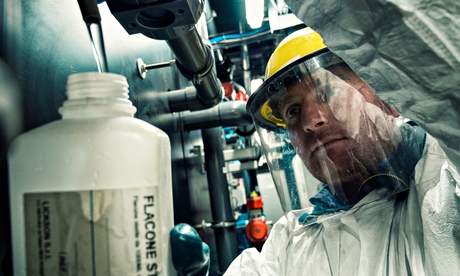
The fertiliser we use to grow ripe and healthy vegetables is doing damage to our groundwater, and it is often due to one thing: phosphate.
Used in the production of phosphoric acid for fertiliser, phosphate often contains naturally radioactive elements, like many other natural rocks. Making phosphoric acid leaves phosphorous gypsum, a by-product. Its disposal in a landfill over time contaminates the accumulated rainwater.
Phosphate contamination is a growing global concern. According to a 2012 Greenpeace study, increased mining of phosphates to meet a greater demand for fertiliser has meant that the quality of the rock is getting worse. Around 110m tonnes of phosphorous gypsum is produced every year.
A phosphate challenge in Sicily
Italy is one of many countries with a phosphate contamination problem. One look at the chemical analysis of the water at the phosphorous gypsum stack in Gela, Sicily, and most water purification companies would cringed in horror. This polluted water had elevated concentrations of heavy metals, phosphoric acid, fluorides and radioactive elements.
But two companies did not cringe. Danish pump manufacturer Grundfos and German water purification company Clear Water Technologies (CWT) teamed up to create a system that made even the most contaminated water pure again.
“You have to understand the chemistry,” says Ulrich Bäuerle, owner of Clear Water Technologies. “Most people would look at the water and say it was impossible to purify, but we and our partner company Servizi Technologici per l’Ecologia Srl Uninominale (STE) used our experience and tried one thing and then another until it worked.”
The root of the contamination problem was in an old phosphoric acid production plant, which operated for several decades before closing down in the 1990s.
Even though the plant was closed long ago, contamination problems continued to plague the area. In spite of retaining walls that run deep into the clay below, there is still a risk of radiation getting into the groundwater, so surface water is pumped into two huge artificial lakes alongside the site.
In 2010, the International Atomic Energy Agency dedicated significant effort into determining how to measure the risk posed by the site and how to deal with the radioactivity in the stack itself. The solution was a water treatment plant that was able to make even the most contaminated water 99.9% pure again.
Purifying the water
The first stage is chemical pre-treatment. The second stage treats the remaining water physically.
“The pre-treatment removes the bulk of salts, heavy metals, phosphorous and fluoride,” explains Ulrich Bäuerle. “The second stage removes the rest of the dissolved salts and other solubles.”
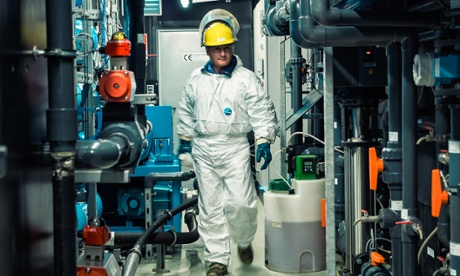
After pre-treatment, the water continues on to the treatment plant, which is neatly packed inside a pair of sea containers.
The first filter in the container is a porous membrane – a physical filter that is so fine, it removes suspended solids as well as bacteria and viruses. The water then undergoes reverse osmosis, in which it is forced through three membrane stages. At each stage, explains Ulrich Bäuerle, the concentrate of pollutants and chemicals will be returned to an earlier stage so that it can be retreated.
At the end of the process, all suspended solids and 99.9% of the salts are removed. The water is now clean enough to meet the discharge limits set by the environmental authorities and is fed into a nearby stream.
But one treatment plant was not enough. Now two identical plants work 24-hours a day, seven days a week, with a total capacity of 600 cubic metres of water per day.
“There are around 20 other locations around the world that face the same problems,” says Ulrich Bäuerle, “Until now, nobody has known how to deal with them. Now we want to take [our solution] elsewhere, and we can adapt this experience for use on other equally difficult but different problem sites.”
Read more about the Grundfos solution, see a system drawing and more photos here.
Copy on this page is provided by Grundfos, sponsor of the water hub