Closing summary
We are closing this liveblog on the immediate aftermath of the Greek election. Thank you for all the comments.
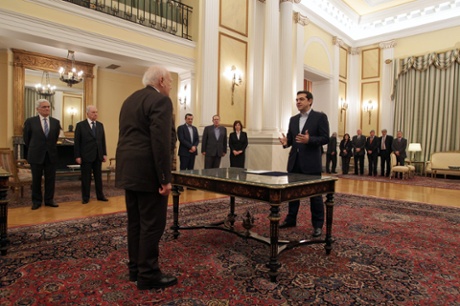
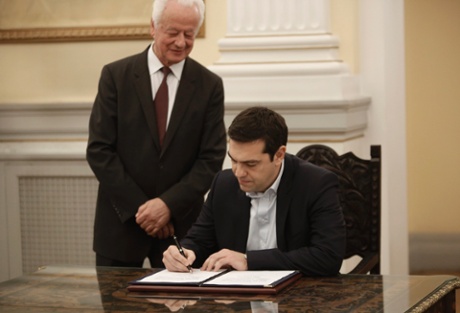
- Alexis Tsipras, leader of the Syriza anti-austerity party, was sworn in as prime minister at a brief ceremony by President Karolos Papoulias. Tsipras said he will give his all “to protect the interests of the Greek people”, then signed the book - as tradition dictates of newly sworn in prime ministers - with a large Mont Blanc fountain pen.
- Tsipras’s first act as Greece’s new prime minister was to lay flowers at the National Resistance Memorial at Kaisariani, a suburb in Athens where hundreds of communist national resistance fighters were executed by the Nazis on May 1 1944.
-
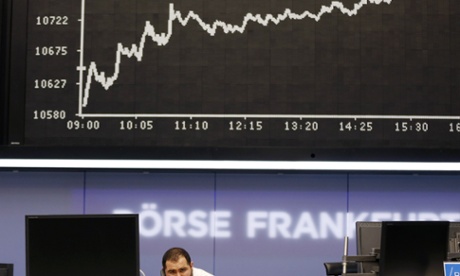
Talk of an immediate market meltdown after Syriza won the Greek election proved wide of the mark. The rally which followed last week’s quantitative easing announcement from the European Central Bank was not derailed by the vote, despite Syriza saying it wanted Greece’s debts to be restructured. Investors seemed willing to take advantage of any market dips to step in and buy, believing it is unlikely Greece will actually exit the eurozone.
- EU leaders realise that Greece’s new leader will drive a very hard bargain in the coming negotiations over the national debt. The only thing left-wing Syriza and the right-wing Independent Greeks (Anel) have in common is economic populism. Tsipras has deliberately created conditions in which substantial compromises with Greece’s creditors - the hated troika of the IMF, European Central Bank (ECB) - and EU would sink his government.
Emily Tripp has this profile of Peristera Batziana, the media-shy partner and childhood sweetheart of Alexis Tsipras.
‘Betty’, as she is known, will be the country’s first unmarried first lady: marriage, perhaps unsurprisingly, was never on the cards.
The two have kept their thirty-year relationship largely out of the public eye. Unlike the first ladies that have come before her, Batziana has so far stayed away from the glamour that will come with the Maximos Mansion, the official seat of the Greek prime minister. The flat that she shares with her partner and their two young sons is in the heart of working class district Kypseli, in Athens.
Fittingly, perhaps, their youngest’s middle name is ‘Ernesto’. Growing up in Thessaly, in central Greece, Batziana has been on the left since secondary school, where she met Tspiras in 1987. Like him, she took part in the student protests in Athens during the late 1980s that reflected widespread disillusionment with mainstream politicians and the educational reforms.
She studied electrical engineering at the University of Patras, where she demonstrated the same strength of will in her studies as she did in her student activism, becoming involved in a court battle with one of her professors to defend her PhD. Batziana joined the Communist youth party before Tsipras; indeed, she reportedly encouraged him to join.
Updated
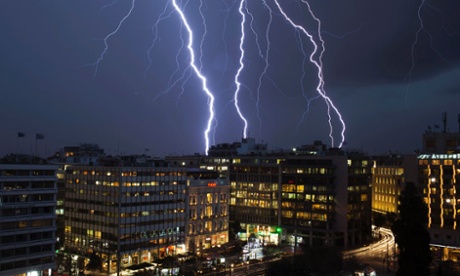
Is Zeus unhappy?
Associated Press has useful facts on Greece’s stricken economy.
Public debt: €316bn, or 176% of gross domestic product - highest within eurozone (as of end of Q3 2014)
Public deficit: 0.8% of annual GDP (as of end of Q3 2014)
Unemployment: 25.8% (Oct 2014)
GDP (2013): €182bn
Bailout loans: €240bn
European markets close higher after Syriza election victory
Talk of an immediate market meltdown after anti-austerity party Syriza won the Greek election proved wide of the mark, writes Nick Fletcher. The rally which followed last week’s quantitative easing announcement from the European Central Bank refused to be derailed by the vote, despite Syriza saying it wanted Greece’s debts to be restructured. Despite the uncertainty, investors seemed willing to take advantage of any market dips to step in and buy, believing it is unlikely Greece will actually exit the eurozone. The exception, unsurprisingly, was the Greek market, which ended lower after a volatile day. The final scores showed:
- The FTSE 100 finished up 19.57 points or 0.29% higher at 6852.40
- Germany’s Dax added 1.4% to another new record high of 10,798.33
- France’s Cac closed 0.74% better at 4675.13
- Italy’s FTSE MIB rose 1.15% to 20,756.72
- Spain’s Ibex ended 1.08% higher at 10,696.1
- But the Athens market lost 3.2% to 813.55
The euro is currently marginally higher at $1.1282 after earlier falling to a new 11 year low in Asian trading immediately after the election results were known, helped the confidence generated by the ECB’s money printing programme.
On Wall Street the Dow Jones Industrial Average is down 17 points or 0.10%.
Meanwhile Greek bond yields have risen 50 basis points to 9.35%.
The White House has sent its congratulations to Greece.
The U.S. congratulates #Greece on successfully completing its parliamentary elections. http://t.co/zJ1rzFgFrU via @WhiteHouse
— Department of State (@StateDept) January 26, 2015
We congratulate Greece on successfully completing its parliamentary elections, and we look forward to working closely with its next government. The Greek people have taken many difficult but important steps to lay the groundwork for economic recovery. As a longstanding friend and ally, the United States will continue to support their efforts and those of the international community to strengthen the foundation for Greece’s long-term prosperity.
Charles Robertson at Renaissance Capital investment bank does not think that Syriza is a Lula-type movement that will move to the centre ground and predicts uncertain times ahead. He writes:
The Greeks had the chance to vote for the leftwing party that does a deal with the EU – it is called Pasok and used to govern Greece and win over 35% of the vote and yesterday it won just 5% of the vote. In total the moderate left got about 13% of the vote. The Greeks, whether in anger or real enthusiasm, have voted for a hard left-movement that is fundamentally opposed to the current profile of the German-led eurozone. We take that seriously. It suggests we’re in for months or years of uncertainty.
This is Mark Tran stepping in for Graeme Wearden. Jon Henley has been getting more reaction in Athens. It ranges from “it will be OK” to “hopeless”.
“What is there to be worried about, really?” asked Thanassis Katsoulis, a former factory owner who sold up a few years ago and now divides his time between the even wealthier Athens suburb of Kifissia and his holiday place on Poros.
“Tsipras won’t drag Greece out of the euro, because the majority of Greeks are very clear they don’t want that. And I can’t see him really coming after the oligarchs and the very rich like he says he will, because there simply aren’t the mechanisms for that in Greece. I think things will be okay.”
Vassiliki Karamerou, a shop assistant in a fashion boutique, said she was struck by “how relaxed everyone is around here today. Before the elections, a lot of people round here were really terrified, you know? But today I’m hearing a lot of good things. Perhaps it’s good, finally, to try something different.”
Only Mariana Iannou, who owns “a small company selling leather accessories”, said she was disappointed with the outcome. “It’s worse than bad, it’s crazy,” she said. “Why? Because people voted for Tsipras, but they can’t really expect him to do what he says he will because he can’t.”
Syriza voters “probably expect Tsipras to get them more money”, she said. “But the only place he can get that is from Europe, which he’s not going to do – or at least he says he won’t.
“Plus, if he does try to take more money away from the rich then everyone will be the same – and then who will invest in this country? No one, that’s who. The man is a fraud and his voters are deluded. That’s my opinion. It’s hopeless.”
Tsipras sworn in after dramatic win
Time for another catch-up.
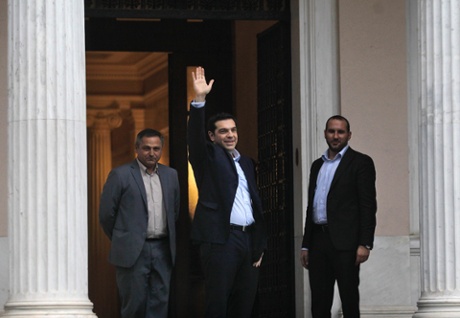
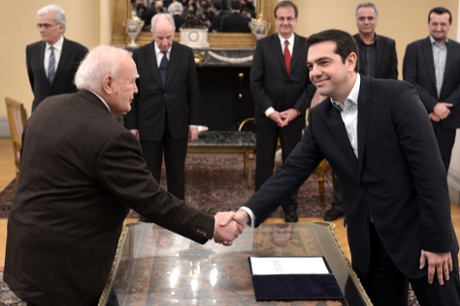
Alexis Tsipras has been sworn in as Greece’s next prime minister. The leader of Syriza took a civil oath, in a brief ceremony at the presidential palace.
Tsipras promised to uphold the constitution and protect the interests of the Greek people.
He then immediately headed to the National Resistance Memorial at Kaisariani, where 200 resistance fighters were shot in the second world war.
But in Brussels, some eurozone officials are disappointed and concerned that Tsipras has chosen the populist Independent Greeks as his coalition partners.
The Jubilee Debt Campaign has called for Greece to be given debt relief, just as Germany was in 1953.
And rating agency S&P has warned that it could rush out its next review of Greece’s credit rating, if the country’s financial state worsens.
And I’m handing over to my colleague Mark Tran. Thanks for reading, and for all the comments.... GW
Updated
Ties really have fallen out of fashion in Greece:
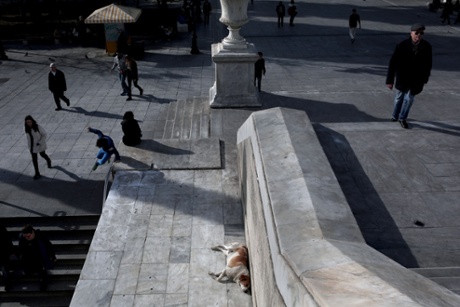
On Syntagma Square, scene of pitched and sometimes fatal battles between riot police and up to 500,000 demonstrators during the anti-austerity protests of 2011 and 2012, all is calm, reports Jon Henley.
“This is a necessary change for the country,” declared Panos Grigoriou, a law professor.
“There is still some uncertainty for the future, but look around you – you almost feel the hope coming back.”
Although he saw “sizeable differences” between Syriza and the Independent Greeks on many issues, Grigoriou felt Syriza’s position might even be strengthened by the coalition when it came to negotiating with the European Union, “because it will show the breadth of feeling in Greece”.
Maria Papadopoulos, who runs a small shop selling agricultural supplies, said she was “just so much more optimistic now”. The coalition “may not be ideal”, she said, but she would accept it:
“We were just so tired, after all these years. Our life has .. so little quality. None, almost. Look I have no heating in my home. So you know, if it is for the best I can accept it. I trust Tsipras.”
Joseph ben Bassat, another academic on his way back to the university, said that while it was a shame Syriza leader Alexi Tsipras had to seek a coalition partner, it wasn’t a major problem:
“It’s really not a big issue – the balance of power will be so one-sided. They may get a minor ministry. But all the major portfolios, all the big decisions, will be in Syriza’s hands.”
JH
Updated
Here’s the moment that Greek radical leftist party SYRIZA leader Alexis Tsipras signed the official protocols after being sworn in (using a secular oath) by president Karolos Papoulias.
Followed by a handshake:
Julian Borger: Brussels fears tough line from Tsipras
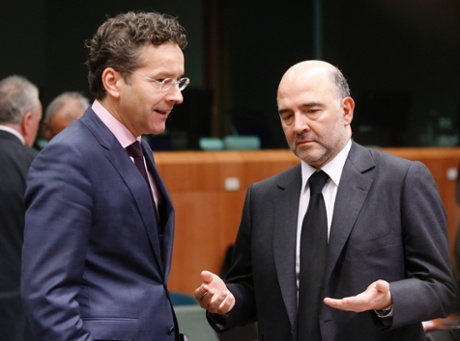
Alexis Tsipras’s choice of coalition partners came as a unpleasant surprise to the Eurozone’s finance ministers gathering under wet, leaden skies in Brussels today, writes diplomatic editor Julian Borger.
The official line from all of them going into their Eurogroup meeting was identical: Greece has spoken, we will deal with this government just as we have with its predecessors, we want the best for the Greeks but the country has to keep its existing agreements and pay its debts.
Underneath the bromides, there is realisation this morning that Greece’s new leader will drive a very hard bargain in the coming negotiations over the national debt. The only thing left-wing Syriza and the right-wing Independent Greeks (Anel) have in common is economic populism. Tsipras has deliberately created conditions in which substantial compromises with Greece’s creditors - the hated troika of the IMF, European Central Bank (ECB) - and EU would sink his government.
“He has strapped himself to the mast with this coalition,” a European diplomat said.
Mujtaba Rahman, an analyst at the Eurasia Group political risk consultants, said that with his partnership with Anel rather than the moderate party Potami (The River), Tsipras is “signalling he is prioritising internal over external constraints. He has formed a coalition he can sell to the hard left in Syriza even if it makes tougher to negotiate a new deal on Greek debt.”
On the other side, Rahman argues, the room for manoeuvre for the German chancellor, Angela Merkel, has also narrowed as a result of last week’s quantitative easing decision by Mario Draghi, the head of the European Central Bank, pumping more than €1 trillion into financial markets. That decision was taken in spite of opposition from Merkel and German institutions, who saw it as a financial bail-out to free-spending governments in the Eurozone.
Rahman said:
“Quantitative Easing is a big problem for Merkel, as it has mobilised constituencies which opposed it in a vocal way.”
As a result, the room for negotiation has narrowed from both sides. “The probability of Greek exit from the Eurozone has to increase,” he concluded, but he still believes it is more likely that an eleventh-hour compromise can be found in the remaining months before Greece has to be repay a nearly €7 billion loan to the European Central Bank in June. That is the really hard deadline that the negotiators are facing.
The coalition deal is “firing up a lot of red lights” in Europe, said Simon Tilford, the deputy director for the Centre for European Reform. “It could be taken as a cause of concern that the new government is going to take a very tough line.”
“In private, there are acknowledgements from some Europeans that they are going to have to move to towards the centre..and acknowledge that the European side has been part of the problem.”
“A robust negotiating position from Athens could be a good thing,” Tilford added. “The non-confrontational approach had allowed the Eurozone countries to roll back on some of their earlier promises about debt relief.”
The stage is set for some tough wrestling on the edge of cliff, one that represents the prospect of a Greek debt default and consequent exit from the Eurozone - something that none of the protagonists, not even Anel, really want. JB

This must be a record for a rating agency. S&P has just suggested it could downgrade Greece, within an hour of the new prime minister being sworn in.
S&P said in a statement that it might bring forward its next review, scheduled for March 13, if it believes Greece’s credit worthiness has been hurt by the political upheaval.
Frank Gill, the rating agency’s Senior Director of European Sovereign Ratings, said the uncertainty of a showdown over its debts with the rest of the euro zone risked snuffing out its recovery.
Gill also warned that Greece’s financial performance appears to be deteriorating..... More here.
Updated
The Jubilee Debt Campaign also has history in mind, calling for Greece to be given German-style debt relief.
Sarah-Jayne Clifton, Director of the Jubilee Debt Campaign says:
“The Greek bail-out was in reality a bail-out of reckless European banks, for which the Greek people have been paying the price. Greece should have received debt relief in 2010, and debt cancellation is now urgently needed to tackle the huge increase in poverty seen during this crisis, and bring hope back to Europe.
Debt crises across the world show that constant debt rescheduling does not work. When debts are too large and causing pain they need to be cut, as happened for Germany in 1953.”
That deal, hammered out in London, paved the way for the country’s “economic miracle” (or wirtschaftswunder). Creditors agreed to cut West Germany’s debts (corrected) in half, and delayed repayments until it was running a trade surplus.
That means West Germany didn’t spend its valuable foreign currency reserves, or have to borrow even more money to meet debt repayments.
The Observer covered the whole story this month:
A new idea steals across Europe – should Greece’s debt be forgiven?
Updated
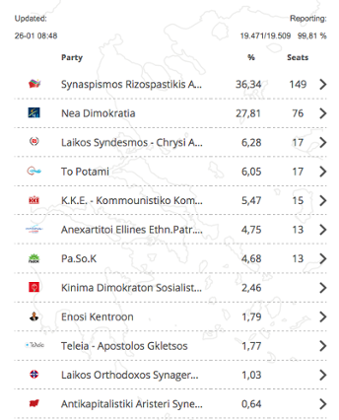
The final few votes cast yesterday have been counted, confirming that Syriza fell two seats short of an overall majority:
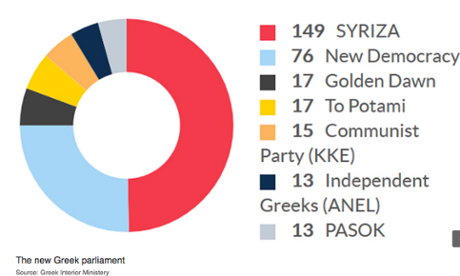
100% of the vote has been counted (1/3): SYRIZA 36.34% (149 seats), New Democracy 27.81% (76 seats) #greece #ekloges2015
— Kathimerini English (@ekathimerini) January 26, 2015
100% of the vote has been counted (2/3): Golden Dawn 6.28% (17 seats), To Potami 6.05% (17 seats), KKE 5.47% (15 seats) #greece #ekloges2015
— Kathimerini English (@ekathimerini) January 26, 2015
100% of the vote has been counted (3/3): Independent Greeks 4.75% (13 seats), PASOK 4.68% (13 seats) #greece #ekloges2015
— Kathimerini English (@ekathimerini) January 26, 2015
Alexis Tsipras has just entered the Megaros Maximou, home of Greek prime ministers.
The outgoing PM, Antonis Samaras, in a departure with tradition, has not handed over the office to Tsipras personally, Helena Smith reports.
The two men have been fierce rivals, arguing over austerity for the past year.
Earlier, Tsipras told president Karolos Papoulias that there was no time to waste. “We must expedite procedures as we face an uphill struggle,” he told the head of state, moments after being given a mandate to form a government.
More details of Tsipras’s visit to the Kaisariani rifle range:
First act as PM, #Tsipras visits Kaisariani rifle range where Nazis executed 200 Greeks on 1 May 1944 v/@dgatopoulos pic.twitter.com/a4CeNgsw66
— Damian Mac Con Uladh (@damomac) January 26, 2015
Among those executed in 1944 at Kaisariani firing range, where #Tsipras laid flowers today, was brother of Syriza MEP Manolis Glezos
— Damian Mac Con Uladh (@damomac) January 26, 2015
Tsipras honours Greek war dead
Alexis Tsipras’s first act as Greece’s new prime minister has been to lay flowers at the National Resistance Memorial at Kaisariani.
That memorial commemorates two hundred Greeks who were killed there in the second world war.
Helena Smith explains:
In a highly symbolic act, he laid a wreath at the memorial in Kaisariani, a suburb in Athens where hundreds of communist national resistance fighters were executed by the Nazis on May 1 1944.
Hundreds of well-wishes, many in tears, were there watching as he approached the site. Greek TV commentators couldn’t help themselves. “It is another up yours to the Germans,” they said.

Updated
Helena Smith: Tsipras sworn in at record speed
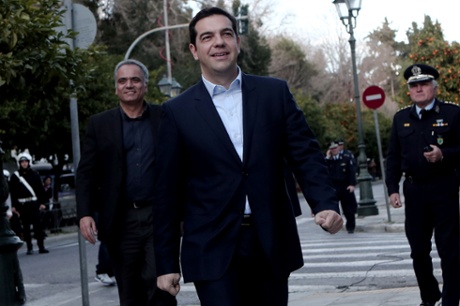
Alexis Tsipras was smiling broadly in front of scores of photographers from the global media as President Karolos Papoulias arrived to swear him in a few minutes ago, Helena Smith reports.
The two men stood either side of a table. Tsipras pronounced that he will give his all “to protect the interests of the Greek people.”
He then signed the book - as tradition dictates of newly sworn in prime ministers - with large Mont Blanc fountain pen.
Helena confirms that there was much clapping as Tsipras emerges from the presidential palace, adding:
“This was the fastest and perhaps most low-key swearing in ceremony of a Greek prime minister in modern times,”
After express elections, and express negotiations to form a government, Greece now has an express prime minister!
Updated
Tsipras sworn in as Greek prime minister
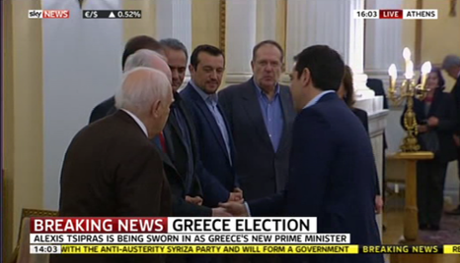
That’s it! Alexis Tsipras, the 40-year old left-wing radical, has been sworn in as Greece’s next prime minister by outgoing president Papoulias.
And very quickly, the ceremony is over and Tsipras has headed back out of the presidential palace.
There is scattered applause as he heads to Maximos Mansion, the official prime ministerial residence when he will start preparing for his vote of confidence.
And now Tsipras signs the official book. He’s looking in good spirits -- in another break with tradition, Tsipras isn’t wearing a tie. He’s said he won’t wear one until Greece has a debt reduction deal.
Updated
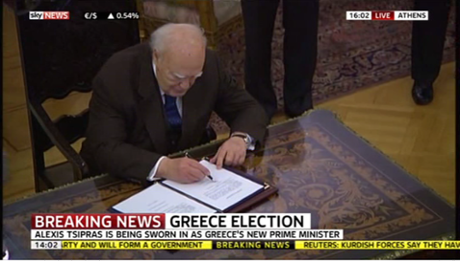
President Karolos Papoulias goes first, signing the official mandate to form a new government.
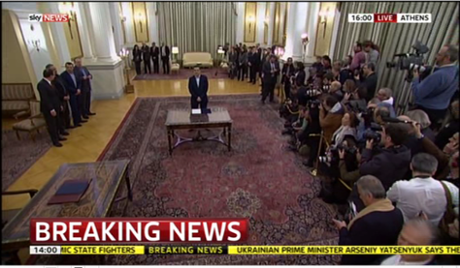
Tsipras has sworn to serve the Greek people and alway uphold the constitution.
Tsipras swearing-in ceremony underway
Alexis Tsipras is standing in the Greek presidential palace right now, ready to be appointed as Greece’s new prime minister.
Prime minister Karolos Papoulias has just entered the room.
Syriza's victory: What the readers say
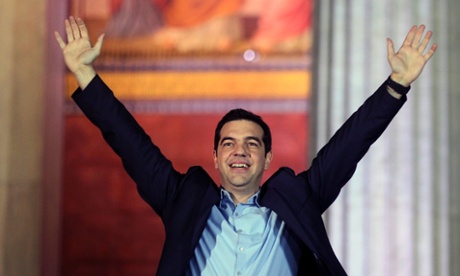
We’ve been hearing from our readers in Greece about their initial reactions to Syriza’s victory - and its implications for Greek’s economic obligations.
“I voted for Syriza,” said wellfightintheshade.:
“I am elated and worried at the same time. I am elated because the progressive political domain I traditionally belong in seems to be achieving a historical victory. But I am worried because, despite Alexis Tsipras’ declared intentions to fight against austerity, the conservative political forces in Europe seem irremovably positioned against that prospect.”
“41 years after the restoration of democracy, Greece starts a new chapter, sending a clear message of hope and courage, to all the oppressed by austerity countries of EU,” said Lambros Roussodimos, adding:
“We can now take a deep breath, looking forward to the negotiations and the changes that will create new opportunities and possibilities. We feel emotionally relieved and optimistic for the future.”
Other readers struck a more cautious note. “I am not supporting [Alexis] Tsipras’s party, and I don’t think that his plan is realistic”, said Κωνσταντίνα Μπίσμπου, adding:
“However,it is undeniable that the Eurozone has pressured us relentlessly all these years. “[Syriza] should try to negotiate with realistic and feasible goals.”
Syriza election victory: what’s the mood in Greece?
If you’re just joining us, check out this summary by Shiv Malik
Syriza forms Greek government: what we know so far
Tsipras arrives at presidential palace
Alexis Tsipras is very very close to being Greece’s new prime minister.
The Syriza leader just arrived at the presidential palace, Helena Smith reports from Athens.
He is expected to be sworn in - on time - at 4pm local time or 2pm GMT. Syriza says it wants a government to be formed by the end of the day.
Tsipras told president Karolos Papoulias that he has enough support to form a government, adding:
I want to hope and believe that the absolute majority we have secured of 162 seats will increase during the confidence vote… we have to expedite procedures because an uphill struggle awaits us.”
(Tsipras must win a confidence vote in parliament to prove he has the support of a majority of MPs)
Papoulias then gave the radical leftist leader a mandate to form a government, Helena adds.
#Greece Tsipras to Prez Papoulias: Mr President, after yesterday elex, I met w Kammenos and he agreed to give confidence vote
— Efthimia Efthimiou (@EfiEfthimiou) January 26, 2015
Updated
The White House says America is looking forward to working closely with the new Greek government.
White House on Tsipras' election #Greece #ekloges2015 pic.twitter.com/RMzfdicXZ2
— Derek Gatopoulos (@dgatopoulos) January 26, 2015
Many established European parties have seen falling support since the financial crisis began, but the collapse suffered by the left-wing PASOK party is quite remarkable:
From PASOK-land to Syriza-land in one map (via @makisv1): pic.twitter.com/wMuRmmSDWW
— Alberto Nardelli (@AlbertoNardelli) January 26, 2015
Alexis Tsipras also intends to talk to the heads of two other parties, the centrist To Potami and the communist KKE, after being sworn in today.
He’ll be seeking their support even if they do not join the coalition.
To Potami, or The River, bill themselves as a moderate, forward-looking party -- “post-bailout”, rather than pro or anti.
They had been seen as potential kingmakers, before Tsipras allied with the populist Independent Greeks instead.
Potami's Theodorakis says Syriza's deal with ANEL a 'bad omen' for the new govt. To meet Tsipras 1700 GMT; vote of confidence for gov't open
— Yannis Koutsomitis (@YanniKouts) January 26, 2015
Jean-Claude Juncker, president of the European Commission, has written a letter of congratulation to Alexis Tsipras:
. @atsipras I look forward to working with you for the benefit of the citizens of Greece and the European Union pic.twitter.com/5XNGl9R3rr
— Jean-Claude Juncker (@JunckerEU) January 26, 2015
Syriza have confirmed that prime minister in waiting Alexis Tsipras has been meeting with Archbishop Ierōnymos:
#Tsipras meeting with Archbishop of Athens now. Oh, for a microphone in the room. http://t.co/NbCr1PNkes
— Andrew McC Crawford (@andymccc) January 26, 2015
Tsipras Won't be Sworn In by Archbishop, but will Give Political Oath | http://t.co/saWAxMgELT http://t.co/9N37qf09AQ via @sharethis
— Hendro Munsterman NL (@HendroM) January 26, 2015
Belgium has added its voice to the chorus telling Greece to stick to the plan:
Belgian Fin Min @jvanovertveldt ahead of #eurogroup: "[Troika] agreements should absolutely be respected" http://t.co/eIdcYZJtau #Greece
— Pieter Cleppe (@pietercleppe) January 26, 2015
Here is reaction to the Greek election from Ireland, with Sinn Fein president Gerry Adams welcoming the Syriza victory but others warning that the Irish government would be worried by the outcome. Henry McDonald in Dublin writes:
Gerry Adams had spoken to the Alexis Tsipras on the phone on Friday to wish him luck ahead of the Greek poll. Following the result Adams said Syriza’s victory “opens up the real prospect of democratic change not just for the people of Greece, but for citizens right across the EU”.
Veteran anti poverty campaigner in the Irish Republic Father Sean Healy described the result as “the politics of hope” and that the austerity politics of “business as usual is not an option”.
Prior to the Greek vote, the Taoiseach Enda Kenny had warned that “a drift towards populism” could damage Ireland and Europe’s economic recovery.
One commentator in the Irish Independent newspaper said that “few politicians have more to fear from yesterday’s Greek elections than Enda Kenny.” Coming from a newspaper that has by and large backed cost cutting austerity measures in the Republic, it is an apposite warning to Kenny and his Fine Gael-Labour coalition [ahead of the 2016 election.]
Updated
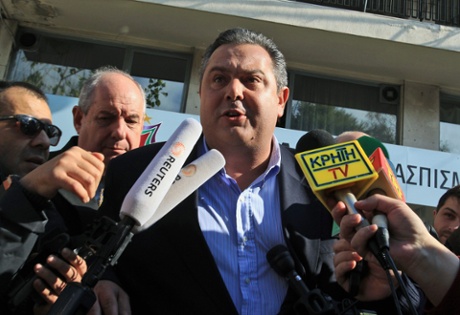
Here’s the inside line on the populist, nationalist, pro-German war reparations, anti-austerity group who are going to be part of Greece’s next government:
Pierre Moscovici, the European Commissioner for Economics and Finance, says the EU recognised what he called “the clarity and legitimacy of the new Greek government”.
Julian Borger, our diplomatic editor, reports from Brussels:
Moscovici, a member of the French Socialists, said that he looked forward to negotiations with the new Greek PM, Alexis Tsipras as soon as possible, stressing that the European Commission and the new government had a lot of goals in common.
Speaking on arrival at a Eurogroup meeting of Eurozone finance ministers, he said: “We all want a Greece that stays on its feet, creating jobs and growth, reducing inequality, and a Greece that repays its debt.”
Updated
Summary: A new anti-austerity Greek government
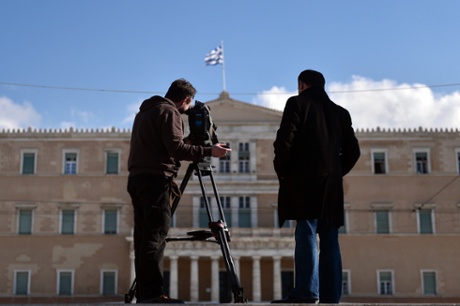
Greece is getting a new anti-austerity coalition government, just hours after the leftwing Syriza party won a sensational victory in Sunday’s general election.
Syriza will form an alliance with the rightwing populist group Independent Greeks, giving it a majority in parliament (with 162 of the 300 seats).
From Athens, Jon Henley writes:
Greece is headed into a new era of anti-austerity as the radical leftist Syriza successfully formed a government with the Independent Greeks party after falling agonisingly short of an outright majority in Sunday’s landmark elections.
“I want to say, simply, that from this moment, there is a government,” the Independent Greeks leader, Panos Kammenos, told reporters after emerging from a meeting at Syriza’s headquarters.
Full story: Syriza forms government with rightwing Independent Greeks party
Alexis Tsipras is due to be formally appointed as Greece’s new prime minister in 90 minutes time, at 4pm local time or 2pm GMT.
In a break with tradition, though, he isn’t expected to be sworn in by Athens Archbishop Ieronymos, who he is meeting right now.
Details of Tsipras’s cabinet are already emerging. Political economist Yanis Varoufakis is widely expected to get the finance ministry brief.
Varoufakis sounded ready for action this morning, warning that Greece has been turned into a debt colony and insisting that it will not leave the eurozone. He also called victory a ‘poisoned chalice’, given Greece’s economic woes.
Experts fear that the coalition could be unstable, given that Syriza has little in common with the Independent Greeks despite a shared loathing of troika-mandated austerity. The two parties are polls apart on issues like illegal migration, Turkey, gay marriage and the role of the Greek Orthodox Church.
Open Europe’s analyst Vincenzo Scarpetta warns:
“Not only will [the coalition] drive a harder line in the debt negotiations, making a compromise even more difficult. But it could also undermine political stability in Greece in the medium term
Tsipras’s victory has put the issue of Greece’s debt mountain back in the heart of European politics, on the day when finance ministers are gathering in Brussels for a regular meeting.
Battle lines are already being drawn …
IMF chief Christine Lagarde has said Greece cannot get special treatment.
Eurogroup chief Jeroen Dijsselbloem has warned that there is not much appetite among eurozone members for cutting Greece’s debts.
UK chancellor George Osborne argued that Syriza’s win is not a rejection of austerity.
Finland’s PM has declared that the Finns will “not accept a demand for debt cancellation”, but floated the idea of extending its original bailout terms.
My statement on the Greek elections. http://t.co/PMi8h1xvku
— Alexander Stubb (@alexstubb) January 26, 2015
In France, the rightwing National Front has hailed Syriza’s victory, while socialist president François Hollande was more restrained.
And Germany has pledged to work constructively with Greece.
Here’s some further reading:
-
Greece Q&A: what now for Syriza and EU austerity?
-
Greece shows what can happen when the young revolt against corrupt elites
Financial markets have not been shaken by events. The Athens stock markets is down just 2%, after shedding 5% earlier. The FTSE 100 has lost 30 points, while the euro is actually slightly higher today at $1.1236.
Updated
In the UK, Labour party leader Ed Miliband has responded rather cautiously to his fellow left-wingers’ triumph in Greece.
I’ve taken the quotes from Politics Home:
“Just like our elections are a matter for the people of this country, so who the Greek people elect is a decision for them.
“It is the responsibility of the British government to work with the elected government of Greece for the good of Britain and Europe and not to play politics.
“And it is up to each country to choose its own path on how to deal with the economic and social challenges they face.
“We have set out our path for Britain: to make sure our country is fairer and more prosperous and balance the books.
Ed Miliband responds to Syriza's victory in Greece: http://t.co/tPAl8heKNg
— PoliticsHome (@politicshome) January 26, 2015
Analysis: Greece's looming debt payments
Greece has €4.3bn of debt repayments due in March, and then more than €6bn will fall due in July and August.
So what might happen now?
Our data editor Alberto Nardelli explains:
In the immediate term, one likely first step will be extending the financial bailout beyond February 28. This buys time. The ECB is also very likely to continue providing liquidity to Greek banks on favourable terms, which Greek financial institutions so desperately need, and Greek bonds will benefit from the ECB’s latest round of QE - despite Mario Draghi warning that “some additional eligibility criteria will be applied in the case of countries under an EU/IMF adjustment programme.”
In the past, two rounds of relief were applied to Greece’s debt burden (which now stands at 175% of GDP), these extended the maturity of the country’s debt to an average 16.5 years, double that of Germany and Italy, and also provided an interest rate cut. Total interest expenditure in 2014 was 2.6%, only marginally above France’s 2.2%.
A new round of this type of support is imaginable, even though other countries with far shorter maturities, and higher rates, may seek similar deals. Most importantly, according to Greek voters this approach hasn’t worked. And in a slow-growing, and now deflationary, economy, the debt burden remains heavy.
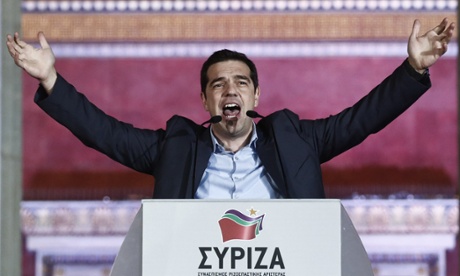
Alexis Tsipras will most probably not convince other eurozone members to abolish large amounts of Greek debt. But a plan under which Greece would repay its debts according to future economic growth rates may be given some attention.
In mid-January, the European Commission unveiled new guidelines that allow for greater flexibility on EU budget violations. These changes will provide greater fiscal flexibility and extensions on missed targets to countries like Italy and France in exchange for relevant reforms. The FT’s Peter Spiegel wrote at the time “the new guidelines for the first time make explicit that a country can get a waiver of EU deficit rules by proposing a significant economic reform plan”.
A compromise around flexibility for reforms is where the conversation between Greece and its eurozone partners will most probably begin - once again.
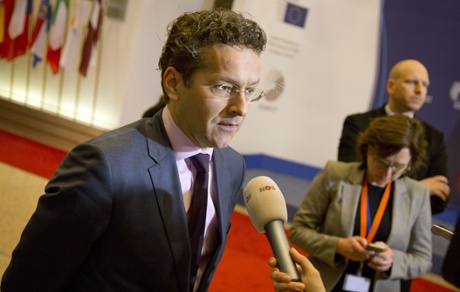
Eurogroup chief Jeroen Dijsselbloem was sticking very much to the Eurozone script by ruling out a debt write-off this morning, while hinting that talks to make the debt more sustainable might be possible.
Diplomatic editor Julian Borger explains, from Brussels:
A Eurozone review of Greek debt sustainability is underway. The overall debt is 175% of GDP, €317 billion, which is a lot. But in terms of the burden of annual debt servicing, it is about 4% of GDP which is not as bad as some other Eurozone countries like Ireland, Portugal and Italy, and there are predictions that the Greek interest payment burden will continue to fall as a share of GDP this year.
The reason is that most of Greek debt is official debt to government, at relatively low interest rates. So in the view of some in the Eurozone, Greek debt is not unsustainable by European standards, and to agree to write down the debt would send the wrong signals to other big debtors in the zone.
The time for new negotiations is very limited. Greece’s existing loan package expires at the end of February.
Updated
In case you missed it, Paul Mason has written a great piece about how Syriza’s victory is a triumph for passionate youth over corruption and elitism.
Greece shows what can happen when the young revolt against corrupt elites
@paulmasonnews: "The classic couple in a dysfunctional economy is a grey-haired man with a twentysomething woman." http://t.co/QtuqwEpyDd
— John Gapper (@johngapper) January 26, 2015
Germany: we'll work with new Greek government
Germany has pledged to work with Greece’s new government, but not given any hint that it might support a debt deal.
My colleague Louise Osborne reports from Berlin:
In a press conference on Monday, government spokesman Steffen Seibert said: “The Greek voters have chosen Syriza and we have to respect that … Currently, we have a result and no government. But when we do we will offer to work together with them.”
However, Seibert made clear that any talks on the current issues would not be taking place between Germany and Greece, but between Greece and the European partners.
He added: “The position of the European partners and Germany has not changed. Since the beginning of the crisis, the goal has been to stablise the whole of the eurozone, including Greece, and that remains the goal of our work.”
He said that the aid measures put in place for Greece had “always been European measures, not German nor Spanish or Italian or any other, but European measures.”
Speaking about how the relationship will continue between Germany and a new Greek government, Seibert added: “Germany has an interest in a good friendship and relationship with Greece.”
Updated
David Cameron’s spokeswoman has just told reporters in Westminster that he respects the Greek people’s decision, but the country must deal with its debts:
Reuters: GREECE MUST TACKLE ITS DEFICIT, MEET ITS INTERNATIONAL COMMITMENTS - UK PM CAMERON’S SPOKESWOMAN
French reaction: Marine Le Pen hails Syriza victory
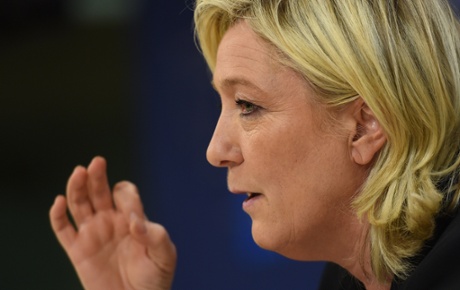
In France, the extreme-right National Front leader, Marine Le Pen, led the cheers for the Syriza victory, hailing “the start of the trial of euro-austerity”, writes Anne Penketh.
Le Pen, whose party wants to ditch the euro, expressed delight at the “giant democratic slap in the face by the Greek people to the European Union.”
Far-left leaders also praised the Greek election result, while the head of the ruling Socialist Party, Jean-Christophe Cambadélis acknowledged “a tidal wave against austerity”, in an interview with Le Parisien.
But French President Francois Hollande reacted cautiously in a statement. He expressed a desire to “continue close cooperation” with Athens “in the service of growth and the stability of the eurozone”.
Nicolas Sarkozy, the leader of the centre-right UMP who was in Berlin on Monday for a meeting with Angela Merkel, also urged both the future Greek government and European leaders to show “responsibility” and “restraint”. In comments to reporters, Sarkozy said the cancellation of Greece’s debt should be ruled out.
The right-wing Le Figaro urged the Greeks to stick to existing commitments to international creditors. In an editorial, it said:
“Whoever has heard of a debtor dictating its terms to its creditors, particularly after pocketing money?”
It warned that European leaders should avoid making concessions to the Greek electorate which could only give more oxygen to eurosceptic parties in Europe, including those led by Le Pen and French leftist Jean-Luc Mélenchon.
Mélenchon, meanwhile, has predicted that Syriza’s success will ripple through Europe like a ‘domino effect’
L'effet domino, vite ! - http://t.co/MlMDqfmaE8 - Nouvelle note de blog sur #Syriza et la dette de la Grèce. #Tsipras pic.twitter.com/dRG8eTtu8D
— Jean-Luc Mélenchon (@JLMelenchon) January 26, 2015
Greece will be the major topic of conversation at the eurogroup meeting of finance ministers in Brussels today.
Our diplomatic editor Julian Borger is there, and reports:
Jeroen Dijsselbloem, the Dutch president of the Eurogroup, has just arrived at the European Council headquarters in Brussels for the first meeting of the Eurozone’s finance ministers since the dramatic Greek election result.
He send the Eurogroup was ready to talk to the new Greek goverment “as soon as it is up and running.”
He said: “We stand ready to work with them, as we have with previous Greek governments, to strengthen the Greek economy within the Eurozone.”
He stressed that working within the Eurozone meant keeping all previous agreements. Dijsselbloem, a Dutch Labour Party politician, said the Eurogroup had already done a lot to lift the Greek debt burden by extending maturity terms, but there was no appetite for writing off debt.
However, he added that “if necessary” the Eurogroup could have another look at the debt sustainability facing Greece, after the completion of a review of the country’s current financial situation.
Updated
Eurogroup chief: Not much support for debt writeoff
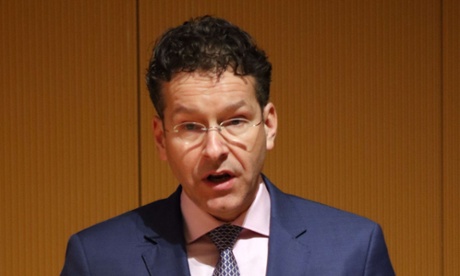
Dutch finance minister Jeroen Dijsselbloem has warned that there isn’t much support for writing off Greece debt across the eurozone.
Dijsselbloem was speaking as he arrived for today’s Ecofin meeting in Brussels (he’s also the head of the eurogroup).
Gavan Reilly of Irish radio station Today FM has the key quotes:
Dijsselbloem: "We stand ready to work with [Syriza], as we've always stood ready to work with the previous Greek government"
— Gavan Reilly (@gavreilly) January 26, 2015
Dijsselbloem: "We've already done a lot to lift the debt burden for Greece in terms of interest and maturity..."
— Gavan Reilly (@gavreilly) January 26, 2015
Dijsselbloem: "The possibility of a further extension we will discuss today with the Eurogroup but also with the Greek government"
— Gavan Reilly (@gavreilly) January 26, 2015
The key question. Dijsselbloem: "Writing off debt in nominal value? I don't think there is a lot of support for that in the Eurozone."
— Gavan Reilly (@gavreilly) January 26, 2015
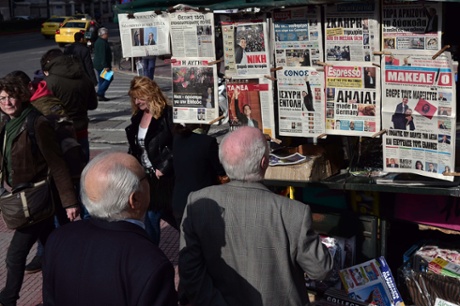
Greek media are making much of the fact that both French Left Party leader Jean-Luc Melenchon and Front National leader Marine Le Pen have BOTH congratulated Syriza on its electoral victory, writes Helena Smith.
And as suggested earlier, it appears Tsipras won’t be sworn in by Archbishop Ieronymos.
Greek media are now reporting that Syriza’s leader Alexis Tsipras will be formally sworn in at 4PM local time. At 40 he becomes the youngest Greek prime minister in modern times.
He will also break tradition by not being sworn in by the head of Greece’s orthodox church, Archbishop Ieronymos. A self-described atheist, Tsipras, who has also refused to tie the knot in a religious ceremony with his long-time partner, Betty, will make a courtesy call to the cleric at 2:30 PM.
Although Syriza wants to end some of the privileges enjoyed by the Greek Orthodox Church, Tsipras has a good relationship with Ieronymos who has taken a leading role in efforts to alleviate the humanitarian crisis sustained as a result of wrenching recession and austerity.
Updated
Newsflash from Brussels: EUROPEAN COMMISSION SAYS READY TO ENGAGE WITH NEW GREEK GOVERNMENT ONCE IT IS FORMED
Not that they have much choice - Tsipras has just been democratically elected
Video: Optimism and uncertainty on the streets of Athens following Greek elections
Finland’s prime minister has floated the prospect of giving Greece some wriggle-room over its debt payments, but insisted that a Greek restructuring is unacceptable.
Alex Stubb congratulated Syriza on its success, before warning:
If the new Greek Government commits itself to the earlier agreed arrangements and necessary structural reforms, we are ready to discuss the possibility of extending Greece’s programme by a few months.
Finland will not accept a demand for debt cancellation which made part of the discussions prior to the elections.
Stubb made similar points at Davos last week, where he warned that Greece must avoid a “dirty exit” from the eurozone.
My statement on the Greek elections. http://t.co/PMi8h1xvku
— Alexander Stubb (@alexstubb) January 26, 2015
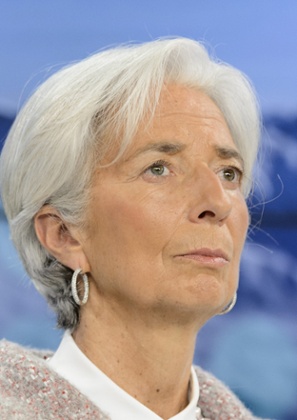
Christine Lagarde, the head of the International Monetary Fund, says Greece cannot be given special treatment over its debts.
She told Le Monde:
“There are internal euro zone rules to be respected. We cannot make special categories for such or such country.”
Lagarde also urged Tsipras to get to grips with Greece’s tax-collecting service, and the judicial system.
“It’s not a question of austerity measures, these are in-depth reforms that remain to be done,”
Updated
#Greece Tsipras to take civil oath in swearing-in ceremony at 16.00 (EET) with Pres. of Democracy Papoulias TR @doleross #ekloges2015
— spyros gkelis (@northaura) January 26, 2015
Now hearing that Alexis Tsipras will be sworn in at 4pm local time, or 2pm GMT.
Alexis Tsipras will meet with the Archbishop Ieronymos of Athens in around 90 minutes time, at 2.30pm local time (or 12.30pm GMT)
The swearing-in ceremony is traditionally heavy with religious ceremony. But might Tsipras, who was accused of atheism last year, want a different approach?
@damomac seeing (reliable) tweets that tsipras meeting with archibishop to seek permission for a civil oath.
— Diane Shugart (@dianalizia) January 26, 2015
#Syriza & #IndependentGreeks coalition is worst possible outcome: @wolfpiccoli talks #Greece http://t.co/rGzMTnzXC7 pic.twitter.com/5jJj6SMfHU
— Mark Barton (@markbartontv) January 26, 2015
Wolf Piccoli of Teneo Intelligence reckons that a Syriza/Independent Greeks coalition is the ‘worst possible outcome.
He told Bloomberg that:
At the end of the day, the Independent Greeks are a conspiracy-prone, nationalist party.
Piccoli fears that’s there’s nothing in this coalition to temper their approach to austerity or to smooth negotiations with the Troika
It is a bad mix, and no experience in government on either side.
Greek media are reporting that Yanis Varaufakis has been given the brief of finance minister. Varaufakis insisted this morning that Grexit was not ‘on the cards’.
The official announcement comes later
Acc 2 local media, @ydragasakis may be appointed Deputy PM supervising Fin & Dev Ministries, @yanisvaroufakis FinMin. #Greece #ekloges2015
— Manos Giakoumis (@ManosGiakoumis) January 26, 2015
.@yanisvaroufakis as FinMin almost feels like as big of a story as Tsipras as PM.
— Joseph Weisenthal (@TheStalwart) January 26, 2015
The German government has already declared that Greece will not get debt relief.
Reuters reports:
A senior lawmaker from Angela Merkel’s conservatives said on Monday “with us there will be no further debt reduction for Greece,” in reaction to a pledge by Greek election victor Alexis Tsipras to renegotiate Greece’s debt agreements.
Norbert Barthle, spokesman on budgetary affairs for the conservatives in the lower house of parliament, told Reuters by telephone that Tsipras, whose leftist Syriza party swept to victory in a snap election on Sunday, must realise that German taxpayers are liable for a large portion of Greek aid.
“I cannot tell them that they should now bear the weight of that risk,” Barthle said.
Open Europe’s analyst Vincenzo Scarpetta warns that the Syriza-Independent Greeks coalition “could prove problematic””
“Not only will it drive a harder line in the debt negotiations, making a compromise even more difficult. But it could also undermine political stability in Greece in the medium term.
While the two parties agree on rejecting EU-mandated austerity, they disagree on a number of other issues.”
A smattering of instant reaction to the coalition deal:
Key question has been: will Syriza moderate policies post-election? Coalition with the Independent Greeks suggests the answer is 'no'.
— Duncan Weldon (@DuncanWeldon) January 26, 2015
#Syriza & its creditors are stuck in a Gordian Knot, both sides will need to cave on smthing. @economistmeg on @AP http://t.co/T4dFcqM9U5
— Elena Becatoros (@ElenaBec) January 26, 2015
Syriza’s choice of coalition partner will worry Brussels. Sig reduces chances Greece will compromise on bailout. Coming months will be bumpy
— Ed Conway (@EdConwaySky) January 26, 2015
Syriza coalition with right wing Indy Greeks- they can't change EU migration law, but probably give them something on church / military?
— Paul Mason (@paulmasonnews) January 26, 2015
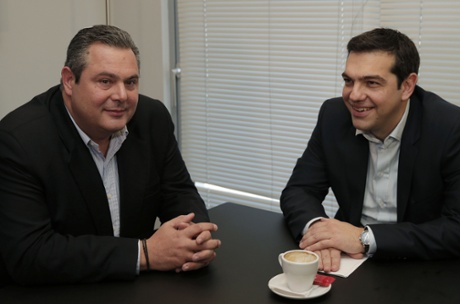
Photo: The moment Greek coalition deal was agreed
Alexis Tsipras (on the right) was understandably cheerful when he met with Panos Kammenos, chairman of the right-wing Independent Greeks party, today to hammer out a coalition.
Some details of the new government are leaking out:
#Greece | Syriza MP Dragasakis [@ydragasakis] to become Deputy PM overlooking Finance & Economy Ministries, to lead negotiations w Eurozone.
— Yannis Koutsomitis (@YanniKouts) January 26, 2015
So, rightwing Independent Greeks to join leftist Syriza in anti-austerity govt. Uneasy bedfellows one would think. Cabinet composition tbc.
— NikiKitsantonis (@NikiKitsantonis) January 26, 2015
Alexis Tsipras is expected to meet with other party leaders today to discuss the way ahead; Channel 4’s Paul Mason reckons he will be looking to make agreements on various issues.
tsipras also expected to meet with theodorakis (potami) and koutsoubas (kke), presumably after he receives mandate to form government.
— Diane Shugart (@dianalizia) January 26, 2015
Syriza-ANEL coalition - Tsipras is constructing issue by issue coalitions. Most of what he needs to do does not happen in parliament.
— Paul Mason (@paulmasonnews) January 26, 2015
Helena Smith confirms that Greece’s new prime minister Alexis Tsipras will meet president Karolos Papoulias at 3.30pm:
The head of state is expected to hand the radical left leader a mandate to form a government.
Insiders saying in ideal world a new government will be formed by the time the euro group of euro area finance ministers meets in Brussels this evening. Express elections, express government!
Greece’s government could be wrapped up by dusk; Alexis Tsipras is due at the presidential palace at 3.30pm local time, or 1.30pm GMT.
Tsipras to meet Greek president Karolos Papoulias at 3.30pm, will submit the names of his cabinet. Things moving fast here.
— Tony Connelly (@tconnellyRTE) January 26, 2015
Alexis Papachelas, one of Greece’s leading commentators has warned that “huge political instability lies ahead” following Sunday’s election.
The New Statesman’s George Eaton sums up the new Greek government for UK readers:
Syriza has just formed a coalition with the Greek equivalent of UKIP (The Independent Greeks or ANEL).
— George Eaton (@georgeeaton) January 26, 2015
This is an unusual coalition.
Alexis Tsipras’s army of left-wing radicals will be sharing the government benches with a group of populists right-wing MPs who broke away from New Democracy in 2012.
The Independent Greeks share Syriza’s determination to end Greece’s bailout agreements, but has a much more hard-line attitude to immigration. They have also called for Germany to pay World War 2 reparations.
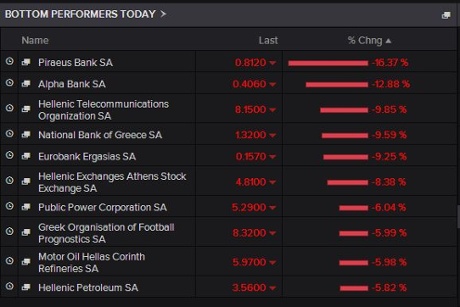
Traders on the Athens stock market have hailed the quick creation of a coalition. The ATX index has reversed this morning’s 5% slump, and is now flat.
Bank shares are recovering too; Piraeus is only down 6.6%, having shed 16% earlier.
Updated
Parliamentary mathematics time: the new government will have a working majority of 162 seats in the 300-seat parliament (Syriza’s 149 MPs plus the Independent Greeks with 13).
BREAKING: Coalition announced, as expected, between SYRIZA and ANEL (Independents with 13 MPs, giving a majority of 162).
— Alex Andreou (@sturdyAlex) January 26, 2015
The coalition deal means that Tsipras can now be summoned to the Greek presidential palace to be given a mandate to form a government.
We’ll then get details of his cabinet ministers.
kammenos: the cabinet will be announced by the prime minister. we executed the mandate of the greek people.
— Diane Shugart (@dianalizia) January 26, 2015
So, Tsipras has managed his first task - agreeing a coalition between his radical left-wing Syriza and the populist right-wing Independent Greeks.
The hard work starts here, though, as veteran conservative MP and former health minister Antonis Georgiadis explains.
Georgiadis just told Skai News that “And now the difficulties begin”, adding.
“The [economic] evaluation has to be concluded as soon as possible. It’s not a matter of months or weeks but days! I very much hope that Alexis and Panos [the government’s two new leaders] can save Greece.”
With both at the helm of government his greatest fear is that the country would ultimately turn to the extreme right, if the coalition fails.
Golden Dawn, which pulled off the stunning feat of emerging as the third biggest political force in Sunday’s poll, is waiting …. eagerly, Helena Smith explains.
Updated
GREECE HAS A GOVERNMENT
It’s official: Greece has a government - a coalition between Syriza and the Independent Greeks.
Less than an hour after talks began, Panos Kommenos, leader of the Independent Greeks party has emerged from Syriza’s party HQ saying the country has a new government.
Helena Smith reports that Kommenos said:
“I want to say, simply, that from this moment, there is a government.” “The Independent Greeks [party] will give a vote of confidence to the prime minister Alexis Tsipras.
“The prime minister will go to the president and … the cabinet make-up will be announced by the prime minister. The aim for all Greeks is to embark on a new day, with full sovereignty.”
#GreekElections we have a new government announces on greek TV Kamenos leader of independent greeks ... pic.twitter.com/CcG0ncXDqg
— tsamadosantiques.com (@AthensAntiques) January 26, 2015
Updated
Alexis Tsipras must achieve “deep structural and institutional change” in Greece before trying to get a debt deal out of Brussels.
So argues Greek journalist Nick Malkoutzis this morning. He reckons that Syriza’s top priority should be to reform the justice system, the civil service, the tax-collection operations, to show eurozone allies he is serious.
Writing on MacroPolis, Malkoutzis writes:
If SYRIZA really wants to seize the opportunity it has been given then the best service it can offer to Greece is to deal with the deep-rooted malaise in the public administration and political system.
This will offer Greece a sounder platform for the future than a reduction in the public debt or a faster rate of growth. In fact, securing the last two without the first will only lead to Greece ending up in the same place it is now sooner or later.

German newspapers react
There’s a mixed reaction in German newspapers to radical leftist Alexis Tsipras’s triumph.
My colleague Louise Osborne has scoured the pages, and reports:
Germany’s biggest newspaper Bild leads with the headline, “Greeks vote for the Euro-fright”, writing that Alexis Tsipras achieved a “landslide victory”.
The paper goes on to ask, “What will the winner’s fist cost us?” accompanied by a picture of Tsipras punching the air following the news of his victory.
Front page digital edition of Germany's tabloid @BILD: "Euro schock as Tsipiras triumphs!" #ekloges2015 pic.twitter.com/BabAHYwzFS
— Nina Schick (@NinaDSchick) January 25, 2015
A Bild comment piece also predicts that Tsipras will make his goals clear today; an end to the reforms and more help for Greece. Germany must resist, Bild argues:
“Sorry, Mr Tsipras, but that’s going too far! The Eurozone is no gambling den in which every gambler can do what he wants. And where once closed agreements can be questioned at one’s own pleasure. What applies here is: An agreement is an agreement!”
Meanwhile, Germany’s left-leaning newspaper die Tageszeitung says the result brings both “opportunities and risks”.
It writes:
“The victory of Syriza is a chance for Greece to free itself from the decades of corruption and nepotism, with which both the conservative New Democracy and the social democratic Pasok were inextricably bound,”
It adds, however, that Tsipras has produced “insatiable hopes” and will have to make it clear that Syriza cannot avoid entering into negotiations with European lenders, otherwise Greece could be insolvent in a few months and without much-needed social improvements.
Are you one of Greece’s 9.8 million voters? After the historic win by Syriza, we’d like to hear your hopes and fears for the future of the country.
Updated
Dimitris Vitsas, a member of Syriza’s central committee has just told SKAI TV that “our immediate and most pressing priority is to alleviate the humanitarian crisis.”
“The Greek people have cancelled the policies of the memorandum,” he said referring to the deeply unpopular bailout accords outlining the onerous conditions of EU-IMF aid to debt-stricken Greece.
Vitsas, Syriza’s chief policy chief, added:
“We don’t want a rupture [in relations] with Europe … disagreement is one thing, rupture quite another.”Despite all the forecasts of economic catastrophe with the advent to power of a left-wing government “we have woken up to a sunny day.”.
“The banks haven’t closed, they are operating normally, schools are open. Everything is just as it should be.”
(via Helena Smith)
Greek bonds have also fallen in value this morning.
That has pushed up the yield, or interest rate, on Greece’s 10-year bonds trading in the markets to 8.96% this morning, up from 8.74% on Friday.
That’s deep into the ‘danger zone’ where a country cannot borrow from international investors.
Investors flee Greek bonds after Syriza win. #Greece's 10yr yields jump by 22bps to 8.96%. pic.twitter.com/K0uypwhLxw
— Holger Zschaepitz (@Schuldensuehner) January 26, 2015
Greek stock market drops 5%
Greek bank shares have slumped in volatile early trading in Athens.
The ATG stock index has tumbled by over 5%, as investors raced to offload stocks following Syriza’s success.
Financial stocks led the selloff, reflecting fears that Athens could now become locked in a battle with Europe over debt relief.
Patrick Wintour: Conservatives warn about economic risks
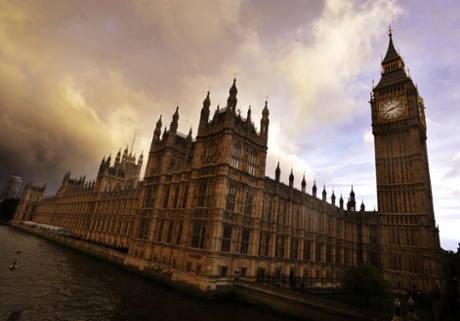
Syriza’s victory in the Greek election will “increase economic uncertainty across Europe”, prime minister David Cameron has warned (writes political editor Patrick Wintour) .
His warning of fresh risks facing the UK economy came as the chancellor, George Osborne, went further and said the promises by Syriza would be “very difficult to deliver and incompatible with what the eurozone currently demands of its members”.
His warning that Syriza’s demands would require exit from the eurozone came as he denied that the Greek vote reflected opposition to austerity and said that instead it was a vote against economic policies in the Europe that had not been working.
There are likely to be calls from the left in Britain for tougher anti-austerity policies from Labour’s leader Ed Miliband, but they will be resisted by the shadow chancellor Ed Balls.
Labour is likely to argue that Syriza’s success does not have a huge reach across to UK policies since the UK is outside the eurozone. But the Green party will argue that the vote shows latent public support for bolder calls to protect the poor and boost public spending.
Speaking on the BBC’s Today programme, Osborne said:
“I certainly understand that if you have unemployment at 25%, if your economy has shrunk by 20%, as the Greek economy has over recent years, you are looking for other answers, alternatives – because ultimately this is just the latest chapter in the eurozone crisis. It increases economic uncertainty and it reminds the United Kingdom that it needs to work through an economic plan that is delivering lower unemployment, and growth and economic security.”
He added:
“People get tired of economic failure. They get tired of rising unemployment. And in the UK, returning to economic chaos, returning to the lack of an economic plan would see higher unemployment. So i think the lesson for us is: continue to work through the plan that is working, that is delivering that higher job rate …
“What people don’t like is economic policies that don’t work; in the UK, we have an economic policy that is working.
He said the South-West alone has seen almost 100,000 jobs created over the last year, one of the fastest job-creation rates across the world.
“People here – and indeed this is true across the country – are seeing greater economic security, jobs being created, more personal prosperity as earnings rise faster than prices. So I think what you see is not a defeat of austerity; it’s a defeat of economic plans that don’t work. And in Britain we’ve got an economic plan that is working.”
He rejected suggestions that the solution lay in higher public spending.
“I don’t think it’s just a question about the public finances. I think that is a panacea, It is a false hope that it’s just a question of spending more money in these countries. One of the reasons these countries are in a mess is because they weren’t able to bring their public finances under control in the past”.
Coalition talks begin in Athens.
The coalition talks between Alexis Tsipras and the Independent Greek party have begun, slightly earlier than expected.
From Athens, Helena Smith reports:
Such it seems is the enthusiasm for a new change of course that Panos Kammenos, head of the small, populist right-wing Independent Greeks party has turned up EARLY for talks at Syriza’s HQ with Alexis Tsipras.
Greek media reporting it is almost “100 percent certain” that a coalition government will be formed. Skai TV says radical left leader Alexis Tsipras may even announce its make-up later in the day. Neither Tsipras nor Kammenos have much in common - bar the desire to see punishing austerity ended.
Updated
Greece’s debt pile is simply too high for the country to return to growth and services its borrowing, says Professor Christopher Pissarides.
Pissarides, of the London School of Economics, explains:
“You can’t really have growth coming out of such a deep recession by running the kind of budget surpluses that are needed [to repay debts] at the same time”.
Pissarides adds that Greece is probably the least competitive economy in Europe; it needs more than debt relief.
The CEO of Greek Bank Piraeus then told the Today Programme that savers are less nervous than in 2012.
“There is definitely not a bank run. Definitely not the panic we saw a few years ago”
Syriza MP: Grexit is not on the cards
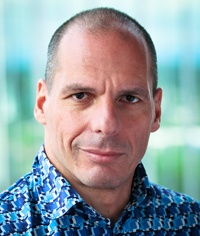
What are the chances of Greece still being in the eurozone in one year, or five years?
Yanis Varoufakis MP (and finance minister in waiting?) insists that Greece will stick with the euro:.
We who are in the eurozone must not toy with loose or fast talk about Grexit or fragmentation. If that happens, disruptive forces would be unleashed.
Grexit is not on the cards, he adds. We will not go to Brussels in a spirit of confrontation. There is plenty of room for mutual benefit, including those in Britain.
Updated
Syriza MP Yanis Varoufakis says his party will show Europe a plan that cuts the cost of this debt debacle to the average German, the average Slovak, who is even poorer than the average Greek.
What details can you give us?
Varoufakis cites three priorities:
- Genuine reforms to end Greek bureaucracy and tax immunity.
- A rational plan for debt restructuring, so Ponzi Austerity ends.
- Don’t want to pay back less than we can, but this schedule is “completely unrealistic” and unconnected from growth.
We want to bind our repayments to our growth. We have a humanitarion crisis... people sleeping on the streets. It is “preposterous” that any sensible European could deprive us of the money we need.
Updated
Yanis Varoufakis, a Syriza MP who is tipped to become Greece’s next finance minister, is being interviewed on the BBC’s Today Programme now.
Congratulated on Syriza’s success, Varoufakis replies soberly that:
It’s a poisoned chalice, but I accept your congratulations.
He says Greece has been suffering since authorities decided to “pile the burden on the weakest shoulders”, forcing the country into a slump.
It takes an eight or nine year old to understand this, Varoufakis says, adding:
Fiscal waterboarding has turned us into a debt colony.
But what about the ‘glimmer of light’ recently, when Greece’s recession ended?
Varoufakis dismisses this idea. Prices and income are both falling, he say, which is “a typical case of a Great Depression -- and Europe decided to call it a glimmer of light”.
Updated
The London stock market has fallen at the start of trading, but it’s a muted reaction.
The FTSE 100 is down just 28 points, or 0.4%, at 6804.
Events are moving fast in Greece. Alexis Tsipras is due to meet with the leader of the right-wing Independent Greeks, Panos Kammenos, at 10.30 a.m local time (or 8.30am GMT).
Tsipras should also receive a mandate from president Karolos Papoulias to form a government today.
Having won 149 of the 300 parliamentary seats [results table here] , Syriza needs a coalition partner to secure a working majority. The Independent Greeks won 13 seats,.
Tsipras and Kammenos reportedly spoke last night about forming a government. But analysts warn that an alliance with the populist Independent Greeks could be unstable.
Including the Independent Greeks in the coalition suggests we can expect dangerous brinkmanship in the Greek govt's negotiation w the troika
— Megan Greene (@economistmeg) January 26, 2015

Updated
George Osborne: all sides must act responsibly
Britain’s chancellor has denied that austerity has been defeated in the voting booths of Athens.
Chancellor of the Exchequer George Osborne told BBC Radio that:
“People get tired of economic failure, they tired of rising unemployment ... what you see is not a defeat of austerity, it is a defeat of economic plans that don’t work and in Britain we have got an economic plan that is working,”
Osborne also warned that it will be very hard for Syriza to deliver debt restructuring:
“I hope that both sides now act responsibly....It is certainly in the United Kingdom’s interests that we have stability, that we have a proper dialogue here between members of the euro.”
The prime minister tweeted a similar message last night:
The Greek election will increase economic uncertainty across Europe. That's why the UK must stick to our plan, delivering security at home.
— David Cameron (@David_Cameron) January 25, 2015
Updated
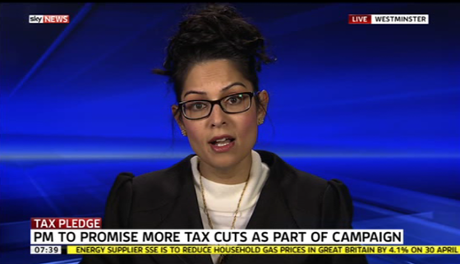
Priti Patel, Conservative MP in Westminster, just told Sky News that Greece’s economic problems are “a stark reminder that we should never join the euro”.
Updated
Green MEPs: Austerity has failed
Syriza’s victory should energise the battle against austerity across Europe, argues the Green Party.
MEPs Keith Taylor and Molly Scott Cato just issued a statement, saying:
Greens share the view of the new government that austerity is a failed model which has piled misery on the poorest while making the wealthiest even richer.
This result shows that challenging business as usual politics can win the support of the people. In the UK we are witnessing a Green Surge, in no small part due to our anti-austerity agenda, and we hope the Greek election result marks the beginnings of ordinary people standing up to a discredited economic model and failing Governments across Europe.”
News of Syriza’s victory has pushed the euro to an 11-year low.
The single currency hit $1.1098, for the first time since September 2003, as investors anticipate clashes between Alexis Tsipras and the EU.
More here: Greece elections: euro hits 11-year low after victory for anti-austerity party
Table: The Greek election results
Updated
Syriza wins historic victory in Greek elections
Good morning.
The people of Greece have spoken, demanding an end to the austerity that has gripped the country since the debt crisis began.
Europe is waking up to the news that the left-wing Syriza group has secured a stunning success in Sunday’s general election, but fallen just short of an overall majority.
They have won 149 seats out of the 300 in the Athens parliament, meaning coalition talks should now begin to form a new administration.
It’s a personal triumph for Alexis Tsipras, the charismatic left-winger who has persuaded millions of Greeks that he can negotiate a debt restructuring deal.
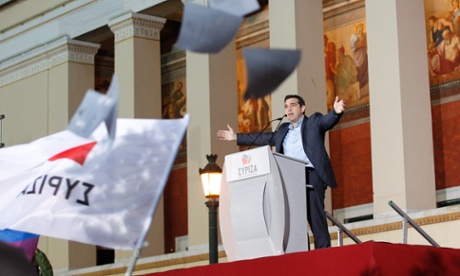
Last night, he promised Greeks:
The verdict of the Greek people ends, beyond any doubt, the vicious circle of austerity in our country,”.
“The verdict of the Greek people, your verdict, annuls today in an indisputable fashion the bailout agreements of austerity and disaster. The verdict of the Greek people renders the troika a thing of the past for our common European framework.”
Tsipras declares end to ‘vicious cycle of austerity’ after Syriza wins Greek election – live updates
Tsipras is now on a collision course with the European establishment, particularly those Northern European countries who have already ruled out giving Greece debt relief.
In the short term, Tsipras must now form a coalition – probably with the anti-bailout Independent Greeks party. They should be talking today, while the ousted government parties lick their wounds. New Democracy secured 76 seats, while junior partner Pasok was humilated with just 13 MPs.
Syriza’s success opens up a new chapter in Europe’s debt crisis, giving support to other anti-austerity parties across the region such as Spain’s Podemos, already flying high in the polls.
The whole basis of the painful cuts and tax rises imposed on many of Europe’s weaker nations is now under threat.
Syriza’s triumph will be top of the agenda in Brussels today, where eurozone finance ministers will be gathering for an Ecofin meeting.
And the financial markets could be turbulent as investors react to the news. Traders are predicting that shares will slide across Europe, while Greece bond yields - the cost of borrowing -- could spike.
We’ll be tracking all the action through the day.