Closing summary
We’re closing this live blog down now. Here’s a summary of the day’s events:
- The UK government called Moscow’s accusation that Britain directed the attack on Douma “ludicrous”. A Foreign Office spokesperson said the allegations showed Russia’s “desperation to pin the blame on anyone but their client: the Assad regime”.
- Russian foreign minister, Sergei Lavrov, claimed Moscow had “irrefutable” evidence that the suspected chemical weapons attack in Syria was staged with the help of a foreign secret service. He did not provide evidence for the claim. Russia’s ambassador to the UK, Alexander Yakovenko, said the UK-funded White Helmets were behind fake reports about the incident.
- French President Emmanuel Macron has called for more dialogue with Russia in in a phone call with his Russia counterpart Vladimir Putin. “The president of the republic called for dialogue with Russia to be maintained and stepped up to bring peace and stability back to Syria,” a statement from Macron’s office said.
- Russia tested the use of door handles as a way of delivering nerve agents and targeted the email accounts of Sergei Skripal and his daughter Yulia, according to previously classified intelligence over the Salisbury attack.
- Ambassador Yakovenko has demanded proof that Yulia Skripal is alive and well. He announced that Russia is lodging an official challenge to the way the UK investigated the incident and claimed evidence was being destroyed. He denied Russia had produce or stored novichok or tracked the Skripals but said he not seen the UK’s latest dossier.
- Labour leader Jeremy Corbyn has accused the government of “waiting for instructions” from Donald Trump adding that military intervention risks “escalating an already devastating conflict”. He also called for a UN-led investigation of the chemical weapons attack in Douma.
- There are growing calls for the government to give MPs a vote before launching any military intervention in Syria. Labour is actively exploring ways to bring a debate on any military action to parliament, but will have difficulty forcing a Commons vote.
Earlier today, we reported that the labour leader, Jeremy Corbyn, had been granted a security briefing from the government on the Douma attack. That meeting has now taken place.
The prime minister, Theresa May, has also spoken to the French president, Emmanuel Macron, though no details of what they discussed have yet been released.
Donald Trump’s erratic tweets regarding strikes – and when they will happen – are already impacting tourism, with tour operators weighing in after Europe’s central aviation agency warned commercial airlines to exercise caution in the eastern Mediterranean.
Officials in Cyprus, whose economy is highly dependent on tourism, are heaving a sigh of relief after Britain made clear it was not altering its travel advice to the island. Britons, followed by Russians, comprise the bulk of the 3.4 million holidaymakers expected to visit the destination this year.
The Cypriot government’s spokesman, Prodromos Prodomou, says:
We may be closer to Syria than anyone else but Cyprus is not involved in what is happening. Nobody has asked to use our airbase in Paphos, for example.
What the British authorities decide to do on the sovereign bases is not within the control of the Republic of Cyprus. They are not obliged to give information to us … we have no say in what goes on in them, although – unofficially as a matter of courtesy, let’s say – they will often inform us.
The decision of some commercial airlines to reroute flights after Euro Control’s warning was bad publicity, but did not overly affect the island where bookings had been pre-paid. “It was a first. Last year there was no such warning,” said Prodromou, referring to the tomahawk strike Trump ordered after a previous chemical attack in Syria.
Updated
Over in Cyprus, officials are attempting to kill off speculation Russia would retaliate with an attack against British sovereign bases on the island in the event of US-led punitive airstrikes inside Syria.
Speaking to the Guardian, the government spokesman Prodomos Prodromou describes the scenario of a counter-attack as “so remote” it borders on being “crazy”. He says:
It is impossible to imagine a scenario where Russia not only hits Britain [ in retaliation] directly but does so in Cyprus,” he said. “It would be crazy to have a confrontation between the US and Russia … the scenario of a counter attack [staged] in Cyprus is a fantasy, a fiction.
Cyprus, an EU member state with traditionally good relations with Russia, has found itself caught in the middle as debate over missile attacks has mounted. The former colony is host to two British sovereign bases, including a vital military installation at RAF Akrotiri, where eight typhoon and six tornado fighter bombers are stationed.
As Britain’s main forward mounting base for overseas operations in the Middle East, RAF Akrotiri’s front line role as a launch pad makes it a prime candidate for counter attack, analysts say.
Updated
UK government rejects Russian allegations over Douma attack
The Foreign Office says Moscow’s accusation that Britain directed the attack on Douma is “ludicrous”. A spokesman says:
Russia has wielded its UN Security Council veto six times since February 2017 to shield the Assad regime from scrutiny for its use of chemical weapons.
These accusations from Moscow are just the latest in a number of ludicrous allegations from Russia, who have also said that no attack ever happened. This simply shows their desperation to pin the blame on anyone but their client: the Assad regime.
The chemical weapons attack in Douma last Saturday was a shocking and barbaric act that cost up to 75 lives including young children.
Updated
British UN ambassador Karen Pierce said that Britain was not involved in an alleged deadly chemical weapons attack in Syria, rejecting an accusation by Russia’s defence ministry.
Pierce told reporters:
This is grotesque, it is a blatant lie, it is the worst piece of fake news we’ve yet seen from the Russian propaganda machine.
My colleague Jessica Elgot has learned that both Jeremy Corbyn and Vince Cable are receiving security briefings on Syria today.
Understand Jeremy Corbyn and Vince Cable are receiving security briefings this afternoon on Syria.
— Jessica Elgot (@jessicaelgot) April 13, 2018
Updated
United Nations war crimes investigators today condemned the suspected use of chemical weapons in the Syrian town of Douma in eastern Ghouta and called for evidence to be preserved with a view to future prosecutions.
International chemical weapons experts were travelling to Syria to investigate an alleged gas attack by government forces on Douma which killed dozens of people.
The UN international commission of inquiry on Syria said in a statement:
Perpetrators of such attacks must be identified and held accountable. We stress the imperative need to preserve evidence, and call upon all relevant authorities to ensure no party tampers with suspected sites, objects, witnesses, or victims before independent monitors and investigators are able to access the area.
French UN ambassador Francois Delattre said that the Syrian government’s decision to again use chemical weapons meant they had “reached a point of no return” and the world must provide a “robust, united and steadfast response”.

He told the UN security council:
In deciding to once again use chemical weapons the regime has reached a point of no return. France will shoulder its responsibility to end an intolerable threat to our collective security.
Yousif Al Bustani, 27, from Douma, Syria, had to flee to the Aleppo countryside five days ago following the chemical attack.
In response to Donald Trump’s threats of military action, told me:
I’m like a large number of Syrian people who is in support of attacking Assad’s regime but not to destroying Syria. This is a criminal regime surrounded by a bunch of gangsters, they have killed people and destroyed cities. Attacking Bashar has been the demand of the Syrian people for more than five years not just today.
We want Trump to shell the presidential palace, security sites, army bases and militias bases. We do not consider these sites to be part of Syria but part of the Russian and Iranian occupation of Syria. I have no problem at all if these sites are levelled to the ground, they are the source of all evils. The aim of the attack should not be only attacking the regime, it should force Bashar to step down and to be summoned before a tribunal for all his massacres against the Syrian people, of which some are documented and many others are not.
Frankly speaking, I have no confidence in any state especially the US administration, which only takes care of its own interests. The Americans themselves have helped in lengthening the suffering of the Syrian people for more than seven years now by not arming the Syrian rebels with anti air missiles rockets. They did not do anything to protect the Syrian people and at the same time, they did not allow the Syrian people to protect themselves. The Syrian people are used now by the Americans as a means of pressure on the Russians.
I have no problem with any state in the world who wants to help in toppling the regime though it is difficult to predict what the Americans can do.
Updated
US ambassador to the United Nations Nikki Haley said that Washington estimates that Syrian president Bashar al-Assad’s forces have used chemical weapons at least 50 times during the seven-year-long conflict.

She told the UN security council:
Our President has not yet made a decision about possible action in Syria. But should the United States and our allies decide to act in Syria, it will be in defense of a principle on which we all agree.
All nations and all people will be harmed if we allow Assad to normalize the use of chemical weapons.
Updated
Russia’s UN ambassador Vassily Nebenzia has told the UN Security Council that the United States, France and Britain are only interested in ousting Syrian president Bashar al-Assad’s government and containing Russia.

He said:
We continue to observe dangerous military preparations for an illegal act of force against a sovereign state in what would constitute a breach of international law. We call on the leadership of these states to immediately reconsider.
The sole thing they have an interest in is to oust the Syrian government and more broadly to contain the Russian Federation.
Updated
United Nations Secretary-General Antonio Guterres, addressing the Security Council on Syria, urged all states “to act responsibly in these dangerous circumstances.”

He told the 15-member council:
Increasing tensions and the inability to reach a compromise in the establishment of an accountability mechanism threaten to lead to a full-blown military escalation.
Labour MP Lloyd Russell-Moyle has written a thread on Twitter arguing that joining a US strike would be “folly” and that Britain should pursue humanitarian and diplomatic support while also “suspending sales of arms and chemical weapon precursors”.
He points out that Britain approved export licences to Syria for the sale of chemicals between 2004 and 2012.
It is worth noting that the British Government approved exports of dual use precursors for chemical weapons including sarin to Syria between 2004 and 2012, after the civil war began and after Assad was accused of using gas. CAEC report (2015): pic.twitter.com/TsvthAcZRR
— Lloyd Russell-Moyle (@lloyd_rm) April 13, 2018
He adds:
I have sympathy with the desire to act; to try and enforce both international law and to show Syria that it cannot continue to poison its citizens. But there is no way to bomb Syria into the country we want it to be.
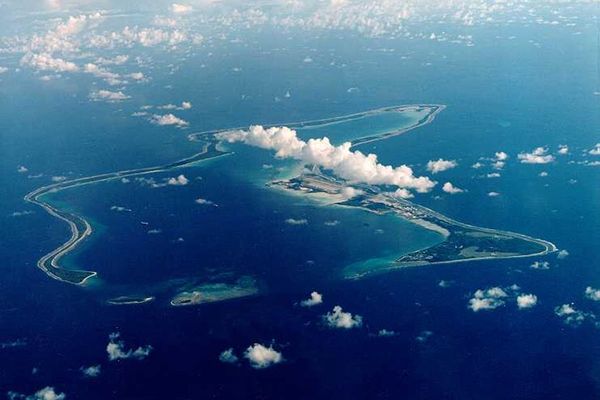
RAF Akrotiri in Cyprus is at the sharp end of the British military presence in the eastern Mediterranean. Rumour is rife on the island that the installation would be targeted if Russia were to retaliate in the event of US-led military action in Syria.
At last count, Britain’s main forward mounting base for overseas operations in the Middle East had eight typhoon and six tornado fighter bombers ready for action.
Summary
Here’s what we know so far:
- Russian foreign minister, Sergei Lavrov, claimed Moscow had “irrefutable” evidence that the suspected chemical weapons attack in Syria was staged with the help of a foreign secret service. He did not provide evidence for the claim. Russia’s ambassador to the UK, Alexander Yakovenko, said the UK-funded White Helmets were behind fake reports about the incident.
- French President Emmanuel Macron has called for more dialogue with Russia in in a phone call with his Russia counterpart Vladimir Putin. “The president of the republic called for dialogue with Russia to be maintained and stepped up to bring peace and stability back to Syria,” a statement from Macron’s office said.
- Russia tested the use of door handles as a way of delivering nerve agents and targeted the email accounts of Sergei Skripal and his daughter Yulia, according to previously classified intelligence over the Salisbury attack.
- Ambassador Yakovenko has demanded proof that Yulia Skripal is alive and well. He announced that Russia is lodging an official challenge to the way the UK investigated the incident and claimed evidence was being destroyed. He denied Russia had produce or stored novichok or tracked the Skripals but said he not seen the UK’s latest dossier.
- Labour leader Jeremy Corbyn has accused the government of “waiting for instructions” from Donald Trump adding that military intervention risks “escalating an already devastating conflict”. He also called for a UN-led investigation of the chemical weapons attack in Douma.
- There are growing calls for the government to give MPs a vote before launching any military intervention in Syria. Labour is actively exploring ways to bring a debate on any military action to parliament, but will have difficulty forcing a Commons vote.
Summary
Donald Trump has been tweeting today but so far not about Syria. The target for his insults today is the former FBI director James Comey.
James Comey is a proven LEAKER & LIAR. Virtually everyone in Washington thought he should be fired for the terrible job he did-until he was, in fact, fired. He leaked CLASSIFIED information, for which he should be prosecuted. He lied to Congress under OATH. He is a weak and.....
— Donald J. Trump (@realDonaldTrump) April 13, 2018
....untruthful slime ball who was, as time has proven, a terrible Director of the FBI. His handling of the Crooked Hillary Clinton case, and the events surrounding it, will go down as one of the worst “botch jobs” of history. It was my great honor to fire James Comey!
— Donald J. Trump (@realDonaldTrump) April 13, 2018
Ambassador Yakovenko says Russia was not tracking Sergei Skripal in the UK. “We want to know what happened in this country, because Russia was blamed. We want to know the truth,” he said.
If Yulia Skripal claims political asylum in the UK that’s a decision for her, he said. “We want to hear her story. We want to have a fully-fledged investigation. Theresa May has said Russia was behind this. We want to see the evidence,” Yakovenko said.
“We didn’t produce novichok. We never had it. We never stored it in the army,” Yakovenko added.
He added that Russia will send an official request today to the UK challenging its inspection into the Salisbury incident.

Updated
Yakovenko says he is not aware of any conversations between Putin and Trump since last week’s suspected chemical attack. But he confirms that Putin has not spoken to Theresa May about the incident.
Asked more about the claim the Douma attack was staged, Yakovenko denies he was implying British special forces were involved in such an operation.
He says the White Helmets were responsible for the “fake” report.
On UK claims that Russia had been spying on the Skripals for five year, Yakovenko chuckles. “They always complain when something goes wrong,” he said.
Yakovenko is also about the UK’s claim that Russia tested nerve agent on door handles before the Skripal attack. He said the UK has not shared those concerns with Russia. “I didn’t see this, because I was preparing for this press conference,” he said.
On Salisbury Yakovenko disputes the UK claim that the OPCW backed the UK’s analysis of the poisoning. The OPCW never confirmed where the nerve agent involved was manufactured. “The report is saying nothing about that,” he said.
“All the statements made by Boris Johnson and other people are not correct,” he said. “The report never supported the British version,” he said.
Asked why Russia is backing a suspected war criminal in Syria, Yakovenko says Assad was democratically elected and the only legitimate leader in Syria.
On Russia’s veto of a UN investigation into the Douma attack, he said the US were proposing an old way of investigating which would not have involved visiting the site of the suspected attack.
The planned OPCW inspection is “exactly what we wanted”, Yakovenko said.
Yakovenko says Russia will publish its own report into the Salisbury nerve agent attack.
He says Russia is currently studying the OPCW full unpublished report into the incident. He refuses to say whether the “quite thick” full OPCW report mentions the nerve agent novichok.
The British side are not transparent, Yakovenko claims and suggests the UK is flouting international law over the investigation into the poisoning.
Yakovenko demands “proof” that Yulia Skripal is safe. He questions why there have been no photographs of the Skripals or interviews with them since the incident. “What is happening in this country, if the press is supposed to be free?” he asks.
Yakovenko claims the UK-funded White Helmets are “famous for staging attacks” in Syria.
"Russian services... visited the site in Douma and didn't find any traces of chemical substances there, or traces of chemical poisoning" - Russian ambassador to UK on suspected chemical attack in Syriahttps://t.co/uY4ua5mkro pic.twitter.com/0c8ZliRpdv
— BBC News (UK) (@BBCNews) April 13, 2018
Macron calls for more dialogue with Russia
French President Emmanuel Macron has raised concerns about the deterioration of the situation in Syria in a phone call with his Russia counterpart Vladimir Putin. He also called for more dialogue with Moscow, his office said.
Macron, who claims France has proof the Syrian regime used chemical weapons in an attack last week, also expressed regret at Russia’s use of its United Nations Security Council veto on the attack.
“The president of the republic called for dialogue with Russia to be maintained and stepped up to bring peace and stability back to Syria,” a statement from Macron’s office said.
Yakovenko pointed out, at his continuing press conference in London, that France has provided no evidence of proof that Syria was behind the Douma attack.

Yakovenko taunted western allies considering military action by playing clips of Tony Blair before and after Iraq war.
In a statement, the embassy said: “The infamous aggression against Iraq in 2003 immediately comes to mind, when the then Prime Minister Tony Blair deliberately misinformed the Parliament and the public. It is well known how it ended – with Chilcot inquiry delivering a condemnatory verdict.”
On Syria, Yakovenko says Russia has been warning for weeks of the possibility of a staged chemical attack by Syrian rebels. He alleges that the Western-backed White Helmets could have been behind staging the incident.
He welcomes the fact-finding mission by the OPCW which is due to start tomorrow. He claims any delay could be used by the west to deliver military strikes to destroy evidence.
Yakovenko accuses the UK and France of “mechanically” following America’s lead on Syria.
Updated
Russia’s UK ambassador Alexander Yakovenko is giving a press conference in London.
He complains that the UK has refused consular access to Yulia Skripal after she was discharged from hospital. He claims the UK government is deliberately destroying all evidence on the Salisbury incident.
He claims a letter to Boris Johnson about the Skripals has remained unanswered.
Russia tested nerve agent on door handles before Skripal attack
Russia tested the use of door handles as a way of delivering nerve agents and targeted the email accounts of Sergei Skripal and his daughter Yulia since at least 2013, according to previously classified intelligence over the Salisbury attack made public by the UK on Friday.
The UK is making public previously classified intelligence linking Russia to the attack on the Russian double-agent, including claims that Moscow had tested the use of door handles as a way of delivering nerve agents and that Russian military intelligence had targeted the email accounts of both victims since at least 2013.
The claims were made in a letter from Sir Mark Sedwill, the UK’s national security adviser, to the Nato secretary general, Jens Stoltenberg. It is extremely rare for the UK to make such intelligence public.
In the letter, Sedwill, who has an overview of the work of all the UK spy services, filled in some of the intelligence that Theresa May referred to when she made a House of Commons statement saying Russia was “highly likely” to have been behind the attack.
Russia claims Douma attack 'staged'
In that news conference Russian foreign minister, Sergei Lavrov, claimed Moscow had “irrefutable” evidence that the suspected chemical weapons attack in Syria was staged with the help of a foreign secret service, AFP reports.
“We have irrefutable evidence that this was another staged event, and that the secret services of a certain state that is now at the forefront of a Russophobic campaign was involved in this staged event,” he said during a press conference.
He did not provide evidence for the claim.
According to Syrian medics and a statement by the World Health Organisation, more than 40 people died in an 7 April strike on the former rebel outpost of Douma of symptoms consistent with the use of chemical weapons.
The US and its allies believe the Syrian regime was behind the attack, but Russia has long insisted it was staged by rebels in an attempt to provoke further Western intervention.
Russia’s embassy in the UK says it concerned by reports that the cabinet has agreed to take action against Syria.
In a statement it said any airstrikes could hamper the OPCW’s investigation into the possible use of chemical weapons in Douma.
It said:
“At the request of the Syrian Government the OPCW sent a fact-finding team to Douma. The experts will arrive tomorrow. Syrian authorities will provide all the relevant security guarantees. Russia is ready to assist in ensuring its safety. We are interested in seeing independent experts there, so they can make all the necessary tests without delay.
The conditions on the ground, now that the Russian military police is present in Douma, are appropriate for conducting investigation of the alleged incident.
Russian services for chemical and radiological security visited the suspected site of the incident and did not find any traces of chemical substances. No persons treated for chemical poisoning were found in local hospitals ...
UK statements in favour of an independent investigation clearly contradict those automatically laying the blame on the Syrian government.
Military strikes may be used to cover up all the evidence, or lack thereof, on the ground. Such a decision, if it’s taken, in violation of the international law and the Charter of the United Nations may well mark the latest in the series of the reckless military adventures by the UK ...
It’s essential to avoid any steps which could escalate the tensions.
Donald Trump and Theresa May last night discussed the need for a joint response to Syria’s use of chemical weapons, according to Woody Johnson, the US ambassador to London.
In a tweet Johnson suggested that any US-led action in Syria would be coordinated with the UK.
Last night President Trump & Prime Minister May spoke on the need for a joint response to Syria's use of chemical weapons. We will continue to coordinate with our #1 Ally. pic.twitter.com/P1zm1mYCr8
— Ambassador Johnson (@USAmbUK) April 13, 2018
Isamael Abdulla, a 31-year-old resident of western Aleppo, says he is constantly monitoring Donald Trump’s Twitter feed.
I’m waiting for his most powerful tweet yet in which declares war against Bashar Al-Assad. The problem with the Syrian crisis is the international community’s hesitation. It has refused to halt the killing machine of the Syrian regime and its deadly supporters in Russia and Iran.
I’m worried that his tweets are merely negotiating tactics.
We are fed up of US red lines that turned to be traffic light warnings. Maybe Trump is waiting for other powers to back his decision, but last time when he attacked Shayrat with 60 missile, he did not wait for any international endorsement.
The US administration and the UN only get upset only when there is a chemical attack, as if other sorts of weapons used to kill people are alright. This daily killing should be stopped as soon as possible.
The only solution for the Syrian problem is a unified world repsonse to disband the foreign support to Bashar and back the Syrian people who have become refugees all over the world.
I support an attack that can change the Syrian regime without causing great loss among civilians. If Bashar stays in power, we will witness more massacres in the future.
Updated

Russia’s foreign minister, Sergei Lavrov, has said he hoped that there would be no repeat of the experience of Libya and Iraq in the Syria conflict.
“God forbid anything adventurous will be done in Syria following the Libyan and Iraqi experience,” Lavrov told a news conference on Friday, Reuters reports.
He said that even the smallest miscalculation in Syria could lead to new waves of migrants and that ultimatums and threats do not help the dialogue.
Russia and the United States are using their channels of communications on Syria, according to the minister.
Lavrov also questioned the UK claims that the OPCW report into the Salisbury poisoning confirmed its analysis of the incident. He said this was an “overstated” interpretation of the OPCW’s report.
The Labour leader has asked for a security briefing - on privy council terms - on Syria, but it is understood no response has been received from Number 10.
Labour are also actively exploring ways to bring a debate on any military action to parliament, but will have difficulty forcing a Commons vote. The party does not have any scheduled opposition debates next week.
It could potentially force an SO24 emergency topical debate - a technical procedure which would allow the House to vote on whether there should be a vote to authorise military action.
But the vote would not be binding on the government, which has shown over the past six months it is minded to abstain and effectively ignore opposition motions.
Updated
Russia’s foreign ministry spokeswoman Maria Zakharova has told Sky News it will protect its people on the ground in Syria if missiles are launched by the US and its allies.
She said: “Russia should protect its people on the ground, of course. We came to Syria at the invitation of the people. You can see their appreciation on the ground.”
Zakharova also criticised Donald Trump warning in a tweet that Russia should “get ready” because missiles “will be coming, new and new and ‘smart’”.
She said:
“I was surprised that such strong messages were sent through social media because this should be a time to phone your partner ... We can resolve all these problems by picking up the phone, not by force.”
Bassam Abu Abdullah, an advisor to Syrian Ministry of Information, has again denied that the Syrian army attacked civilians with chemical weapon.
Speaking to BBC News he said: “We didn’t use and we will not use any kind of chemical weapons because we don’t have these kind of chemical weapons after 2013. We joined the international agreement on the prohibition of chemical weapons.”
Abdullah claimed videos appearing to show the aftermath of the suspected attack on Douma were “fabricated”.
He said: “The source of these films said that 10 people died and 600 were injured. Where are these people? Can you show us them? What are their names? Nothing.”
“We are ready to receive the investigators from the OPCW and show them anything they want. We have nothing to cover.”
On the threat of US-led military strikes he said:
“We are not ready to give any opportunity for the US, France or Britain to attack us. We are defending ourselves. We are not attacking British interests. We are not a threat to the national security of the US or France or Britain. This is our right to defend our state. We are combatting terrorists, we are not combatting democratic people. Who left Eastern Gouta? They are terrorists from Jaish al-Islam the Wahhabi movement.”

Thousands of Islamist fighters and their relatives left Douma as the last evacuations from Eastern Ghouta continued, AFP reports citing the UK-based Syrian Observatory for Human Rights (SOHR).
The fighters from the Jaish al-Islam group left overnight with thousands of civilians on board 85 buses that took them to areas of northern Syria still held by rebels.
The evacuations are part of a deal brokered by Damascus’s Russian ally to re-establish regime control on Eastern Ghouta, a area just on the edge of the capital that had escaped government control since 2012.
“After midnight, 85 buses left Eastern Ghouta carrying 4,000 people, both fighters and civilians,” the SOHR.
“Over the past few days, most of the Jaish al-Islam fighters have left Douma in four successive waves,” the Britain-based monitor’s head, Rami Abdel Rahman, said.
The group was the last in the erstwhile besieged Ghouta enclave to resist the exit proposed by Russia but an alleged chemical attack by the regime on 7 April appeared to break their will.
The government has consistently denied the attack and a delegation of experts from the OPCW chemical watchdog arrived in Damascus to investigate.
They are expected to start their work on Saturday.
“The evacuation operation should wrap up before the OPCW experts enter Douma,” Abdel Rahman said.
Russia’s deputy prime minister Arkady Dvorkovich has said international relations should not depend on the mood of one person when he wakes up in the morning, according Russian news agency reports cited by Reuters.
In an early-morning tweet on Wednesday, Trump warned that missiles “will be coming” in response to an alleged chemical weapons attack by Syrian government forces. Russia is Syria’s most important military ally in the country’s civil war.
“We cannot depend on the mood of someone on the other side of the ocean when he wakes up, on what a specific person takes into his head in the morning,” Dvorkovich said at a forum in Krasnoyarsk, according to the Tass news agency.
“We cannot take such risks.”
In another tweet on Thursday, Trump appeared to cast doubt on at least the timing of any US-led military action. “Never said when an attack on Syria would take place. Could be very soon or not so soon at all!” it said.
Trump usually starts tweeting in the next hour or so.

Lebanon’s Iran-backed Hezbollah does not believe the latest Syria crisis will spiral into a wider war, its deputy leader has said, Reuters reports.
The heavily armed Shia Hezbollah movement has been a vital military ally of Syrian President Bashar al-Assad in the seven-year war.
“We rule out the situation developing into a direct American-Russian clash or a wide state of war,” Sheikh Naim Qassem told Lebanese daily al-Joumhouria in an interview.
“The conditions do not point to a total war happening ... unless (U.S. President Donald) Trump and (Israeli Prime Minister Benjamin) Netanyahu completely lose their minds,” he said.

Turkey’s president Recep Tayyip Erdogăn has warned Russia and the US against treating the Syrian conflict as a proxy war.
“No one has the right to engulf the Mediterranean and the Syrian lands in the fire of their political and military power struggles,” he said at speech in Ankara.
Erdogăn has discussed his concerns about Syria in separate phone calls with both Donald Trump and Vladimir Putin in the last 48 hours.
In his speech he said: “We are extremely uncomfortable about the fact that some countries who have confidence on their military power are using Syria as their arm-wrestling field.”
He claimed that the international community had used the fight against Islamic state (or Daesh) to support Kurdish separatists.
He said: “We see even a single terrorist, whether it be from Daesh or PYD (the Kurdish Democratic Union Party) or under any other name, along our borders as a threat to us and consider it a condition for our survival to do what is necessary.”
“Our relations with Russia, Iran and China are complementary to our relations with the West, not an alternative. Yet, this is not an obstacle to us expressing the wrongs of the two sides in other fields. Those who support the murderous Assad regime are wrong. Those who support the PYD terror are wrong. We will fight against both of these wrongs to the end.”
Updated
France’s foreign ministry has produced a video, translated into English, setting out why it thinks France has a duty to react to the use of chemical weapons in Syria. It also repeats President Emmanuel Macron’s claim in a TV interview on Thursday that France has proof that the Assad regime used chemical weapons in Douma.
Douma, #Syria: we have a duty to react. pic.twitter.com/mVMJMozxVj
— France Diplomacy🇫🇷 (@francediplo_EN) April 13, 2018
Such simple and short videos, tailored for social media, are all the rage in modern diplomacy. Here’s the Foreign Office’s take on the OPCW’s report into the poisoning of Russian double agent Sergei Skripal and his daughter Yulia.
The OPCW has completed its independent analysis of the chemical substance used in the Salisbury attack. The report confirms the UK’s findings. pic.twitter.com/4JAGJjJcYt
— Foreign Office 🇬🇧 (@foreignoffice) April 12, 2018
How has the Assad-Iran-Russia coalition adjusted its military posture following Assad's CW attack? See the NEW #map update: https://t.co/zZHw2VkgoJ #Syria #Russia #Iran pic.twitter.com/C2YAuykTxr
— ISW (@TheStudyofWar) April 12, 2018
The US thinktank the Institute for the Study of War has been tracking reports of military movements of Russia and Syria since last weekend’s chemical attack on Douma.
It has this summary:
Two Russian Su-24M ‘Fencer’ attack aircraft conducted several low-altitude passes in close proximity to the USS Donald Cook and the French frigate Aquitaine in the Eastern Mediterranean Sea on April 11. The Russian Navy conducted a firing drilloff the Syrian coast in a likely attempt to deter U.S. and allied naval maneuvers near Syria on April 11.
Russia reportedly deployed four Tu-95MS ‘Bear’ and Tu-160M ‘Blackjack’ strategic bombers as well as an unspecified number of Il-78M tanker aircraft from the Engels Air Base in Southern Russia. Their final destination is unknown although they may be bound for Syria or theHamedan Air Basein Western Iran. Russia previously targeted locations in Eastern Syria from the Engels Air Base.
Russian and regime forces enhanced the air defenses around Syria’s capital, Damascus, where the regime conducted its chemical weapons attack on April 7. Pro-regime forces deployed short- to medium-range surface-to-air missiles, including six Russian Pantsir-S2s, to theMezzeh Military Air Baseand other sites in Damascus. Pro-regime officials also reportedly issued an alert to the Syrian Arab Army to evacuate personnel and assets from military bases across Syria.
Regime and Russian aircraft relocatedcloser to heavily-defended commercial airfields across Syria. Aircraft relocated from the Seen (Sayqal), Dumayr, Shayrat, and the T-4 (Tiyas) Air Bases to the Bassel al Assad International Airport in Latakia Province, the Nayrab Air Base outside Aleppo City, and the Damascus International Airport.
Iranian proxies, including Lebanese Hezbollah, reportedly began exiting Syria. Hezbollah reportedly relocated a number of fighters from Syria into Lebanon. Hezbollah and other Iranian proxies reportedly also entered Iraq from positions along the Syria-Iraq border, including Abu Kamal in Eastern Syria.
Unspecified pro-regime elements reportedly evacuated a branch of the Syrian Scientific Studies and Research Center (SSRC) in Jamraya near Damascus. The SSRC is a Syrian government body responsible for research and development on advanced weapons systems, including ballistic missiles and chemical weapons.
Russia’s Black Sea fleet is in closer proximity to the Syrian coast than US forces amid reports that the fleet has been on a heightened level of alert since at least mid-March, writes Peter Beaumont.

The shadow home secretary, Diane Abbott, has struggled to defend Labour’s call for a UN-led inspection into the Douma attack.
Asked on the BBC Radio 4’s Today programme whether Labour would back intervention if the Organisation for the Prevention of Chemical Weapons confirms chemical weapons had been used she said: “Let’s see what the inspectors come up with. Even in the US there is an understanding that we don’t have all the evidence.”
When it was pointed out that Russia had repeatedly vetoed calls for a UN-led investigation into the use of chemical weapons in Syria, Abbott said: “There has to be a political negotiation. We would press on trying to bring people to the table. We believe more bombing is not the answer to the crisis in Syria.”
“There is a response which falls short of more bombing. We believe there needs to be a coordinated international drive to achieve a ceasefire and a negotiated political settlement.”
Asked about the circumstances in which Labour would support military action, Abbott cited the Second World War. But she repeatedly refused to say what circumstances she would back military action now.
“There is no evidence to show that further bombing in Syria will make the region more stable,” she said.
She was also asked which country posed the biggest threat to world peace: Russia or the US. After trying to avoid the question she eventually said: “It is clear that at this point Russia, its role in Syria, what we believe beyond reasonable doubt its role in the poison gas attack in Salisbury, is a greater threat to world peace than the United States.”
Updated

A split in the shadow cabinet over military action in Syria has emerged.
Shadow International Development Secretary Kate Osamor told the House magazine that “intervention must take place” if the UN concludes the Syrian government was behind the alleged atrocity.
Politics Home reports her saying: “If a leader is killing their own they need to be removed. We don’t keep them there. They need to go. He needs to be removed.
“Intervention must take place if evidence comes back that the PM or the president or whoever the leader is, is gassing his own people. Get them out.
“If a leader is killing their own they need to be removed. We don’t keep them there. They need to go. He needs to be removed.”
“But I suppose what we’ve seen is it’s not as easy as that. And I think that’s where Jeremy’s position comes from. It’s not as easy as just removing someone.”
Update: Osamar has since clarified her remarks to claim she is not advocating military action in Syria.
My clarification on tonight's media reports. pic.twitter.com/pomFGpE6M8
— Kate Osamor (@KateOsamor) April 12, 2018
Updated
There are growing calls for the government to give parliament a vote before launching any military intervention in Syria.
A Downing Street statement issued after Thursday’s cabinet meeting made no reference to whether MPs should be given a say.
Liberal Democrat leader Sir Vince Cable and Ian Blackford, leader of the SNP in Westminster have both urged May to give MPs a vote.
Ken Clarke, former chancellor and father of the House of Commons, said parliament should be recalled this weekend. “You don’t just waive aside accountability to parliament because it is inconvenient. Saturday or Sunday you could sit,” he told the BBC.
In a letter to May, SNP defence spokesman Stewart McDonald said:
I am not convinced that the retaliatory airstrikes being proposed by the United States is a proper way forward. Though should the UK government wish to participate then it must only do so if the UK parliament gives its consent. This is a view shared by a cross-party group of MPs who have signed EDM 92 to that effect, and a number of your own colleagues who have put forward this view in the media these past few days.
Despite Donald Trump’s slightly more circumspect rhetoric over Syria on Thursday it is hard to escape the drum beat for military intervention.
The Times claims the largest US air and naval strike force since the 2003 Iraq war is heading towards Syria.
Tomorrow's front page: Biggest task force since Iraq on course for Syria #tomorrowspapertoday pic.twitter.com/jeZBmfzu6B
— The Times of London (@thetimes) April 12, 2018
Last night the UK cabinet unanimously backed Theresa May’s warning that Syria’s use of chemical weapons could not go unchallenged, leaving the way open for British participation in military action.
Downing Street said senior ministers had agreed it was highly likely the Syrian government was responsible for the “shocking and barbaric” gas attack on the rebel-held town of Douma, which killed up to 75 people.
Labour leader Jeremy Corbyn has accused the government of “waiting for instructions” from Donald Trump adding that military intervention risks “escalating an already devastating conflict”.
In a statement issue early on Friday morning he called for a UN-led investigation of the chemical weapons attack in Douma.
Corbyn added:
“Further UK military intervention in Syria’s appalling multi-sided war risks escalating an already devastating conflict.
“The Government appears to be waiting for instructions from President Donald Trump on how to proceed. But the US administration is giving alarmingly contradictory signals.
“Even US defence secretary James Mattis has said we ‘don’t have evidence’ and warned further military action could ‘escalate out of control’.”
Meanwhile, Russia has been granted a request for the United Nations Security Council to meet on Friday for fresh discussions on the threat to international peace from air strikes on Syria.
And a team from the Organisation for the Prohibition of Chemical Weapons is due to start its investigation in Syria on Saturday.
On Friday campaigners from the Stop the War Coalition will hand in a letter signed by MPs, trade unionists, celebrities and academics to Downing Street urging May to not take military action in Syria.