The last thing Diaa, 24, remembered was the growl of an aircraft above his village in Deraa, Syria, the target of a brutal regime offensive against the rebels. He and an employee had gone outside their shop to take a look. The ground was suddenly ripped from beneath their feet.
The medics in the poorly-equipped field hospital could do little to help the Syrian shopkeeper whose face had been torn open by the missile that struck the village. His legs and arm had also been broken.
Diaa said he would have died had he not been hospitalised in neighbouring Israel, a country that is the sworn enemy of his home nation.
For me it was the end of the world. I lost hope, the field hospital could do nothing for me, they had no capability to do surgery
“They tried to move me to a hospital in Jordan but I was told the border was closed and you cannot pass. For me it was the end of the world. I lost hope, the field hospital could do nothing for me, they had no capability to do surgery,” he told The Independent.
Diaa spoke in the presence of a member of the Israeli army at Galilee Medical Centre, in northern Israel, where he has undergone two operations to his eye, and a reconstruction procedure to his face.
The hospital is currently treating 43 Syrians, some for as long as six months. It has administered care to a steady stream of the wounded over the last five years.
“One guy offered to help send me to Israel, thank god they did treat me,” Diaa added.
Mohammed, 21, who also fled Deraa and was being treated in the same hospital, said he too was refused access to Jordan, whose border was the closest to the Deraa fighting.
“The only place we had was the Jordanian border to run to, and they closed it on our faces."
Both Diaa and Mohammed are among a growing number of Syrians who fled fighting in the southern Syrian province and have found themselves depending on Israel, a historical foe. Some even talked of wanting to relocate to Israel, in one of the strangest developments of the seven-year conflict.
The only place we had was the Jordanian border to run to, and they closed it on our faces
Since the creation of Israel in 1948 the two countries have been bitter foes and have taken opposing sides in at least three wars, largely over the issue of the Palestinian territories.
Syria, which is home to some 560,000 Palestinian refugees according to the United Nations, has refused to recognise that Israel exists.
The UN has repeatedly called on Jordan to receive some of the estimated 320,000 people displaced in the Deraa offensive. But the country, which is already struggling to host some 650,000 registered Syrian refugees and possibly 600,000 more, has refused so far, citing security and economic pressures.
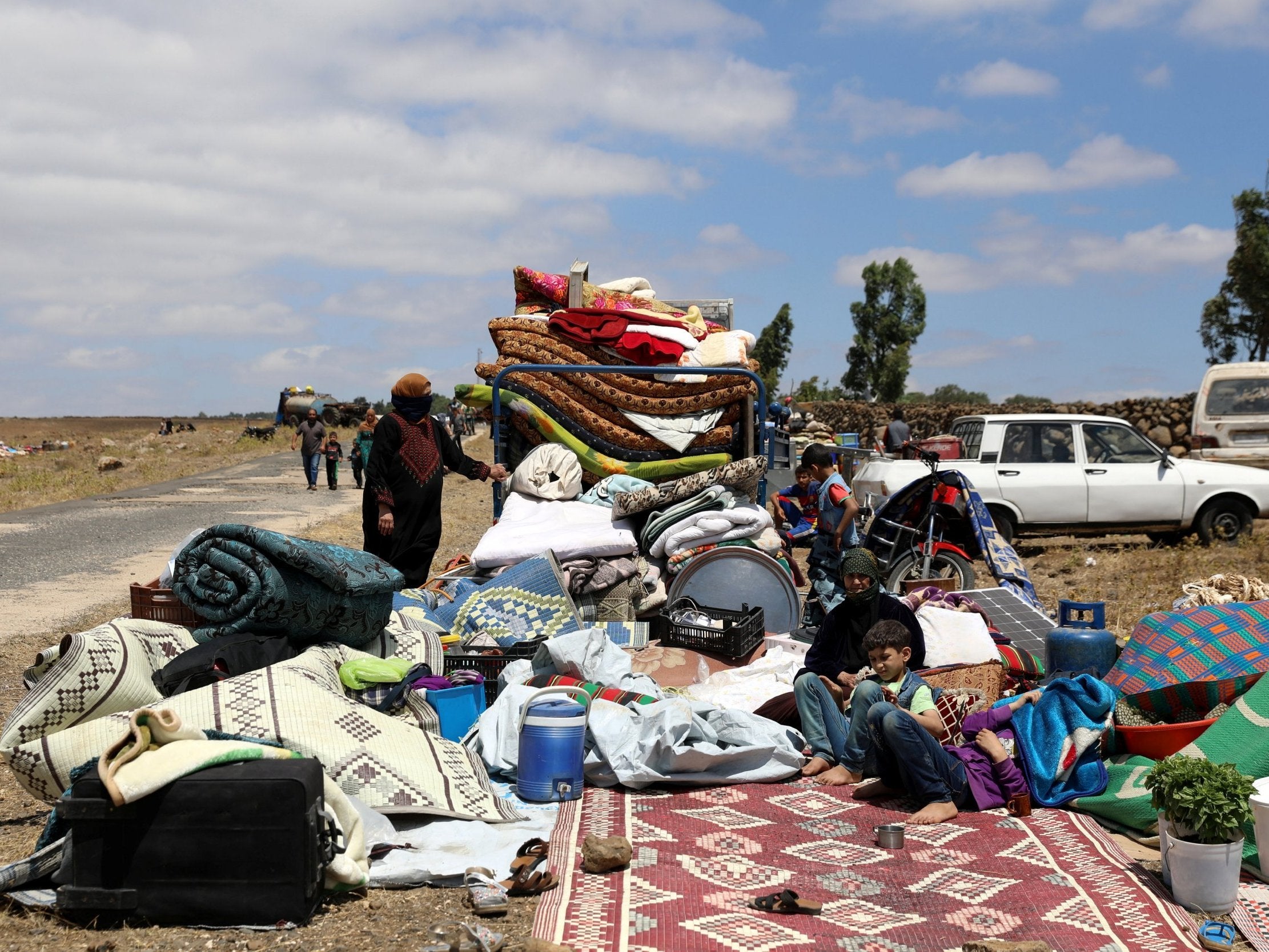
With the Jordanian border closed, tens of thousands of Syrians found themselves taking refuge around the Israeli-occupied Golan Heights that has been demilitarised under a 44-year-old UN-monitored truce between Syria and Israel.
The Israeli military told The Independent it has staged regular humanitarian aid drops and over the two years has delivered more than 1,500 tons of food, nearly a million litres of fuel for heating, as well as 300 tents to the Syrian displaced.
Since 2013, over 4,800 Syrian civilians have also been treated in Israel.
Operation “Good Neighbour”, as it is called, does benefit Israel by helping stabilise the Syrian side of the border. Benjamin Netanyahu, Israel’s prime minister, has taken a firm stance against taking in any refugees. Officials in the hospital where Diaa and Mohammed are being treated said once the wounded are treated they must return to Syria.
Escaping the killing machine of Russia and the militia forces has made us think of allying with what we consider to be the devil
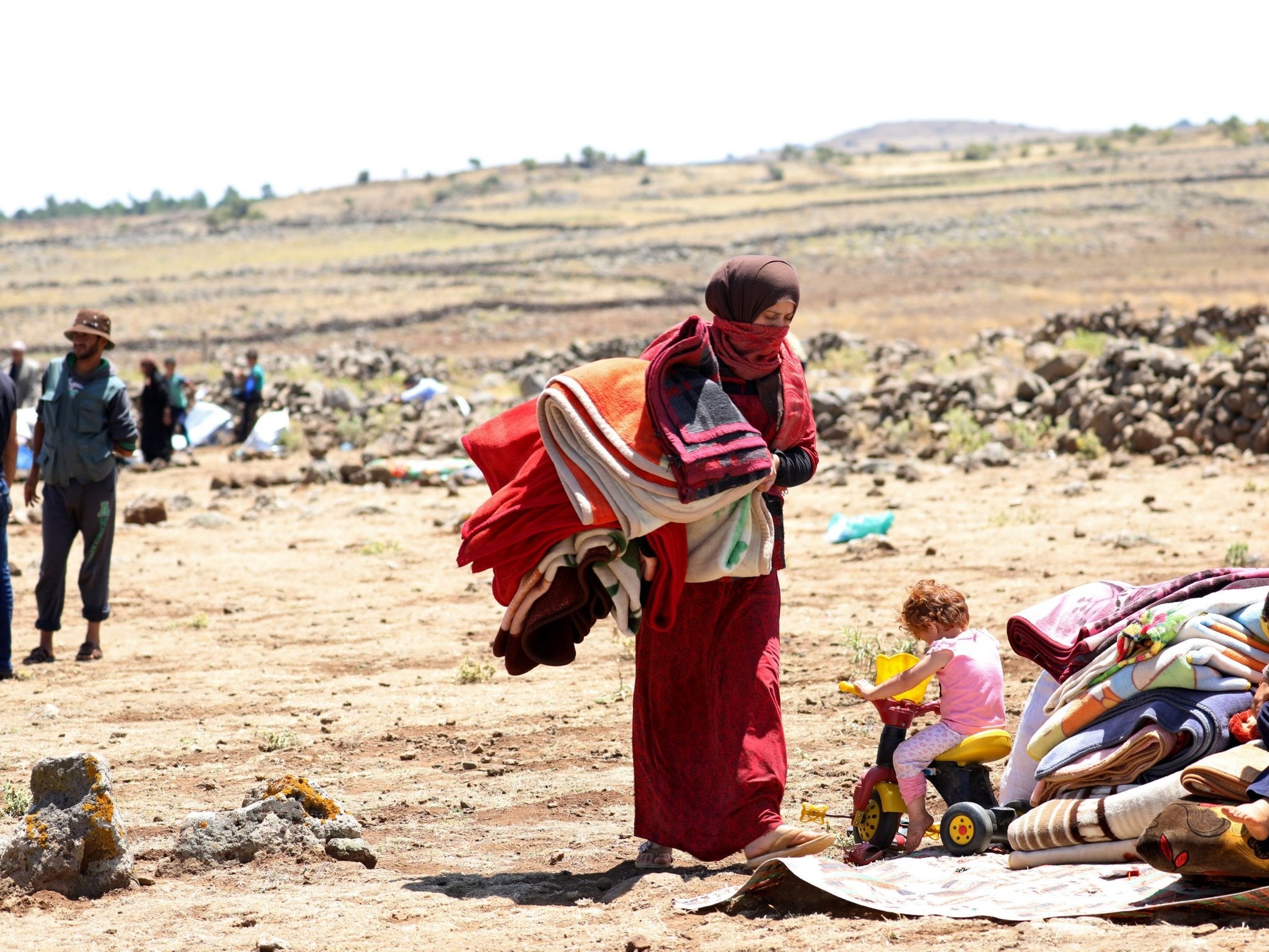
Despite being told there is no place for them in Israel, Syrian families camped close to the Israeli border said if it was permitted, they would consider relocating to Israel, even after decades of fierce hostilities.
“Escaping the killing machine of Russia and the militia forces has made us think of allying with what we consider to be the devil. We all think about going to Israel but it is not allowed. Everyone is trying to escape death because the Jordanian border is blocked,” said Ammar, 27 a father-of-two who is in Rafid, on the border.
"It’s strange for us that Israel is more humanitarian than our Arab brothers. I once even heard people saying they hope that Israel would include this area in the Golan,” he added.
Huda, 42, an agricultural engineer and another displaced Syrian in the same area, agreed. She described families living 10 to a single tent, which are sold for a crippling $400. There is no water or sewer systems, and in the summer months they are battling insects, snakes and scorpions.
“It’s prohibited to go into Israel. But whenever it’s allowed we would definitely go in,” she said.
Backed by Russia, Syrian government troops have seized most of Deraa province, the cradle of the Arab Spring uprising, in a bloody campaign dubbed the final showdown against the rebels.
On Thursday, for the first time in years, regime forces entered Deraa city and raised the national flag, according to witnesses. At the same time senior Russian military delegation reportedly entered the rebel-held area of the city and began negotiations over its handover to state rule.
At the height of the Deraa offensive, the UN said more than 320,000 people were displaced.
On Thursday the World Health Organisation called for immediate access to 210,000 of them in the southern region saying they were in urgent need of health services. The UN agency said at least 15 Syrians, including 12 children, have died in the past week due to dehydration and disease linked to contaminated water.
Oxfam on the same day renewed calls for Jordan to open its borders, saying there are still thousands of displaced from Deraa that are out of reach of humanitarian aid.
Moutaz Adham, Oxfam’s country director in Syria, said: “Their struggles will get worse unless they receive the water, food and medical care they urgently need.”
Their struggles will get worse unless they receive the water, food and medical care they urgently need
Deraa rebels last week agreed to a ceasefire brokered by Russia but it is unclear how long the shaky truce will hold. Several thousand families reportedly decided to go back home as the fighting died down.
But many camped on the Israeli border told The Independent they are staying put as they feel safe and fear another outbreak of violence.
With a burgeoning humanitarian crisis and the war on its doorstep, Israel has become increasingly involved in the Syrian conflict.
In the early hours of Thursday, the Israeli army said it had attacked Syrian military positions close to its border, in retaliation for an incursion of a Syrian drone which was shot down by a Patriot missile over northern Israel.
Israel is also concerned its staunch enemy Iran is building permanent military infrastructure in Syria since intervening on behalf of Syrian President Bashar al Assad in 2013. In May, Iranian forces fired 20 rockets into the occupied Golan. Israel responded with dozens of airstrikes across 70 targets in Syria.
Mr Netanyahu, who is currently in Moscow, told Russian officials that Israel would not seek to topple Assad but urged them to encourage Iranian forces to quit Syria, according to a senior Israeli official.
The official, who spoke to Reuters, said the Israeli leader came away reassured that "they [Russia] are getting the Iranians out”.
David Keyes, a Netanyahu spokesman, has since denied that the prime minister made that statement to Mr Putin.
Back at the Galilee Medical Centre, Israeli hospital officials acknowledged the strange position they are in.
“We are giving care to people who consider us to be their enemy. There were ones who didn’t stay here for the recommended treatment, because they didn’t want to be here any longer,” said Sharon Mann, the hospital’s liaison officer for international affairs.
“But in Syria they are talking quietly about us.”