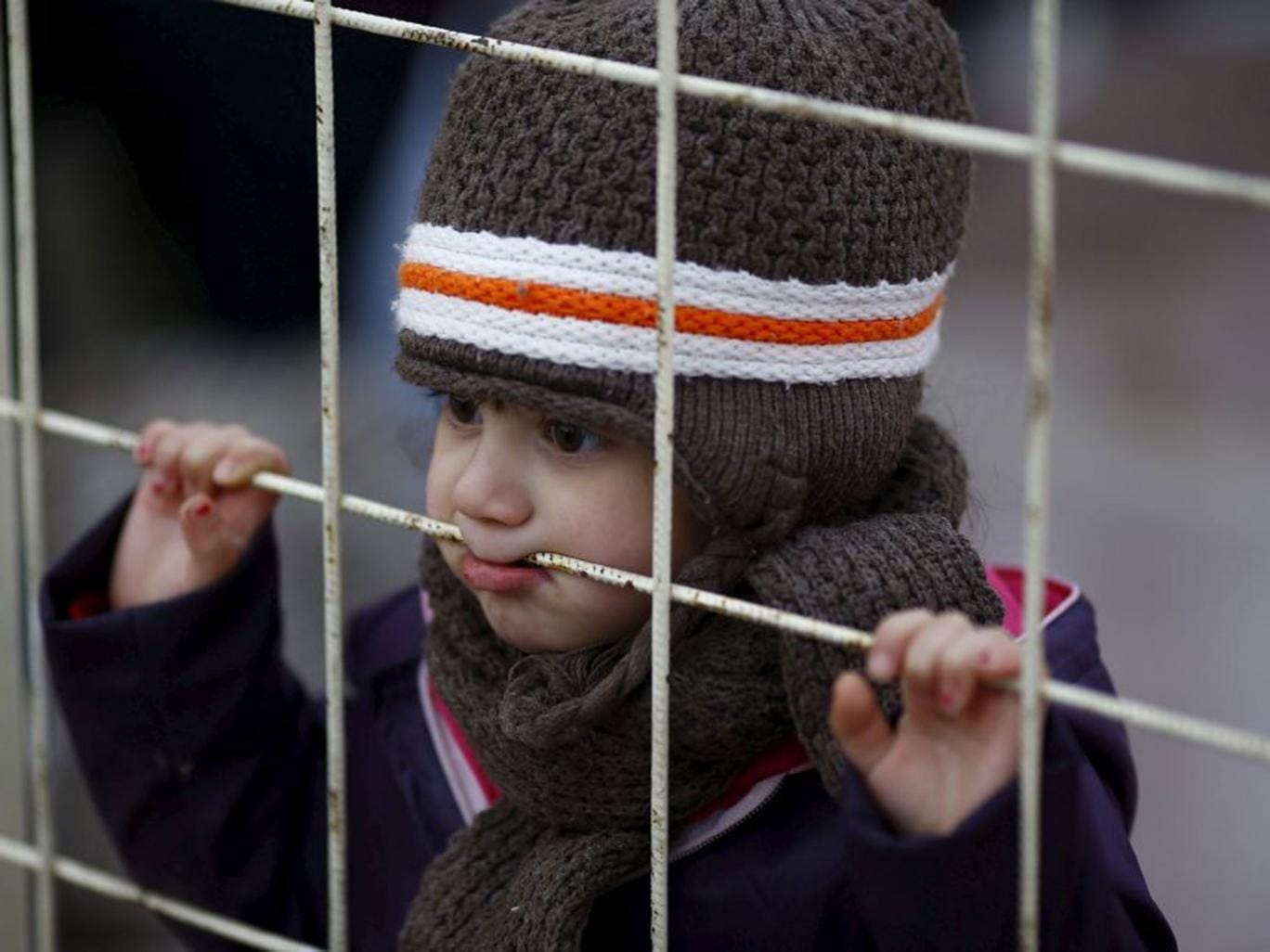
The people of Syria have been handed a glimmer of hope after world powers agrred to seek a nationawide “cessation of hostilities” within a week.
US Secretary of State John Kerry told reporters in Munich that Syrian peace negotiations should resume in Geneva as soon as possible. He said that the cessation in hostilities would not include Western operations against Isis and other miliant groups fighting in Syria.
Mr Kerry said the ceasefire plan was ambitious” and said the real test would be whether the parties honoured the commitments.
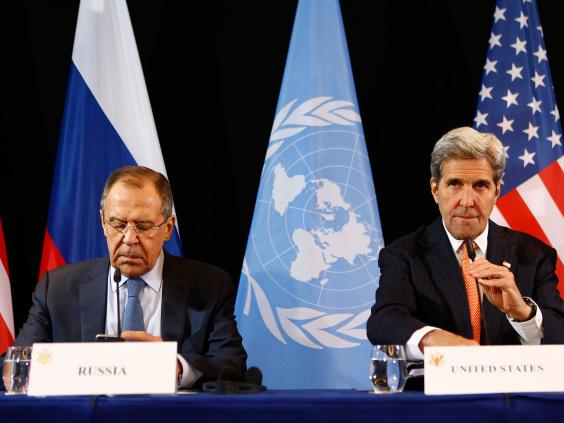
America's top diplomat, flanked by Russian Foreign Minister Sergei Lavrov and UN envoy Staffan de Mistura, acknowledged that the meeting produced commitments on paper only. He and Mr Lavrov agreed that the “real test” will be whether all parties to the Syrian conflict honor those commitments.
“What we have here are words on paper, what we need to see in the next few days are actions on the ground,” he said.
A UN task force will be set up to ensure humanitarian access is granted to all sides, Mr Kerry added. He also said the powers had agreed to immediately accelerate and expand the delivery of humanitarian aid.
Mr Lavrov said there were “reasons to hope we have done a great job today”.
British Foreign Secretary Philip Hammond said a cessation of hostilities in Syria could only succeed if Russia stops air strikes supporting Syrian government forces' advance against the opposition.
“If implemented fully and properly... , this (deal) will be an important step towards relieving the killing and suffering in Syria,” Mr Hammond said in a statement.
“But it will only succeed if there is a major change of behaviour by the Syrian regime and its supporters. Russia, in particular, claims to be attacking terrorist groups and yet consistently bombs non-extremist groups including civilians. If this agreement is to work, this bombing will have to stop: no cessation of hostilities will last if moderate opposition groups continue to be targeted.”
The announcement comes as the Syrian army, backed by Russian air strikes, made further advances in Aleppo province. The move threatens to encircle tens of thousands of civilians in rebel-held parts of the major city of Aleppo.
At the press conference Mr Kerry again suggested that Russian strikes were targeting opposition forces, rather than mililiants, as Moscow says.
One Western diplomatic source told Reuters: "We did not get a deal on the immediate end of Russian bombings, but we have a commitment to a process that if it works would change the situation.”
Russian Prime Minister Dmitry Medvedev on Thursday raised the spectre of an interminable conflict or even a world war if powers failed to negotiate an end to the fighting in Syria, which has killed 250,000 people, caused a refugee crisis and empowered Islamic State militants.
The first peace talks in two years between belligerents in Syria collapsed last week before they began in the face an the offensive by President Bashar al-Assad's forces, one of the biggest and most consequential of the five-year war.
As Mr Kerry met with the Syria group in Munich, US Defence Secretary Ash Carter was in Brussels to rally fresh support for the fight against the Islamic State group in largely the same territory.
Mr Carter said defense ministers from more than two dozen countries gave a “broad endorsement” of a refined US plan for defeating Isis. After a meeting at NATO headquarters, Mr Carter told reporters that nearly all participants either promised new military commitments or said their governments would consider new contributions. He predicted “tangible gains” in Iraq and Syria by March.
“We will all look back after victory and remember who participated in the fight,” he said, appealing to coalition partners to expand and deepen their military contributions.
Statement of the International Syria Support Group:
Meeting in Munich on February 11 & 12, 2016, as the
International Syria Support Group (ISSG), the Arab League,
China, Egypt, the EU, France, Germany, Iran, Iraq, Italy,
Jordan, Lebanon, the Organization of Islamic Cooperation, Oman,
Qatar, Russia, Saudi Arabia, Turkey, United Arab Emirates, the
United Kingdom, the United Nations, and the United States
decided that humanitarian access will commence this week to
besieged areas, and an ISSG task force will within one week
elaborate modalities for a nationwide cessation of hostilities.
The ISSG members unanimously committed to immediately
facilitate the full implementation of the UN Security Council
Resolution 2254, adopted unanimously December 18, 2015. The ISSG
reaffirmed their readiness to carry out all commitments set
forth in the resolution, including to: ensure a Syrian-led and
Syrian-owned political transition based on the Geneva Communiqué
in its entirety; press for the end of any indiscriminate use of
weapons; support and accelerate the agreement and implementation
of a nationwide ceasefire; facilitate immediate humanitarian
access to besieged and hard-to-reach areas and the release of
any arbitrarily detained persons; and fight terrorism.
Ensuring Humanitarian Access
In order to accelerate the urgent delivery of humanitarian
aid, sustained delivery of assistance shall begin this week by
air to Deir Ez Zour and simultaneously to Fouah, Kafrayah, the
besieged areas of Rural Damascus, Madaya, Mouadhimiyeh, and Kafr
Batna by land, and continue as long as humanitarian needs
persist. Humanitarian access to these most urgent areas will be
a first step toward full, sustained, and unimpeded access
throughout the country
The members of the ISSG will use their influence with all
parties on the ground to work together, in coordination with the
United Nations, to ensure that all parties allow immediate and
sustained humanitarian access to reach all people in need,
throughout Syria, particularly in all besieged and hard-to-reach
areas, as called for in UNSCR 2254. To this end, the UN will
submit a plan to an ISSG humanitarian task force, which shall
convene on February 12 and next week. This group will comprise
the ISSG co-chairs, relevant UN entities and members of the ISSG
with influence on the parties in a position to ensure
humanitarian access.
The ISSG reaffirmed that humanitarian access should not
benefit any particular group over any other, but shall be
granted by all sides to all people in need, in full compliance
with UNSCR 2254 and international humanitarian law. The ISSG
asks the UN to report weekly, on behalf of the task force, on
progress on the implementation of the plan referenced above, so
that in any cases where access lags or approvals are lacking,
relevant ISSG members will use their influence to press the
requested party/parties to provide that approval. There will be
a process for resolving any problems so that relief can flow
expeditiously. Any questions about access or delivery will be
resolved through the task force.
All ISSG members commit to immediately work together with
the Syrian parties to ensure no delay in the granting of
approval and completion of all pending UN requests for access in
accordance with UNSCR 2254, paragraph 12.
ISSG co-chairs and members will ensure that aid convoys are
used solely for humanitarian purposes. International
humanitarian organizations, in particular the United Nations,
will play the central role, as they engage the Syrian
government, the opposition and local populations, in arranging
the monitoring and sustained and uninterrupted distribution of
aid.
Achieving a Nationwide Cessation of Hostilities
The ISSG members agreed that a nationwide cessation of
hostilities must be urgently implemented, and should apply to
any party currently engaged in military or paramilitary
hostilities against any other parties other than Daesh, Jabhat
al-Nusra, or other groups designated as terrorist organizations
by the United Nations Security Council. The ISSG members commit
to exercise influence for an immediate and significant reduction
in violence leading to the nationwide cessation of hostilities.
The ISSG members decided to take immediate steps to secure
the full support of all parties to the conflict for a cessation
of hostilities, and in furtherance of that have established an
ISSG ceasefire task force, under the auspices of the UN,
co-chaired by Russia and the United States, and including
political and military officials, with the participation of ISSG
members with influence on the armed opposition groups or forces
fighting in support of the Syrian government. The UN shall serve
as the secretariat of the ceasefire task force. The cessation
of hostilities will commence in one week, after confirmation by
the Syrian government and opposition, following appropriate
consultations in Syria. During that week, the ISSG task force
will develop modalities for the cessation of hostilities.
The ISSG task force will, among other responsibilities
continue to: a) delineate the territory held by Daesh, ANF and
other groups designated as terrorist organizations by the United
Nations Security Council; b) ensure effective communications
among all parties to promote compliance and rapidly de-escalate
tensions; c) resolve allegations of non-compliance; and d) refer
persistent non-compliant behavior by any of the parties to ISSG
Ministers, or those designated by the Ministers, to determine
appropriate action, including the exclusion of such parties from
the arrangements for the cessation of hostilities and the
protection it affords them. Although a cessation of hostilities
can facilitate humanitarian access, it cannot be a precondition
for such access anywhere in Syria.
The ISSG decided that all members will undertake their best
efforts, in good faith, to sustain the cessation of hostilities
and delivery of humanitarian assistance, and take measures to
stop any activities prohibited by United Nations Security
Council Resolutions 2170, 2178, 2199, 2249, 2253, and 2254. The
ISSG again expressed concern for the plight of refugees and
internally displaced persons and the imperative of building
conditions for their safe return in accordance with the norms of
international humanitarian law and taking into account the
interests of host countries.
Advancing a Political Transition
The members of the ISSG reaffirmed the imperative of all
sides engaging in negotiations under the auspices of the United
Nations as soon as possible, in strict compliance with United
Nations Security Council 2254. They reaffirmed that it is for
the Syrian people to decide the future of Syria. The members of
the ISSG pledge to do all they can to facilitate rapid progress
in these negotiations, including the reaching of agreement
within six months on a political transition plan that
establishes credible, inclusive and non-sectarian governance and
sets a schedule and process for drafting a new constitution,
free and fair elections, pursuant to the new constitution, to be
held within 18 months and administered under supervision of the
United Nations, to the satisfaction of the governance and to the
highest international standards of transparency and
accountability, with all Syrians, including members of the
diaspora, eligible to participate.
Full implementation of these objectives will require the
ISSG co-chairs and members, the UN and others, to work closely
on political, humanitarian, and military dimensions.“