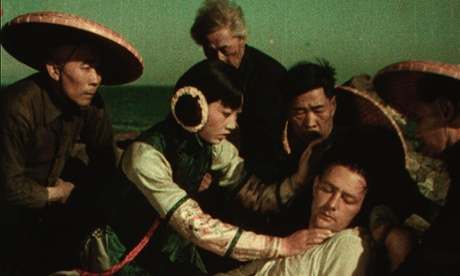
There are some people who would ask why on Earth anyone would choose to spend eight days in the dark watching silent black-and-white films. But it wasn’t a question I heard raised at the Giornate del Cinema Muto in Pordenone, Italy, this year. Not just because this is the world’s leading silent cinema festival, but because these silent, black-and-white films were often not silent, and not black-and-white at all.
The 33rd edition of the festival was a typically eclectic affair, organised into strands that covered early cinema, and films from specific nations, actors and genres. This year, I especially enjoyed a segment called Russian Laughter, which featured the sophisticated comedy films of Yakov Protazanov; my favourite being Protsess O Trekh Millionakh (The Trial Concerning Three Million, 1926). But one thread always appears in the schedule: The Canon Revisited screens the best-known and respected titles in silent cinema to an appreciative audience.
The reality is that “classics” are often very rarely seen, so the opportunity to see Raoul Walsh’s pioneering social drama Regeneration (1915), Pudovkin’s epic Storm Over Asia (1928) or all five hours of the Fritz Lang’s Die Nibelungen (1924), which has been recently restored, is precious indeed. My favourite in this section of the festival programme was Mauritz Stiller’s Herr Arnes Pengar (Sir Arne’s Treasure, 1919), a chilling adaptation of a novel about the theft of cursed riches, and its terrible fallout, made during the golden age of Swedish cinema.
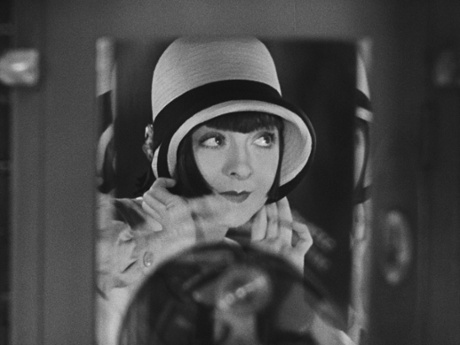
The flipside of the canon screenings is the collection of Rediscoveries and Restorations, which throws up unexpected oddities (example: a German re-release of Battleship Potemkin, with dubbed dialogue!) as well as long-sought-after titles. Sometimes a bit of both. Colleen Moore, a hugely talented and popular comic actor and one of the very first Hollywood “flappers”, is far less well known now than she should be. She intended to keep her legacy intact and bestowed copies of her films on a museum archive, but they were thrown out without her knowledge. For many years, her fans have been satisfied with just a few extant titles and some scraps. So her Synthetic Sin (1929) was warmly welcomed at Pordenone. It was vintage Moore, a romp in which a young woman attempts to become more worldly wise in order to make it as a serious actor. To this end, she checks into a dive hotel in New York and rubs shoulders with gangsters while necking illicit booze: “Let’s you and I make hey-hey while there’s moonshine!” It’s utterly ludicrous and tainted by an unpalatable “blackface” scene, but a sparkling showcase for Moore’s comic skill and charm. The London film festival screens another once-lost Colleen Moore film this week, the tantalisingly named Why Be Good? (1929), complete with its Vitaphone musical soundtrack, which was recorded on disc to be played alongside the film.
Synthetic Sin played with live musical accompaniment, as do most of the films at the Giornate, although the Vitaphone music kicked in at the end – only a single one of the original discs has been found. In contrast, on the opening night of the festival, we witnessed a full evening of Vitaphone sound and vision: the complete programme screened at the Selwyn theatre in Manhattan in February 1927. The historical potboiler When a Man Loves (1927) starring John Barrymore and Delores Costello was preceded by short musical interludes: snippets of Verdi’s Rigoletto and comic songs performed by the duo Van and Schenck. It was, said festival director David Robinson as he introduced the show, just like the modern trend for streaming West End plays to regional cinemas – only with an 87-year delay.
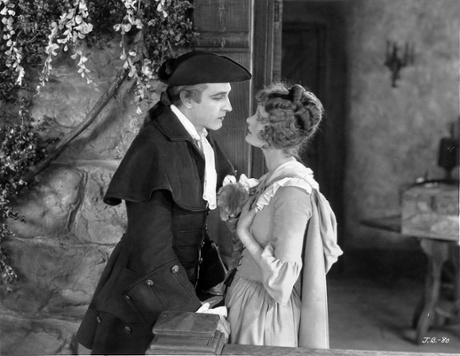
There was more to come from Barrymore, and his siblings Ethel and Lionel, who shared a family retrospective at the Giornate. Hard to make a case for this trio as forgotten faces from cinema’s dim and dusty past, perhaps, but it was revelatory to see and compare so much of their silent-era work. John proved himself more than a Great Profile, with performances as a brokenhearted dandy in Beau Brummel (1924), a licentious poet in The Beloved Rogue (1927), an idle posh boy in The Incorrigible Dukane (1915) and of course his powerhouse dual role in Dr Jekyll and Mr Hyde (1920). He’s always note-perfect, even if those notes are often played crashingly loud.
Lionel, on the other hand, was revealed as an actor capable of powerful subtleties, as in the US civil war drama The Copperhead (1920). If you want to see a silent star in a different light, then how about Lionel in colour, fighting off the grasping tentacles of a giant sea monster (The Mysterious Island, 1929)? Or Clara Bow in Red Hair (1928) with coppery auburn locks? The Technicolor corporation was founded in 1915, and a section of the Giornate was devoted to its coming centenary, screening films and fragments shot in either early Technicolor (Toll of the Sea, 1922) or its predecessors and competitors – British film The Glorious Adventure, 1922, in Prizma Color; a Paris fashion parade filmed in Kodachrome. It was strand packed with strange and innovative material, and the short films were often bolder and better than the features. “The thinking was that audiences didn’t want to be bombarded with a lot of colour – often in bits and pieces as a highlights, rather than throughout the entire film,” says David Pierce, who together with James Layton has produced a book on the first two decades of Technicolor, and programmed this part of the festival.
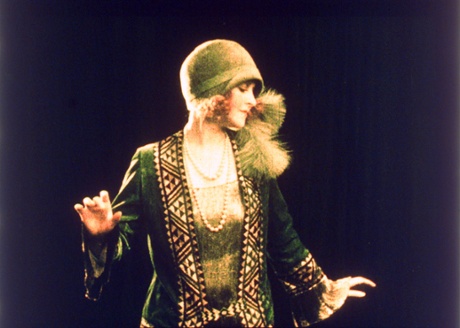
“Technicolor took small steps to get to the end goal,” adds Layton. “From the beginning they knew they wanted a full-colour process, but in the 1920s they had a two-colour process, instead of three, which meant they could only reproduce a limited part of the spectrum.” Two-strip Technicolor film-makers could only play with reds and greens, as blues, yellows and purples would appear as an unattractive brown. The skin tones of these early colour films are astonishingly realistic, and despite the reduced palette, they can be very beautiful: The Toll of the Sea (1922) featuring Anna May Wong was exceptionally gorgeous, a true tearjerker, embellished by the star’s elaborate and vivid wardrobe, not to mention the fact that much of the action takes place in her lovely garden. Subjects were chosen for their suitability for this format: the green seas and crimson blood of the Douglas Fairbanks swashbuckler The Black Pirate (1926) is an excellent example. Even so, the amount of money spent on experimenting with costume and set design, and the extra lighting required, made it prohibitively expensive and dauntingly complex. Another advantage for the Fairbanks movie was that his own studio, United Artists, had the financial and creative independence to become an early adopter.
And Fairbanks’ United Artists colleague closed the festival for us in somewhat more traditional style. Charlie Chaplin fans are also celebrating a centenary this year, 100 years since he first appeared on film – and that calls for an outing of the Little Tramp. City Lights (1931) may not be in full colour, but it nestles between the worlds of silent and sound cinema. We saw the film as Chaplin intended, with his own score played by an orchestra, and the audience providing a chorus of laughter, then at the end a few quiet sobs.