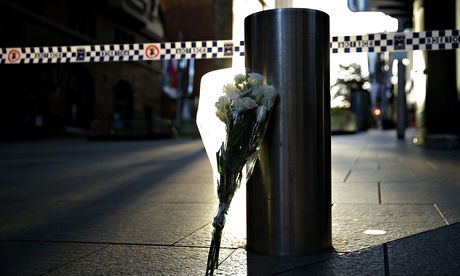
An attack similar to the one in Sydney’s Lindt cafe could happen in Britain at any moment, David Cameron has said, warning that such attacks were very difficult to prevent.
The threat faced by the UK included “self-starting, sometimes quite random attacks that could happen at any moment”, the prime minister told MPs on Tuesday.
“We have seen, over the last few months, there have been a series of plots that have been detected and prevented, that would have seen police officers or other authority figures murdered in cold blood, as Lee Rigby was murdered in cold blood.
“It’s thanks to the brilliance of our policing and security services that these things have been prevented.
“But we can’t count on them to prevent it every time, because it’s one thing understanding the terror networks coming out of Pakistan or Afghanistan or Iraq and Syria, and trying to monitor what they are doing and who is going and who is returning.
“That’s one thing, but people who are self-radicalised, often on the internet, who then suddenly do appalling things, that is much more difficult to prevent.”
Man Haron Monis, who took cafe staff and customers hostage in Sydney, was described as a “lone-wolf” attacker – operating without the support of a wider network, carrying out a low-technology attack, which required little planning, and was thus much harder to prevent. In Britain a significant number of counter-terrorism officials fear that such an attack is a matter of when, not if.
After the large-scale attacks in the past decade – in the US, Madrid and London – counter-terrorism efforts became more successful at chasing down those involved, and identifying the materials they needed to cause large numbers of casualties.
In contrast, the lone wolf would not be traceable as part of a wider network, nor need lots of equipment.
Monis had only a gun; those who butchered Rigby last year had knives bought from an everyday store.
This summer Islamic State called for attacks by followers in the west by whatever means were to hand, but in extremist circles the idea was propagated earlier by Anwar al-Awlaki , the US-born Islamist cleric eventually killed in a drone strike.
In online sermons, he preached the need for violent action and urged followers to do what they could, when they could.
Peter Clarke, former head of counter-terrorism at Scotland Yard, believes the label of “lone wolf” is a mistake: “They are not lone wolves. All these people share the same intolerant ideology; it’s just a different method of attack.
“Instead of the big, set-piece attack, these are people responding to calls from terrorist leaders to attack when they can.
“Their ideology is driven by intolerance, not by religion, race or nationality.”
Clarke advocates a more vigorous drive against the ideology of extremism, not just on calls for violence: “You have to work on the ideology.”
Jahan Mahmood, a former adviser to the UK government on countering extremism, disagrees, saying the west is ignoring the way its own mistakes and policies lead to widespread grievances, which a minority believe should be answered with violence. He said: “These people are not following a structured ideology, and yes, they are brutal people.”
“The focus has been on ideology, [but] there is a lot of grievance-led anger, and we’re not looking at that.”
Mahmood, who now runs anti-extremism programmes independent of the government, points to Monis’s rhetoric against Australia’s involvement in Afghanistan, and sees similarities with other justifications for acts of violence: “The lone wolf is anger- and grievance-led.”“The focus has been on ideology, [but] there is a lot of grievance-led anger, and we’re not looking at that.”
Clarke and Mahmood agree that since 2001 the momentum is with the jihadis.
Mahmood said: “We are losing; we’re losing the hearts and minds of our communities, never mind the extremist world. We are creating the circumstances for anti-western perspectives.”
Clarke said: “Four years ago the sense was that the west had momentum, al-Qaida was in decline, and the Arab spring marked a new beginning. That sense of optimism has now dissipated.”