The latest housing price figures from the Australian Bureau of Statistics reveal that while the peak of the recent housing boom appears to have passed, Sydney’s house price growth continues to outpace all other cities. It also highlights that the housing price boom of the past three years has been vastly different from that of the early 2000s, with home owners being much more cautious about using their increased wealth to either spend or go further into debt.
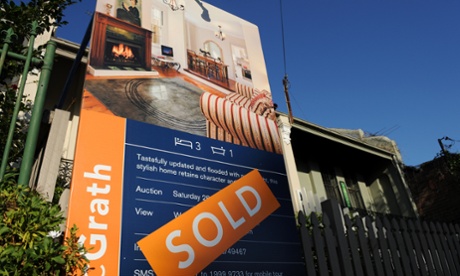
Since the Reserve Bank began its cycle of cutting interest rates in November 2011, the housing market has become divided between Sydney and everywhere else.
In that time, the average Sydney house price has risen by 31.9% – well above the next biggest rise, Darwin’s 17.2%. So dominant is the Sydney housing market that no other capital city’s housing prices have risen by more than the weighted average of all eight capitals:
The divide has, if anything, become more stark over the past year as Sydney’s house prices have increased by 14.6%, compared with a 6.9% rise in the next fastest rising capital city, Melbourne.
The reason for the increase in prices can be placed at the feet of investors. The latest housing finance figures, also released this week, showed growth in lending since the RBA began cutting rates has been overwhelmingly led by investors.
By December last year, investor housing finance had risen by 35%, compared with just 18% for owner occupier loans (excluding re-financing).
The growth in approvals for both types of home loans has declined in the past nine months. But such has been the growth in investor financing that, excluding the refinancing of people’s homes, investor home loans in September for the first time accounted for 50% of all housing loans:
The good news for Sydneysiders and for others worried that housing prices are growing too fast is that the boom seems to have peaked:
The housing boom this time round has been a very different beast from the one that occurred in the early 2000s. In some sense this is good, but in others it is less positive because the usual economic activity that comes from a rise in house prices has not occurred.
In its recent Statement on Monetary Policy, the RBA found that low interest rates since 2011 have caused “a strong rise in construction activity”. This was the primary reason for lowering rates, as the RBA hoped construction could take up some of the slack from the slowing mining industry. It found that this has occurred to an extent as “workers with skills in construction are reported to be readily available, in part because demand for such labour from the resources sector has declined”.
However, house price rises also have an impact on the economy through the increased wealth they bring to home owners. It was this that drove the great explosion of consumption during the early 2000s.
This impact was behind the view put forth by then prime minister John Howard, when he said in 2003, “I don’t get people stopping me in the street and saying, ‘John you’re outrageous, under your government the value of my house has increased’.” In his view, “most people feel more secure and feel better off because the value of their homes has gone up.”
But that is not happening this time round.
The RBA noted that “the increase in wealth from rising housing prices is having less of an effect on consumption than it did previously. In particular, in recent years fewer households appear to have been utilising the increase in the value of their houses to increase their leverage or trade up”.
It suggested that “existing homeowners have become more reluctant to borrow against increases in their net wealth to trade up homes.”
There are a number of reasons for this. The first is that households are already up to their eyeballs in debt. Back in 2003, when John Howard was loving house price rises, housing debt was 103% of disposable income. Now it is 137.1%.
For owner-occupiers debt has gone from being 70% of disposable income to 90%:
The boom of the early 2000s was fuelled by debt like never before. In the three years from 2002 to 2005 the total household debt to income ratio rose by 34 percentage points. By comparison it has risen just four percentage points since 2011:
Such large increases in household leveraging was never sustainable. But it is not the only reason why the housing price boom this time round has not led to people spending their increased wealth. The RBA noted that while interest rates are very low, coupled with higher house prices it meant that “the expected repayment burden on loans is at 10‑year average levels.”
Thus lower mortgage repayments are not making us feel like we have a lot of money to spend because paying off a mortgage is as hard as ever. The RBA found that in NSW and Victoria “the share of current income required to service an average loan over the next 10 years is close to historical highs”.
The other aspect is that people are not stupid. They know the economy is not powering along, and they know their own wages are unlikely to be booming any time soon. The RBA suggested that “homeowners may be less willing to borrow more because growth in labour income has slowed” and that the “widespread expectation is that wage growth will remain subdued for a time”.
This expectation is not foolish, given yesterday the ABS’s latest wage price index figures showed that wages grew by just 2.5% in the past year – the lowest ever rise in trend terms since the figure were calculated in 1998:
For the moment the housing price boom appears to have eased. The lower housing prices have spurred investors, especially in Sydney, and this has led to an increase in construction. But it hasn’t led to any great sense of increased wealth nor any great increase in household spending. Given our current level of debt and the generally limp employment market, it seems we’re happy to wait for the rest of economy to fire up before we start spending.