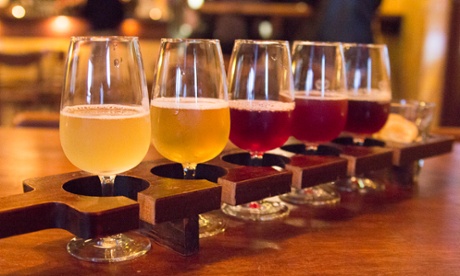
Beers fermented spontaneously with wild yeasts and bacteria. Ales spiked with obscure native Australian plants. It’s craft beer week in Sydney, and rather than checking out the many deliciously regular beers on offer, I’m going to do my best to search out the weirdest beer of the festival. Normal beers are for amateurs*.
First up is the wild and sour beer night at the Local Taphouse. In contrast to conventional beers which rely only on brewer’s yeast (Saccharomyces cerevisiae) for fermentation and actively discourage contaminants, sour beers involve other microbes in the fermentation process such as wild yeasts or bacteria.
Watermelon Warhead
Notes: Beer No 1 is the Watermelon Warhead from West Australian brewer Feral Brewing Company. There’s a hint of watermelon in the smell. Taste-wise it’s very like a sour watermelon lolly as advertised, but not as intense. It’s light, acidic and actually quite refreshing.
It’s made in the style of a Berliner weisse beer, which is a wheat beer with a sour taste achieved by adding Lactobacillus bacteria.
Magic Rock Circus of Sour
Notes: Another Berliner weisse-style beer. The smell is pleasantly citrusy. Reminds me of a synthetic lemon smell, maybe a bit Ajax-y. Beer is actually pretty nice, too.
The accompanying description says it has the added complexity of “Brett” appearing as the beer ages. Initially I was wondering who Brett was, and if he was going to pop over for a cold one, but later research shows the beer is part fermented with Brettanomyces bruxellensis, another type of yeast.
Boon Oude Kriek
Notes: Smells like cherries. Tastes like cherries. Looks reddish (another hint it probably involved cherries). In fact it tastes like I bought reconstituted cherry juice from the supermarket and carbonated it. This isn’t a bad thing though, it’s rather pleasant.
Boon Oude Kriek is a lambic beer, which means it is left exposed to the air so fermentation can occur spontaneously from microbes in the brewery air. In this case it undergoes a second fermentation – with cherries.
La Sirene Cherie Kriek
Notes: The name and colour has tipped me off to the fact that this may actually be another cherry-related beer. Yep. Smells and tastes much more syrupy than the other, though. Much more sour. I must say I prefer the Boon Oude Kriek.
Later research tells me this is an Australian take on the kriek style, produced by La Sirene Brewing.
Rodenbach Grand Cru
Notes: Undoubtedly the most distinctive beer so far. Definitely has the most unusual smell, sort of malty but also earthy like a truffle. The taste is somewhere between a champagne, sour cider and a beer, with hints of fruit. Can’t stop smelling it, unlike anything. Great beer with a unique character.
Later research tells me that this is an award-winning, critically acclaimed Flanders red ale.
Wayward Chockywocky Doppelbocky
Notes: It’s a smoked beer. And it’s a sour. I’ve had both before but I’m a bit wary as to whether these will combine in a good way, but here goes. First taste is not pleasant, the smoked part and the sour part don’t combine very well. It gets better with subsequent tastes. The aftertaste is odd, sort of slightly “off”.

My next stop is at Yulli’s restaurant to try a range of beers spiced with Australian native plants. Apparently all beers have been brewed by homebrewers, so this should be interesting to say the least.
Eucalyptus Olida IPA
Notes: Smells very strongly of eucalyptus oil. It has a very light colour, but the taste is quite astringent and not overly eucalyptus-y. I’m not a fan.
As it’s homebrewed there’s not much information readily available, but there is some detail about the plant involved. Eucalyptus olida, also known as strawberry gum, has leaves that are used as a spice in cooking.
Tasmanian Mountain Pepper mild ale
Notes: Lovely reddish-amber colour. The smell is interesting, hard to describe but sort of fruity. Much nicer generally than the IPA, has a sort of apricot aftertaste.
Mountain pepper, Tasmannia lanceolata, is native to south-eastern Australia. Both the berries and the leaves can be used in cooking as a substitute to regular pepper.
Wattleseed stout
Notes: Not much to say here. It’s a typical stout, dark and chocolatey. If there are any flavours or aromas coming across from the wattleseed I can’t taste or smell them.
Lemon Myrtle Witbier
Notes: Fantastic lemon myrtle smell. The beer itself has a very grassy taste, sort of like drinking leaves. Like the eucalyptus IPA it smells better than it tastes. That said it’s not bad with food, as it cuts through any fatty flavours.
Lemon myrtle is probably one of the best-known native Australian herbs, and is used in cooking.
Overall my favourite beers of the lot were the Watermelon Warhead, Rodenbach Grand Cru, and the Tasmanian Mountain Pepper mild ale. All fairly different to something you’d normally get down the pub, but still enjoyable to drink.
*Yes, OK. I am an entirely amateur beer reviewer.