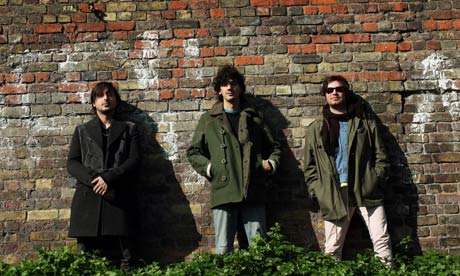
Last time half the team behind the The Rime of the Modern Mariner were at South by Southwest, they got arrested. After a Dirty Pretty Things gig in a too-small bar went unwieldy, Austin's boys in blue hauled Carl Barât and Anthony Rossomando off-stage and down to the station.
Five years on, and their festival involvement is rather more mellow: Barât narrates and Rossomando scores a salty, evocative documentary about the slow death of docking (maritime, rather than computing). Yet something of that rock'n'roll spirit has survived in Mark Donne's movie: a stylish essay that combines chinwags with East End sea dogs with a gonzo two-week adventure on the high seas with the crew of a Maersk cargo boat.
The idea was hatched in the pub, where the threesome (friends first, colleagues later) tend to repair, and where I meet them in London – though today they're on cappuccinos, it being barely noon.
Barât says: "Mark and I have a lot of ideas when we're drunk and talking. We said: 'We gotta do this!' And I said: 'Of course we do, pass the bottle!'" Rossomando adds: "We have a lot of conversations about stuff that never materialises. At first we were talking about going to sea just in general. I was just gonna get in a ship and go to Antarctica."
For Rossomando, currently with the Klaxons, it was the loss of jobs and heritage associated with the industry that attracted him to the project (his grandfather worked on the docks of New London, Connecticut). For Barât, it was the opportunity to be involved in something similar to The London Nobody Knows, the James Mason-narrated documentary from 1967, a sorrowful wander round post-war London. At first, they just had a short in mind. But, again, it was an experience involving a pub that changed all that.
"I wanted to show Mark this mythical postie pub," says Barât, "the smallest in London, the Oxford Arms. It's near my old house in Whitechapel, by an old sorting office. There's only a heavy felt blackout curtain between you and 24 hour drinking paradise. But I couldn't bloody find it, and I was really embarrassed because the three of us have got this pride about how well we know London. It'd been demolished. Like someone had just picked up a massive fucking eraser and gone and replaced it with a straight line. And when you see the sort of things they stick up while they're knocking others down, it just turns your stomach."
"That's one thing that binds us together," says Donne. "We're all passionate about the city around us. None of us is against progress or organic growth but I remember Carl's disappointment. And I thought: someone needs to record this. To apply the brakes, to reflect on what's been lost."
The universality of the story – corporate interests crushing rich traditions – was what appears to have especially appealed to SXSW's organisers (the film is doing especially well in unionised France).
Likewise, Donne's freshness of take. "They explicitly said they liked the way it was shot," he says. "I find quite a lot of documentary really boring to be honest; I think it's a lack of imagination. And the men we found were such gigantic characters I wanted to enlarge them. If you're an actor you get a more imaginative treatment when it comes to framing, but these men are bigger than any roles I've ever seen on film. Though I think we may have overdone it, and overgraded. We ended up with something a little too rich and textured."
Rossomando's score is the standout element, and must have been a clincher for SXSW – an eerie, dissonant, sporadically virtuosic piece of work that takes its cue from field recordings, including a rumbling loop he taped in the container ship's engine room, which turned out to be in the key of A-flat. "That's my get-out clause if no one likes it: conceptually, at least, it works."
Barat's voiceover, too, is something different: intimate and casual to the point, on occasion, of a gabble. Limehouse resident Steven Berkoff was keen to do the honours – and did pitch in with an oratory at a special screening at St Anne's, a Hawksmoor church on the Thames. "But I didn't want BBC English," Donne says. "You can hire anyone, but I wanted that authenticity. The only brief I gave Carl was: do it as if it's just you and I in a pub."
Back, then, to pubs, and to Barat and Rossomando's memories of fine times at SXSW. "It's fun, but it's a scrum," Barât says. "It's really full on. When I heard the film had been accepted I was really pleased. But I just thought: I hope it actually gets shown. I hope they take care of that print … "
• Read all our latest coverage of SXSW film at guardian.co.uk/sxsw/film. You can also follow us on Twitter at @GuardianSXSW or @GuardianFilm. And sign up now for our weekly Close Up email newsletter to get all the week's film news straight to your inbox.