We’ve seen it before, many times. The opening shot, CGI footage of longboats on a misty sea. Cut to a bleak, muddy but photogenic setting many centuries ago. From the silence emerges a horde of extras, preceded by a volley of arrows. Up steps our hero, broody, blue-eyed, hacking his way through the limbs of his foes. He’s about to be cleaved in two by a roaring, bearded behemoth, only for the behemoth to pitch forward, speared in the back by our hero’s equally handsome sidekick. These are desperate, brutal ages but there’s still time for a wry smile and a quip; “What took you so long?” Then, the credits; big, martial kettledrums as we float across a graphic of a country divided into warring kingdoms, to the strains of Celtic wailing.
In the wake of the enormous success of Game Of Thrones, our screens have seen the arrival of veritable fleets of historical, longform dramas that share some, many or all of the above tropes. It is a golden age for the genre, from Outlander, a time-travel drama set during the 18th-century Jacobite uprisings, to Vikings, Marco Polo and The Bastard Executioner, which harks back to the era of Edward I. Then there are New Worlds and The Tudors, both looking unflinchingly at the despotism of English monarchs, and Black Sails, a loud and violent prequel to Treasure Island. The latest such drama is the BBC’s The Last Kingdom, set in the era of Alfred The Great. It’s been saddled from the outset with comparisons to GoT, despite deservedly positive reviews and an obvious absence of dragons. But what is it about these lavish recreations of bygone, bloody times that has such currency? Is there something strangely comforting about all this anguish and despondency?
For Bernard Cornwell, who wrote the novels on which The Last Kingdom is based, popularity is partly explained by the light shed on dark ages. “No one sees past the fact of King Alfred as a bad baker,” he says. “People aren’t aware that England had to be made, that if you’d been around in 880, the word ‘England’ would have meant nothing. This show is about the birth of England, England as we know it. Alfred was incredibly intelligent – very rare for a monarch, you can count on the fingers of one hand the number of intelligent monarchs – but he was not a great warrior. He was too sickly. Still, he knew how to fight wars.”
However as well as the “big story” of the historical backdrop, drama makers need what Cornwell refers to as the “little story”. In the case of The Last Kingdom this means the travails of hero Uhtred. A handsome swashbuckler and warrior, he is in every respect the antithesis to Alfred, not least in his conflicted sense of identity, having been born a Saxon but brought up a Dane. A fictional creation, he provides what co-director Nick Murphy describes as the necessary “romp of the story, the entertaining gallop”. He also provides conflict. Like Wilkin Brattle, the rebellious Welsh knight-turned state-sanctioned killer in The Bastard Executioner, he embodies the contradictions and moral complexities of history, the often terrible choices one has to make when travelling a path that’s cleaved. The morally compromised hero is not just to be found in the Soprano household.

Female leads, meanwhile, are much more obviously anachronistic. The generic modern historical heroine must be, as Emily Cox describes her character Brida in The Last Kingdom, “maybe the first feminist that ever existed”. She takes no sauce from drunken male fools in the grog house scenes, decking them to show that despite this being the late 800s, she has somehow acquired a 21st-century strength and sensibility. She is like Lagertha in Vikings, seeing off two male attackers with ease in the opening episode, or Claire, the second world war nurse in Outlander who travels all the way back to 18th-century Scotland to dish out sharp lessons in modern mores.
Audiences and programme makers alike might assure themselves that these new serials are engaged in education as well as entertainment, but the shows are best advised not to skimp on the latter at the expense of the former. If a historic drama values its chances of being recommissioned for a second season, it should make sure it’s heavy on sex. Set in desperate times in which life, being precarious and easily lost, must be passionately and intensely lived while it lasts, for tomorrow we may die, it would be a pity for two photogenic leads – Claire and Jamie in Outlander, say – not to test their oft-conflicted loyalties through trial by rumpy-pumpy…
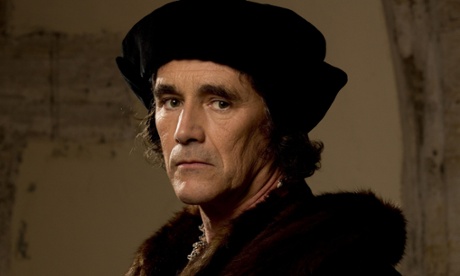
Such activity should be deployed at regular intervals lest the audience switch over. It is instructive here to compare The Tudors with Wolf Hall. The Tudors took historical liberties with Henry VIII, portraying him as perpetually youthful and lean and functioned as much as a lustful soap operatic romp as a depiction of monarchical despotism. It also ran for four seasons. Wolf Hall, meanwhile, was a acute psychological study of the main players at the Tudor court but faced ire from viewers for what they felt were unintelligible scenes of old men mumbling at one another. Audiences had switched on expecting a Bond thriller and found they’d got Smiley’s People.
The new historical drama is a very 21st-century thing, its sumptuousness a product of the now well-worn flight from cinema to TV. As Rutger Hauer who plays Ravn in The Last Kingdom puts it: “The good people are being grabbed by television. Work for us and be paid less. That goes for the writers, the actors, everybody.”
These shows don’t just appeal to an industry in flux but a society in flux too. In our own age of uncertainty and austerity the historical drama provides not only an immersive, escapist banquet for the eyes but also a reminder that we could have done worse than having been born in the relative comfort and tranquility of our own times.
In previous eras, any actor who had to don a toga or step into doublet and hose would immediately lapse into a bizarre sing-song intonation. It was as if they felt obliged to signify that This Was History. That is thankfully no longer the case: historical dramas stress the parallels between our ages, allowing us to understand the concerns and motivations of otherwise opaque dynasties and peoples. Take the latest series of Game Of Thrones, which sees the sudden rise of religious zealots The White Sparrows, the siege of the cynical, dynastic Lannisters, the alliance Danaerys forms with a member of the family she seeks ultimately to displace, all in the midst of a broader cauldron of geographic unrest, an ongoing state of turmoil which many believe won’t be resolved till they send in the dragons. Sound familiar?
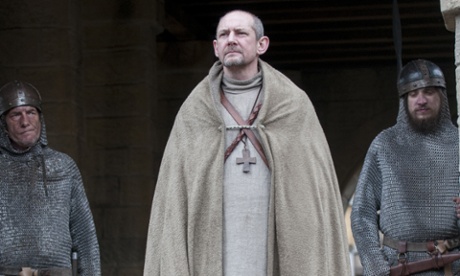
Similarly, The Last Kingdom takes up where Vikings left off and encourages us to empathise with peoples traditionally assumed to be an enemy, violent, alien Other. As Ian Hart, who plays Beocca says: “The Vikings were traders, they came prepared. When they arrived they came ostensibly to farm.” The series shows that, far from simply threatening these benign shores, they enriched the fabric of English heritage.
The overriding message of the modern historical drama, borne in its sometimes anachronistic 21st-century cadences and tones, is that the human condition is permanent. “It’s more about people than absolute historical correctness,” says Emily Cox. People wanted to be happy, the way that they want to be happy now.”
The Last Kingdom ends on Thursday, 9pm, BBC2; the series is out on Blu-ray and DVD on 14 December, courtesy of Universal Pictures (UK)