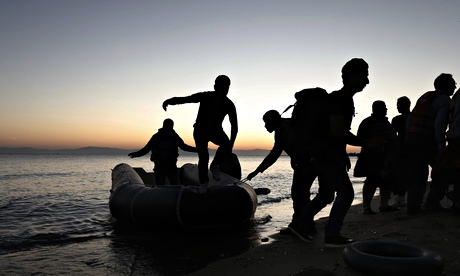
Tracy McVeigh’s excellent article, “Sympathy and solidarity on Kos beaches as two worlds collide” , describes well the dangers Syrian refugees face to reach Greece. But there is nothing new in migrants coming by boat from Turkey to Greece. What has changed is the increasing role of the European Union in endangering the lives of these migrants. Under EU pressure, Turkey has made it harder for refugees to leave the shore, while Frontex, the EU’s border guard agency, collaborates with Turkish border guards to stop boats leaving Turkish waters.
Enforcement has not – and will not – stop the boats. The refugees are desperate and have money to pay smugglers. For more than a decade, Frontex has been spending public funds to “combat” smuggling. Its strategies have been completely counterproductive: they have grown the human smuggling industry. Border control enforcement has pushed up the price of smuggling, increasing the income of smugglers.
More income and greater obstacles brings larger, more organised crime networks into the market. These have greater ability to corrupt officials and willingness to use violence and recklessness. Without legal routes for refugees, the EU’s war on people smuggling is unwinnable. The EU should switch funding from Frontex to provision of humanitarian support in Greece, so refugees can claim asylum there. This is the way to combat smuggling. It’s time the EU stopped spending our money to endanger refugees.
Simon Cox
Migration lawyer
Open Society Justice Initiative
London SW1
Return to vendor
Not only does the taxpayer subsidise landlords via housing benefit and employers via working tax credits, but Peter Winfield (Letters) suggests we should further subsidise those who produce litter by paying for it to be returned. I have a better solution: collect the litter and return it to its originator, Coca-Cola, McDonald’s, KFC or whoever, together with an invoice not to be offset against tax as a business cost.
Roy Boffy
Walsall
London’s vanity project
The copious column inches devoted by the Observer in recent weeks to the proposed garden bridge over the Thames encapsulates the chasm that now exists between the capital and elsewhere. Tens of millions of pounds of public money are committed to a grandiose vanity project in London (“New row over Thames garden bridge as mayor offers public funds for maintenance”, News). Meanwhile, in provincial towns such as Northwich or Lowestoft traffic grinds to a halt several times a day as successive governments fail to find the funding for new road bridges. On the one hand, an “oasis of calm and beauty”, on the other a gridlocked town.
As well as highlighting the gross disparity in infrastructure spending per capita in London compared with the rest of the UK, perhaps you should also consider how many of your readers outside the capital are interested in the Thames garden bridge.
Dr Nigel Battersby
Northwich
Cheshire
Boycotts do have an effect
If not boycott then what – short of criminal prosecution, preventive war or more aggressive direct action (“Oh, why don’t we boycott boycotts? They are pointless”, Comment)?
As governments and international organisations sometimes apply non-violent sanctions, reasonable individuals and like-minded groupings may deny their custom and cooperation to people and projects they hold responsible for obvious evil: persecution of peoples, extermination of species, destruction of environment or corruption of public institutions.
As with most social and political remedies, not to mention medical prescriptions, many boycotts turn out to be ineffective, but some are not.
In 1880, retired British army officer Charles Boycott, an estate manager in Ireland, was ostracised by the local community and was forced to get soldiers to oversee his harvest. In South Africa a century later, an international boycott movement led to government sanctions and the end of that apartheid regime. In Israel, former finance minister Yair Lapid recently told a security conference: “Even a partial European boycott would be felt by every Israeli and the cost of living would go up.” Export earnings could drop by $5.7bn, he said.
Nearer home, most businesses are susceptible to customer pressure: if a product does not sell, or causes more trouble than it’s worth, they drop it. This is why campaigners now target the UK supermarkets that still sell produce from illegal settlements on Palestinian land.
Greg Wilkinson
Swansea
A new Greek myth
A trip to Greece by Barbara Hepworth may have done wonders for her depression (“A life told in six works”, Review) and for her sculpture, but it did not improve her geography. If, standing in the stadium at Delphi, she thought she was beneath Olympus, she wasn’t. She was many miles out and presumably meant Parnassus.
Piers Burton-Page
Buriton, Hampshire