Fifa has suspended bidding for the 2026 World Cup in light of the chaos that has enveloped the organisation on a day when Swiss investigators seized fresh evidence from the offices of the outgoing president, Sepp Blatter.
Amid continuing criminal investigations into the process for the awarding of the 2018 and 2022 tournaments, the Swiss attorney general’s office seized data and IT equipment from Fifa’s Zurich headquarters as part of a pre-agreed handover of evidence.
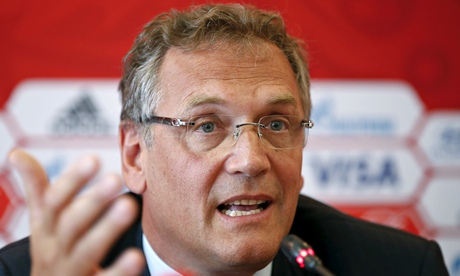
The haul is understood to include material from the offices of Blatter and the secretary general, Jérôme Valcke, who is under pressure over a $10m payment from South African World Cup organisers to the former Fifa vice-president Jack Warner that US prosecutors say was a bribe.
Valcke said it would be “nonsense” to begin the 2026 bidding process in the current climate and that whatever the situation at Fifa, the World Cup had to be protected at all costs. The United States, Mexico and Canada are expected to be among those interested in hosting the 2026 tournament. Fifa has ruled the tournament can go to any continent except Asia and was due to be awarded in May 2017 under a revamped process in which all 209 Fifa associations would have a vote.
Swiss prosecutors and the FBI are looking into the controversial bidding process for the 2018 tournament, to be played in Russia, and the 2022 World Cup, awarded to Qatar. A disputed summary of a Fifa ethics committee report last year ruled there was not sufficient evidence to strip either country of the World Cup but the head of the compliance committee, Domenico Scala, has confirmed it remains a possibility if new evidence emerges.
The summary, which sparked the resignation of the report’s author Michael Garcia, detailed a list of allegations against Qatar and said Russia had been unable to cooperate because the organising committee had lost all its emails and its rented computers had been returned.
Following a meeting of the World Cup organising committee in Samara on Wednesday, Valcke insisted the Russian World Cup was on track before the qualifying draw in St Petersburg in July and that no wrongdoing against Russia had yet been proved.
“Nothing was big enough during the process to say that the final decision was not in line with all the rules and regulations which have been in place. And, in fact, it’s the same conclusion Michael Garcia had in his report,” said Valcke, appearing to suggest he had read the full report.
Valcke also defended Fifa’s handling of a $10m payment to a Caribbean Football Union account controlled by the discredited Warner. The payment followed a 2008 letter from the South African Football Association to Valcke asking for the money to be deducted for the World Cup budget and sent to a legacy programme to be administered by Warner.
“I’m signing all the contracts of Fifa,” said Valcke, who began his job several months before the money transfers in early 2008 to accounts controlled by Warner.
Valcke, who said he had not been questioned by Swiss authorities or the FBI over the payment, insisted the alleged bribe money did not belong to Fifa and questioned why he was targeted by international media. “You have decided that after Blatter, my head is to be cut. Fine, but don’t say it is because of this $10m.”
Vitaly Mutko, the Russian sports minister who is also head of the 2018 organising committee, said Swiss and US investigations into the Russian bid would find nothing improper. “Do not rock this boat,” he warned. “They said already that Germany wrongfully got their World Cup, or Britain hosted some wrong reception for £40,000. And now it will all snowball. We should understand that we acted within the legal football framework that existed at the time.”
His comments were a reference to suggestions in the German media that trade deals played a part in Germany securing the 2006 World Cup and the FA’s decision to pay for a Concacaf dinner in the Caribbean. Blatter confirmed his departure in Zurich last week and said he would stay as president until the election, due to be held between December and March. The date of that election will be confirmed at a Fifa executive committee meeting in Russia next month, before the preliminary World Cup draw, with mid-December one possible option.
Meanwhile, the head of the German FA has called for term limits for the Fifa president and suggested the one member, one vote system for Fifa’s 209 associations should be revisited. Wolfsgang Niersbach also recommended that preliminary technical reports should be used to weed out the weakest candidates for the World Cup.
“If Fifa had deployed this process then Qatar, with the weakest technical evaluation, would not even have reached the vote,” he said.
The pressure on Fifa will grow on Thursday when the European Parliament calls on Blatter to step down immediately. The motion, which expresses the parliament’s “long-held view” that Fifa is full of “systemic, widespread and persistent fraud and corruption”, says Fifa’s credibility will not be restored until Blatter goes and widespread reforms are instituted.
Meanwhile, the Brazil legend Zico has confirmed he intends to stand for the presidency of Fifa, insisting it is his “duty”.