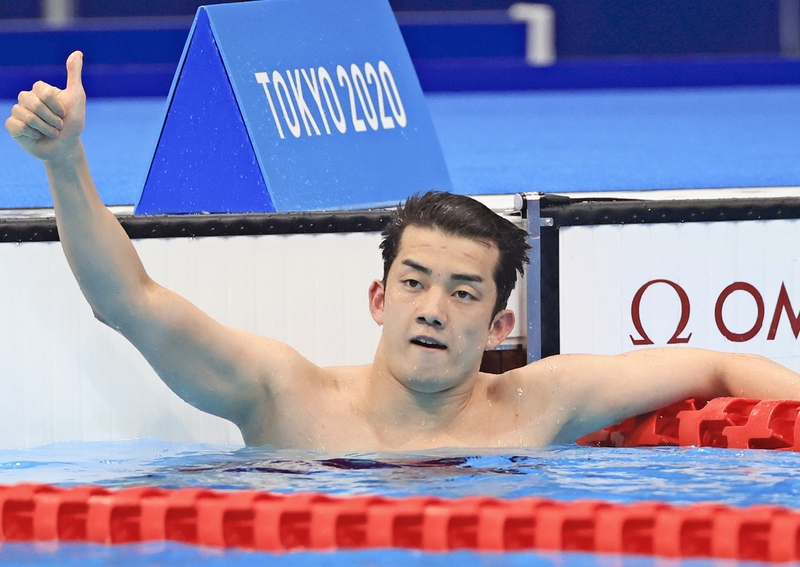
Para swimmer Dai Tokairin said he developed a positive outlook after he started writing in a notebook three years ago about things that he was able to do or things that made him feel happy.
Tokairin, 22, who has an autism spectrum disorder with intellectual disability, finished fourth in the men's 200-meter individual medley SM14 final at the Tokyo Paralympics on Tuesday.
He started swimming in earnest while he was at Yamagata prefectural Kaminoyama High School for students with disabilities in Kaminoyama, Yamagata Prefecture. He became obsessed with doing his swimming practice perfectly and often blamed himself for being unable to do all the things he wanted to do.
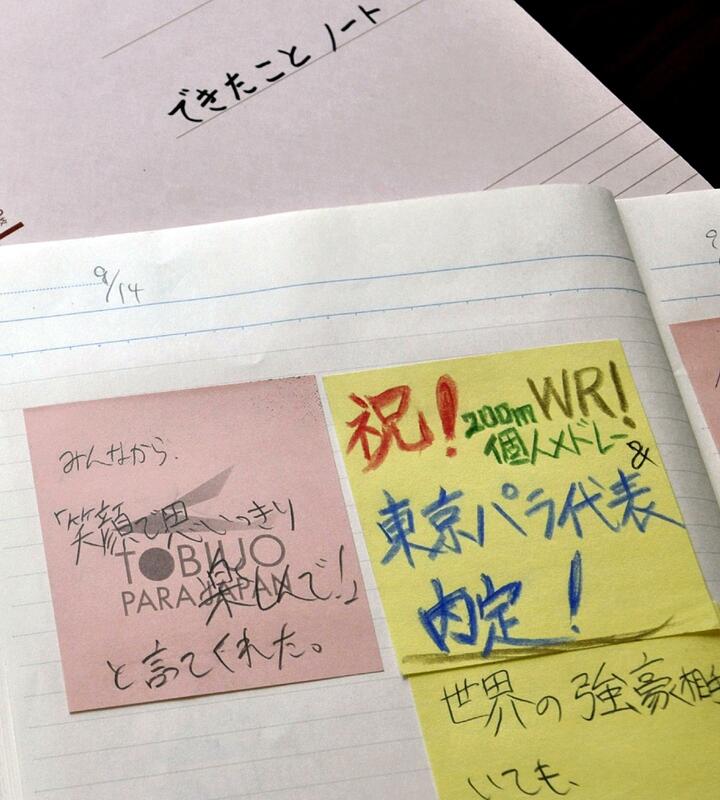
"I can't do it" and "I'm weak." He left such phrases in his swimming journal at that time.
In March 2016, Tokairin was eliminated in the qualifying round for the Rio de Janeiro Games. He said that when he rode the Shinkansen home to Yamagata City from Shizuoka Prefecture, where the round took place, he cried the whole way.
His depression lasted for a month, and he became unable to behave positively. In those days he would often go through the notes he had written about things he needed to fix, which had been pointed out by his coach.
Worried about him, his father, Masaki, now 59, read a lot of books to find a way to raise his son's self-esteem. Having found a book about a method of writing down the things one is able to do and the things that make one happy, he gave his son a notebook, saying, "Let's stop thinking about bad things."
In April 2018, Tokairin began writing down in the notebook things like, "I was able to ask my coach something right away when I didn't understand it," or "I was able to bear something at the very moment when I had to." He wrote down what was good for him on pink and yellow sticky notes and stuck them onto the notebook pages. Tokairin said he then felt more positive. Even when his swimming record did not improve, Tokairin encouraged himself by writing, "Don't call my results terrible."
His performance improved, and in September 2019, he set a new world record and earned a ticket to the Tokyo Games. Impressed with the growth of his student, coach Kenji Sasaki, 71, said, "He has become more persistent and able to complete his tasks."
Tokairin lost in a preliminary round for the 100-meter butterfly and did not perform well in the mixed 400-meter relay at this Games. Even so, he changed his focus by writing down in his notebook that he had interacted with other athletes or he was able to ride a double-decker bus on the way to a competition venue.
On Tuesday, Tokairin, who had finished eighth in the qualifying round for the men's 200-meter individual medley, joined the final. He was in last place at one point, but persevered and overtook three swimmers in the last 50 meters. He finished with his fastest time of the year.
"I never gave up and was able to race until the end," Tokairin said with an air of satisfaction.
Read more from The Japan News at https://japannews.yomiuri.co.jp/