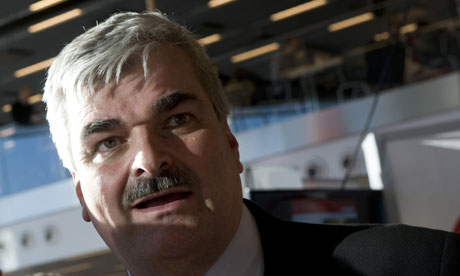
Hakan Juholt, the new leader of Sweden's Social Democrat party (SAP), wants a return to leftwing policies. Over the past decade his party has moved closer to the centre, bringing it defeat in two general elections, in 2006 and 2010. But in a speech to an extraordinary party congress in Stockholm on 26 March, Juholt announced that he wanted to restore the core values of Swedish social democracy.
Elected after a secret ballot, which has attracted fierce criticism in recent months, Juholt came out with a long list of party ideals, heralding a return to first principles for a party that boasts an exceptional record in Scandinavian politics, having held power for much of the time since the 1930s.
He was clearly in favour of market economics but against capitalism. Many observers said that they had not heard the welfare state presented in such terms for more than 25 years.
Although he has been the party's deputy secretary general since 2004, Juholt is a relative unknown. During his years on the party executive, he travelled widely and can count on a solid network in other parts of Sweden. The previous SAP leader, Mona Sahlin, spent her career in the capital or its vicinity.
A fine orator with a great sense of humour, Juholt combines a knack for off-the-cuff remarks with a reputation as an accomplished schemer. Aged 48, he was born in Oskarshamn, a small town 300km south of Stockholm, best known as the location of one of Sweden's three nuclear power stations.
He worked as a journalist on a local paper and went into politics early on. He was first elected as an MP in 1994, soon becoming a defence specialist. Since last year's general election he has chaired the parliamentary defence committee. He advocates transatlantic links between Sweden and the US.
His priorities include ending child poverty, cutting youth unemployment, raising public-sector wages, reviewing the pension system if it cannot sustain an acceptable standard of living, and going back on the "failed" privatisation of certain markets, in particular electricity and rail transport. All that remains to be done, between now and the general election in 2014, is to explain to voters how he plans to achieve these goals.
This article originally appeared in Le Monde