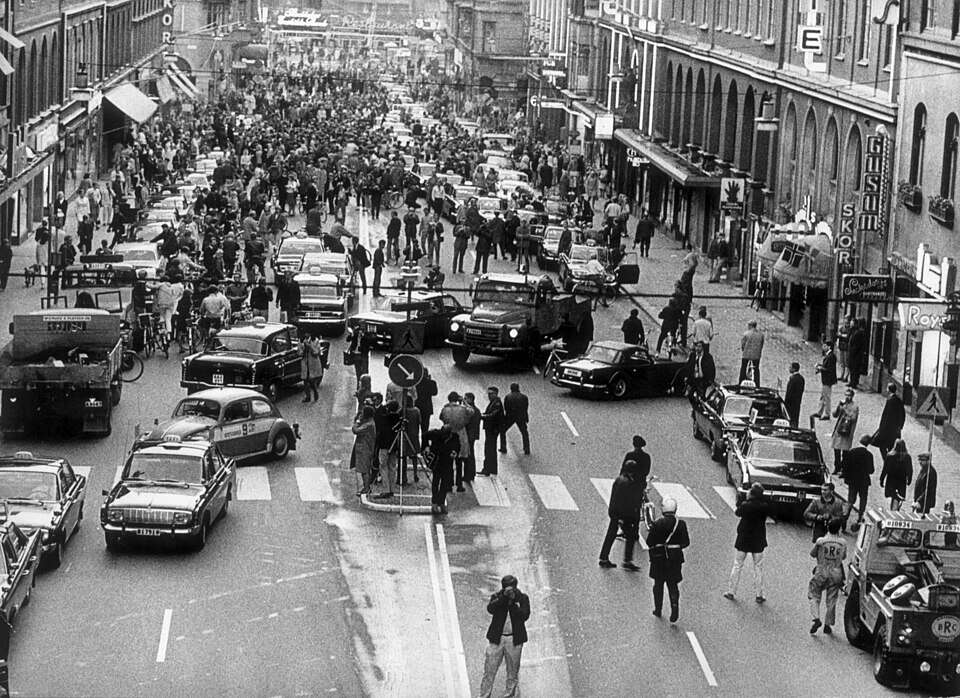
On 3 September 1967, Sweden carried out a major traffic reform. In an operation named "Dagen H", the country changed traffic from the left side to the right side. Drivers woke up to a new traffic system, and the switch was completed in a few hours with little disruption. It took years of planning, massive campaigning of the population, and close cooperation of different government organisations, engineers, police, and people to carry out such an operation successfully.
Get breaking news anytime, anywhere. Download the TOI app now!
It may seem strange now, but there were good reasons for this change. Most of Sweden’s neighbours, including Norway and Finland, drive on the right. Also, nearly all cars in Sweden had left-hand steering, which made overtaking on narrow roads more difficult when traffic was on the left. Thus, with the growth of cross-border travel and car imports in Sweden, it became less efficient and more dangerous to keep traffic on the left side.
Why Sweden decided to change sides
For many years, the people of Sweden were accustomed to the system of driving on the left side of the road. However, in the middle of the twentieth century, this became an issue. Even though the Swedish roads were organised according to the principle of left-hand traffic, around 90% of the cars on the roads of the Scandinavian country were fitted with left-hand steering wheels due to their importation from countries where the opposite was the case.
It became a serious hazard for drivers as they had poor vision when trying to overtake a slower car when driving on the left side of the road, as drivers sat on the left side of the vehicle. In addition, with the development of international tourism, the problem became only more complicated since Sweden had neighbouring countries such as Norway and Finland, which had adopted right-hand traffic.
Although a national referendum in 1955 revealed that 80 per cent or more of Swedish citizens were against the change in the driving side, the government finally decided that issues like safety and conformity to international standards superseded public opinion. The legislature agreed to implement the move, and nine years of preparations ensued until the historic change took place on September 3, 1967.
According to The Handbook of Road Safety Measures , improvements in traffic regulations and road design often produce substantial reductions in road accidents when combined with effective public education. Sweden's transition demonstrates how large-scale policy changes can improve road safety when supported by extensive planning and public awareness campaigns.
Dagen H: The largest traffic operation in Swedish history
The preparation for Dagen H was not a simple task that took only months, but years of careful planning. Many changes were needed, including repainting roads, replacing signs and markings, moving bus stops, and redesigning intersections.
A major priority for the government was educating citizens about the change. TV shows, newspaper advertisements, school posters, pamphlets, and messages on the radio constantly informed citizens about the upcoming change. In addition to that, gloves and stickers with the message “Keep Right” were being given out.
The change happened at an early hour on Sunday morning when there was not much traffic on the roads. By 4:50 a.m., all nonessential cars were stopped. Drivers shifted from the left side of the road to the right side and stayed put for a while. Traffic started moving from 5:00 a.m. onwards following the right-side system of driving.
However, the initiative was widely regarded as successful. Although there were concerns about possible chaos and accidents, everything went without a hitch. The number of accidents fell, possibly because drivers were more cautious.
Research by Evans suggests that increased driver attention and cautious behaviour immediately following major traffic policy changes often lead to temporary reductions in road accidents. This may help explain why Sweden experienced fewer serious crashes in the months after Dagen H.

Lessons from Sweden's historic traffic reform
More than 50 years later, Dagen H still draws attention from urban planners and transport engineers. Though switching from one side of the road to another might seem like a straightforward logistical issue, the Swedish case is often used to illustrate the value of evidence-based policies and careful planning.
Another lesson learned from the case study is that public opinion is sometimes not necessarily in agreement with technical expertise. While many Swedes were against the change, the government said it considered traffic safety, compatibility with neighbouring countries, and engineering factors. Over time, supporters said the change made cross-border travel easier and overtaking safer.
The campaign also shows the importance of clear public communication. Instead of simply declaring the change in the regulations, authorities spent many years preparing the population for it and teaching them new driving rules. It helped in creating a favourable atmosphere for the implementation of the change. Now, Sweden is considered one of the safest countries in the world in terms of road traffic. Although other developments like seat belt laws, car safety designs, and the Vision Zero road safety programme reduced road deaths, Dagen H remained an important event in Sweden’s history.
This case illustrates how infrastructure policy should evolve in accordance with emerging technologies and social shifts. Left-side traffic had become increasingly inconvenient because more imported vehicles came from countries that drove on the right. The change in the traffic regulations to adapt to the new situation demonstrates the emphasis on practical considerations and advancement.