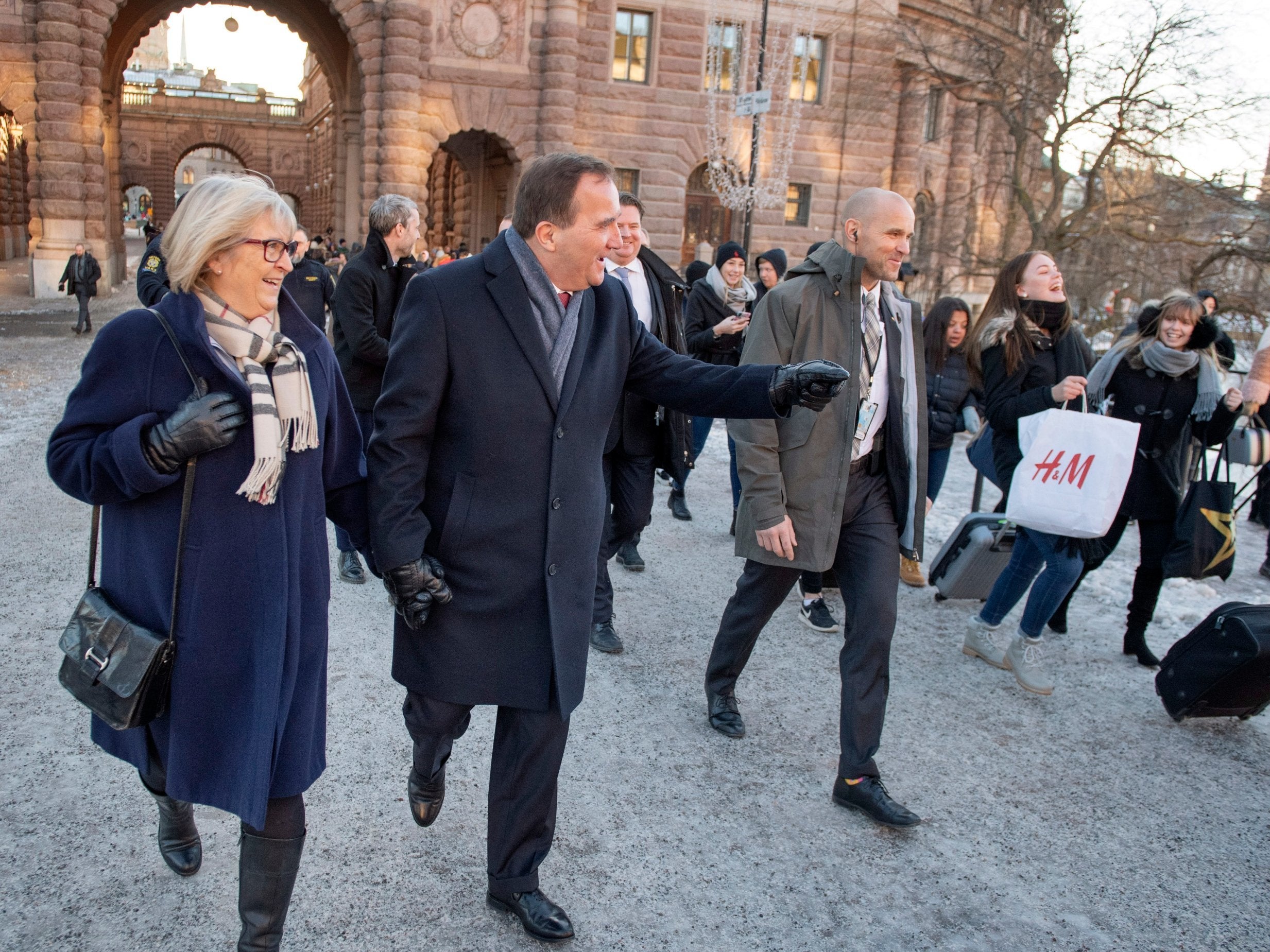
A centre-left minority government has been formed in Sweden following four months of political deadlock after no party was able to secure a majority in September’s general election.
Stefan Lofven, who has been serving as the country’s caretaker prime minister, managed to form a government with the support of 115 politicians, while 153 voted against him and 77 abstained.
Mr Lofven’s Social Democrats were backed by the Greens while the centre-right bloc voted against the arrangement. Three smaller parties abstained.
In Sweden, a prime minister can govern as long as there is no majority against him or her.
Swedish politicians have been trying to form a government without the Sweden Democrats, who came third in the election, due to their alleged ties to neo-Nazis.
“It will be a tough four-year period,” Mr Lofven told a news conference, adding: “Sweden is getting a powerful government that is not dependent on the Sweden Democrats.”
The party had made signicant strides in the 9 September national election but has not been a serious part of the coalition talks.
Sweden Democrats leader Jimmie Akesson, who had hoped for more political influence, repeatedly used the word “absurd” to describe the coalition talks.
“My ambition now is that the Sweden Democrats will be a dominating force in a new strong centre-right opposition,” he said.
Jan Bjorklund of the Liberals, whose party supported Mr Lofven by abstaining, noted “how racist and populist parties have strengthened their positions across the world”.
He cited US president Donald Trump, France’s Marine le Pen and Hungary’s Viktor Orban as examples.
“We have chosen another path,” he said.
The September election produced a hung parliament with the left-leaning side and the centre-right bloc securing about 40 per cent of the vote each, leaving neither with a majority and paving the way for months of complex coalition talks.
To get the support from two centre-right parties, Mr Lofven had to compromise over labour laws, causing irritation from his party’s union backers and those within his party.
Mr Lofven will present his government and start his second term as prime minister on Monday.
Agencies contributed to this report