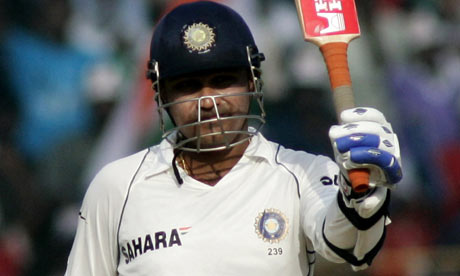
When a teenage Virender Sehwag started attending the net sessions organised by Amar Nath Sharma at the Government Boys School ground at Vikas Puri in west Delhi, the coach would sometimes tie a rope to his back foot and attach it to the back of the net to prevent him from dragging his feet too much. More than 15 years on, the feet don't drag, but he doesn't bat as though in fetters either. When he last played in Chennai, Sehwag smashed a triple-century off 278 balls against Dale Steyn, Makhaya Ntini and Morne Morkel. Today's 68-ball 83 was not as epic an effort but it could mean so much more if India go on to script the unlikeliest of Test triumphs.
Sehwag started off as a middle-order batsman but such was the talent in India's ranks he would not have got a game if he had not been prepared to move to the top of the order. Not one for the nervous start, he announced himself to Test cricket with a sparkling 105 at Bloemfontein, and a 220-run partnership with his idol, Sachin Tendulkar. After 65 Tests, he has 15 centuries, including two triples, and an average of 51.85, a record only Matthew Hayden can match among contemporary openers.
The first half of the day had been all about England's stolid progress to an impregnable target. By stumps, though, Kevin Pietersen's best-laid plans were in tatters and floating somewhere in the direction of Marina Beach. "He almost manipulates the field," said Andrew Strauss, a hint of disbelief in his voice. "You change it, and it's like he says: 'Right, I'm going to hit it somewhere else now.'"
Back when Sehwag was commuting from Najafgarh on the outskirts of Delhi to Sharma's nets, the soft drink 7 Up used to have a commercial with the punchline Normal is Boring. Sehwag's version of "normal" certainly is not.
Known for his Flintoff-like candour, there was no element of gamesmanship involved when Sehwag said: "It was my normal batting and I wasn't going after any particular player."
His prosaic approach involved five fours and a six over third man off Stephen Harmison and a huge six over square leg off the first ball he faced from Monty Panesar. "The fast bowlers were giving me the width and the ball was coming on nicely," he said. "I was playing the square cut and it kept going to the boundary."
Unlike some of his peers, Sehwag has never obsessed over technique or mind games. Nothing fazes him and, as he showed in the Boxing Day Test of 2003 when he walloped 195 in five hours, he bats with the same insouciance that first caught the eye of onlookers in games of gully cricket. Having missed a double-century while attempting a six over midwicket, he simply said: "It was there to be hit."
If not for his mother's encouragement, however, Sehwag might never have made it this far. His father, Krishan, who died last year, wanted the boy to focus on school and take over the family's grain-trading and flourmill business. Children are resourceful, though, and Sehwag used to conceal his kit on the terrace to make sure his father never knew. Today there was no hiding his unique talent, as a crowd of more than 20,000 cleared their lungs to deliver Cacofonix-like decibel levels.
When he was dismissed, a few headed for the exits in disappointment, but the man himself remained confident that those that turn up tomorrow would witness something special. "If we bat 90 overs, we can score 250 or 260 runs," he said. "The wicket is still good to bat on. If you settle down, you can score runs."
The history of Indian cricket is littered with stories of fourth-innings heartbreak, and the most painful one of all came at this very venue 10 years ago. Batting with a sore back and just the tail for company (India were 82 for five at one stage), Tendulkar played perhaps his finest innings, a glorious 136 that ended with a miscue to cover when only 17 were needed.
The remaining three wickets fell in a heap, and Pakistan prevailed by 12 runs. Now, thanks to the small-town boy who grew up wanting to be him, Tendulkar has a chance to bury those ghosts.