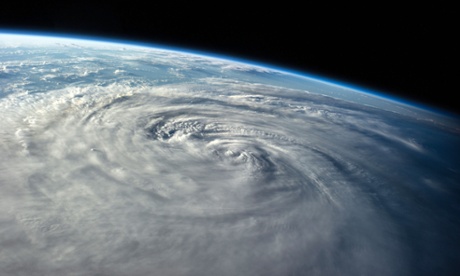
With extreme weather events on the increase, a British team is aiming to use a swarm of miniature satellites to track hurricanes, typhoons and supercell storms more effectively.
Most weather satellites remain in high geostationary orbits, but storm-watching satellites need to be much closer. They usually have a complex polar orbit which covers the entire surface of the planet over several cycles.
The disadvantage of this orbit is that it may be several hours before the satellite passes within range of a ground station, so information about storms tends to be several hours old.
A team from the University of Strathclyde, Scisys and Roke Manor Systems are working on a new approach under a European Space Agency initiative. They envisage a constellation of 26 shoebox-sized CubeSats spread out along the orbital path. This will cut the time between updates to less than an hour.
The main sensor for this type of meteorology is a radiometer – a device to detect the characteristic microwave emissions from clouds, precipitation, ice and storm systems. The CubeSats will have a new sensitive detector based on indium phosphide, capable of tracking severe weather with an accuracy of better than 20km.
The constellation is more robust than any single satellite. The USAF’s car-sized DMSP-F13 weather satellite exploded earlier this year after a power system failure, but a constellation can lose several members and keep functioning. And the team believes the entire swarm will cost less than a single conventional satellite.