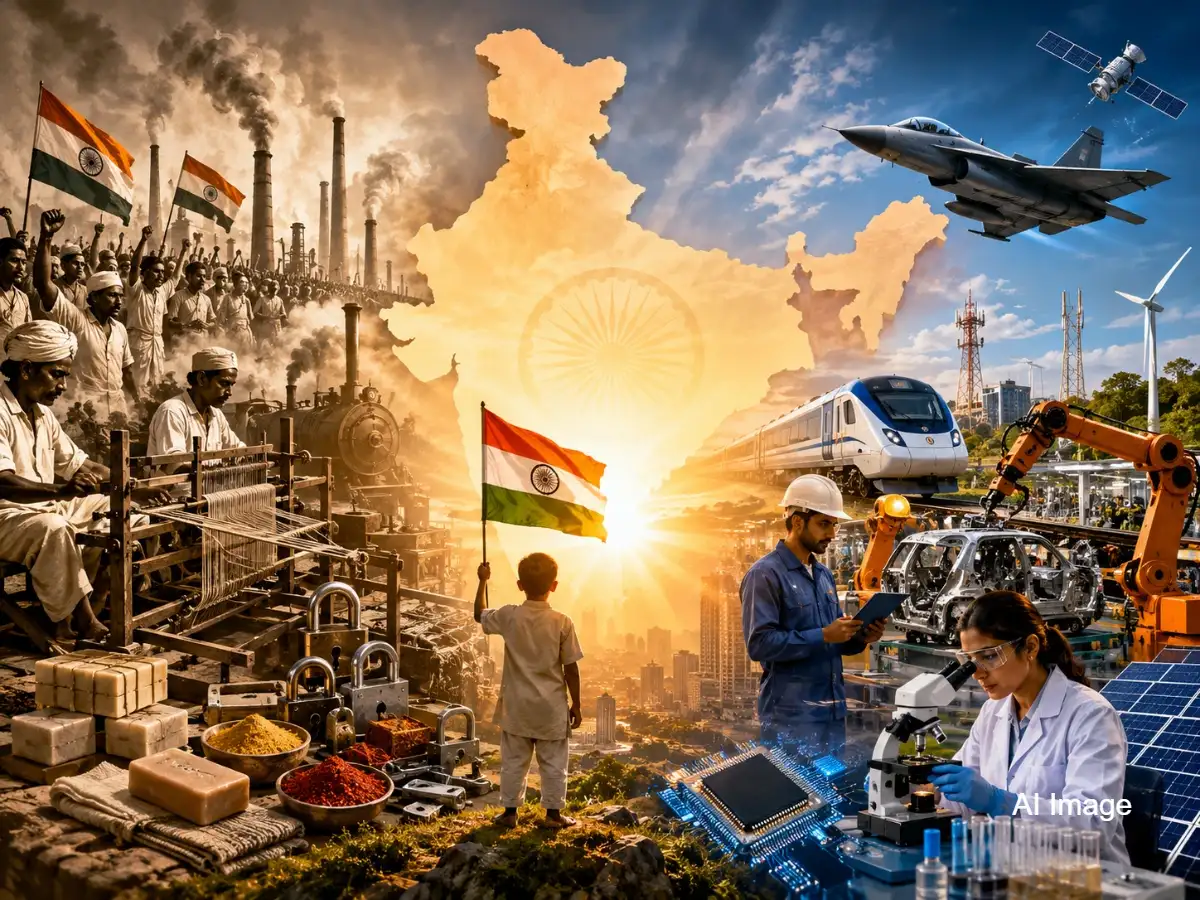
In July 1905, Lord Curzon signed the decree to partition Bengal, inadvertently igniting a commercial firestorm across the subcontinent. Citizens emptied their cupboards of foreign trinkets, casting imported Lancashire cotton, British soaps, and imperial stationery into street corner bonfires.
The Swadeshi Movement did not merely ask Indians to make a political statement; it demanded an economic change.
Four decades later, that instinct for economic self-determination became the bedrock of an independent republic.
Also Read | Did Churchill let 30 lakh Indians die? A journo took on Amartya Sen
Where early freedom fighters wielded Swadeshi as a shield against imperial exploitation, modern consumers embrace Atmanirbhar Bharat and Viksit Bharat as engines of global expansion.
The battleground, however, has traded bonfire smoke for optical fibre.
To trace this arc is to witness how early industrial pioneers turned boycotts into enduring corporate titans—and how modern policy frameworks are rewriting India's industrial narrative on the global stage.
Pitching economic freedom
For consumers embracing the Swadeshi Movement, turning their backs on British imports meant giving up many of the everyday goods of the Raj—from Lever Brothers soaps to British steel rails.
Seeing opportunity amidst the outrage, a league of Indian visionaries stepped up to prove that homegrown ingenuity could rival imperial commerce .
In 1897, Ardeshir Godrej walked away from a budding legal career, convinced that Indian craftsmanship could “out-lock” the finest locksmiths of London.
By 1918, that ambition yielded Godrej No. 1 —the world’s very first soap crafted entirely from vegetable oils instead of animal fats, a move that respected local cultural ethos while outperforming imported alternatives.
Also Read | Made in India, deployed abroad: The expanding map of India's arms exports
Over in Jamshedpur, Jamsetji Tata’s dream took physical form in 1907 with the establishment of the Tata Iron and Steel Company (TISCO). Colonial skeptics scoffed, claiming Indian steelmakers would never meet imperial standards. TISCO responded by churning out hundreds of thousands of tonnes of high-grade steel rails during the World Wars, helping establish India's heavy industry.
The kitchen pantry told a similar story.
In 1929, the Chauhan family launched Parle, determined to break Britain’s monopoly on imported sweets with affordable, locally made confectionery. By 1939, they rolled out Parle-G , a biscuit thatremains a household staple nearly a century later.
Meanwhile, Mahashay Dharampal Gulati’s family laid the foundation for MDH in Punjab, transforming raw local spices into standardised, ready-to-use blends that drove imported British seasonings out of Indian kitchens.
These early pioneers proved that domestic enterprise could earn consumer loyalty through excellence rather than relying solely on patriotic sentiment.