Suzuki Motor Thailand, the local arm of the Japanese carmaker, is ready to upgrade all locally made vehicles to meet the Euro 5 standard, but the government has to decide on a measure for overall compliance.
Suzuki produces three eco-cars at WHA Eastern Seaboard Industrial Estates -- the Swift, Celerio and Ciaz -- but only the Swift meets Euro 5 standards, as the model is under phase two of the eco-car scheme.
The Celerio and Ciaz eco-cars are under the first phase, complying with the Euro 4 standard, while imported models from Indonesia such as Ertiga and Carry have yet to comply with Euro 4.
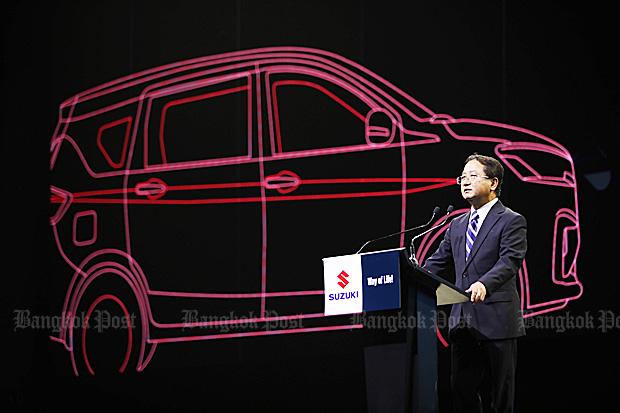
"For Suzuki, it is not a problem to upgrade to Euro 5," said newly appointed president Minoru Amano. "Suzuki has to do so once the government orders it."
He said two existing eco-cars could upgrade to Euro 5 once Suzuki decides to make the new versions.
Mr Amano said complying with Euro 5 is reasonable because the government is allowing a grace period of 1-2 years for car manufacturers and importers to prepare for the new regulation.
In 2019, Suzuki aims to sell 33,000 cars locally, up by 15.8% from last year.
Of total sales, 27,170 units are expected to be Suzuki's eco-cars, and the remaining models are Carry mini-trucks (3,440) and Ertiga multi-purpose vehicles (2,390).
Wallop Treererkngam, executive director for sales and marketing, said Suzuki remains upbeat on local sales in 2019 even though the overall car market is expected to be stable at 1.04 million cars.
"The sales growth comes from Suzuki's local network, which is expected to reach 140 showrooms and service centres by March 2020, up from 125, to support Thai motorists," said Mr Wallop.
In 2018, Suzuki posted 28,503 cars sold, a rise of 14%. The carmaker captured a 2.7% market share and the eighth spot in the local market.
Three eco-cars models sold 24,625 units in 2018, a gain of 16%.
In a related development, Suzuki introduced yesterday the new Ertiga, powered by a 1.5-litre benzene engine. The price tags are 655,000 and 695,000 baht, as they release less CO2 emissions than 150 grammes per kilometre to enjoy a 5% excise tax reduction, compared with the previous version.
Suzuki plans to launch two more new models this year.
Shuji Oishi, managing officer of the Shizuoka-based Suzuki Motor Corporation, said the company has allocated two manufacturing sites for the Ertiga, India and Indonesia, which are the largest two markets for Suzuki.
Both plants produce for domestic sales and export to 30-40 countries, including Thailand.
He said Suzuki has no plans to allocate Ertiga production to the Rayong plant, which is set to produce eco-cars.
Suzuki has applied for two phases of the government's eco-car scheme, in 2007 and in 2014, and was granted Board of Investment (BoI) incentives.
In early 2018, Suzuki announced the implementation of two eco-car projects at the Rayong plant.
"Suzuki's mission for the Rayong plant is to reach maximum capacity of 100,000 units a year in the near future," Mr Oishi said. The plant utilises the capacity for both local sales and exports, the latter of which comprise 60%.
Suzuki applied for the government's electric vehicle (EV) scheme to produce hybrid EVs along with four Japanese rivals -- Toyota, Honda, Nissan and Mazda. Suzuki's project is pending BoI approval, while other four firms were granted privileges.