History has rendered its verdict, but the tragedy is that so few were listening when the verdict still had the power to save lives.
When Daw Aung San Suu Kyi stood before the International Court of Justice in The Hague in December 2019, much of the world believed it was witnessing the moral collapse of a woman it had once revered. What many failed to see was the machinery behind the moment: a military system that had brutalised Myanmar for generations, perfected impunity as governance, and would soon reveal that its appetite for violence was never confined to one people or one allegation before a court.
The catastrophe unleashed by the coup of Feb 1, 2021, made one truth impossible to deny. The Burmese military was never an instrument of law. It was an architecture of domination. It burned Rohingya villages and Karen villages. It bombed Kachin, Chin, Karenni, Shan, and Bamar communities. It imprisoned elected leaders, students, monks, journalists, physicians, teachers, and children. Democracy itself became the newest identity under attack.
What was missed in 2019 was not the reality of suffering. The suffering was immense. What was missed was the structure of power. The world became absorbed in the moral drama of one woman while neglecting the institution that trapped an entire nation inside a constitution designed to preserve military supremacy. It judged personality while ignoring machinery. It debated symbols while the generals retained the guns, the prisons, the ministries, the money, and the constitutional veto. The result was not justice. It was historical blindness dressed in moral certainty.
Daw Aung San Suu Kyi did not create the Tatmadaw. She spent much of her life imprisoned by it. She did not design the 2008 Constitution nor command the battalions that had terrorised ethnic communities for decades. Yet the world, intoxicated by the simplistic narrative of betrayal, found it easier to condemn a fallen icon than to understand the prison in which Myanmar's democracy had been forced to operate.
The crime has not changed. Only the victims have multiplied.
The military has always been impartial in one respect: it brutalises anyone standing between it and absolute power. Rohingya, Karen, Kachin, Chin, Karenni, Shan, Bamar; Muslim, Christian, Buddhist; student, monk, journalist, farmer, physician, mother, child -- the categories change, but the logic remains. Its enemy is not one ethnicity. Its enemy is accountability, federal democracy, and civilian life organised beyond military command.
There is a terrible arrogance in assuming that moral outrage is the same as moral understanding. Outrage can awaken conscience, but outrage without historical comprehension can become another form of violence.
Myanmar was never a morality play arranged for the emotional convenience of distant observers. It was, and remains, a nation struggling to free itself from one of the world's longest-running military dictatorships while holding together one of its most ethnically and religiously diverse societies.
Much of the world confused the failure of a constrained democratic transition with the failure of one woman. It mistook propaganda for analysis, fragmentation for truth, and certainty for knowledge. It underestimated the capacity of authoritarian systems to manipulate perception, weaponise ethnic suffering, and hollow out democratic institutions from within.
That prophecy has become reality.
Myanmar is no longer merely a Burmese tragedy. It is a warning to every democracy. When military power stands above civilian authority, when truth becomes subordinate to narrative, and when law becomes performance, authoritarianism does not retreat. It waits. It adapts. Condemnation without strategy is theatre.
Justice delayed does not disappear. It metastasises.
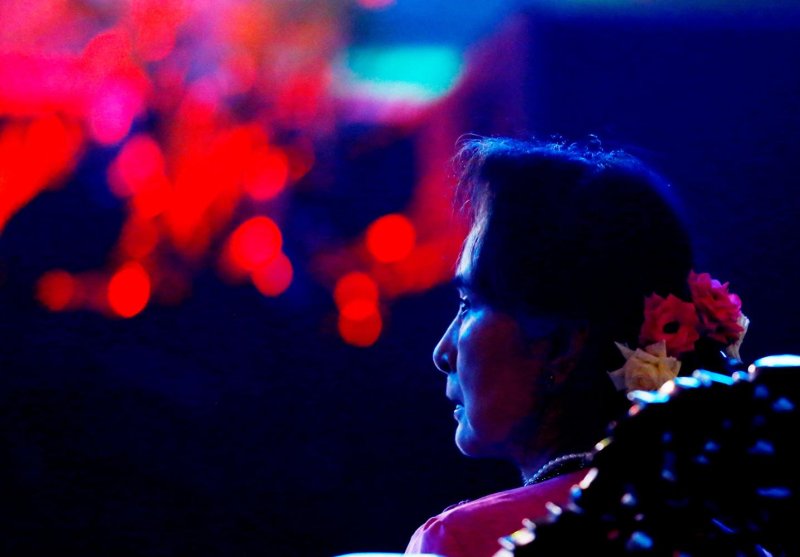
Today, Daw Aung San Suu Kyi remains imprisoned in severe isolation. Her family continues to demand credible proof of life while uncertainty persists over her health and whereabouts. Last week, Myanmar's authorities denied a request for Asean's special envoy to meet her.
Meanwhile, millions of Myanmar's people have been displaced, millions face hunger, tens of thousands have been detained, villages burned, hospitals and schools bombed, journalists imprisoned, and an entire nation's democratic future held hostage by men who have mistaken coercion for legitimacy. Myanmar is not asking for pity. Pity is too small for a nation of such courage. It asks instead for moral imagination, historical honesty, and the discipline to distinguish the smoke from the fire, the symbol from the structure, the accused from the architect.
History has rendered its verdict.
The question now is whether anyone, finally, will listen.
Alan Clements is an author, former monk ordained in Myanmar, and longtime human-rights advocate. He is the author of 17 books, including 'Conversation with a Dictator', 'Unsilenced: Aung San Suu Kyi -- Conversations from a Myanmar Prison', and 'Politics of the Heart: Nonviolence in an Age of Atrocity'.