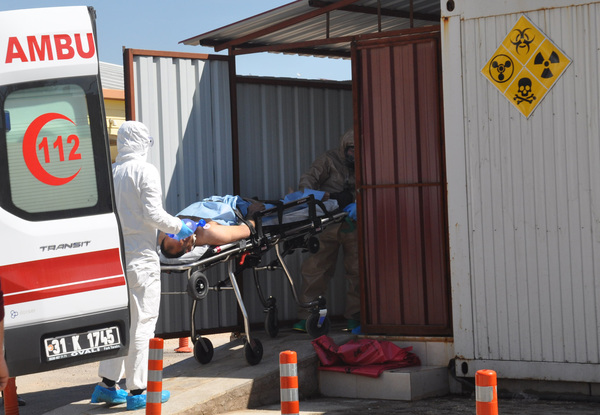
BEIRUT _ Dozens of people were killed and scores were wounded Tuesday in a suspected chemical weapons attack on rebel-held areas of northern Syria, activists and a monitoring group said.
Some activists placed the death toll from 70 to 100. Several reported that airstrikes had targeted clinics treating the wounded.
The Syrian Observatory for Human Rights, a pro-opposition monitoring group with a network of activists in Syria, said medical crews had treated suffocation victims exhibiting iris shrinkage, paleness, spasms and other symptoms of what the medical crews said was poison gas. The group said medical crews reported at least 58 people were killed.
The attack, doctors said, came as a result of an airstrike by unspecified warplanes on the town of Khan Shaykhoun in the northwestern province of Idlib.
Rami Abdul Rahman, the director of the observatory, said in a phone interview that his group had spoken to doctors treating casualties in a medical facility, but had not dispatched its own observers to the site of the airstrikes.
Idlib is the primary bastion of Syria's embattled opposition, and has been the target of frequent attacks by Syrian and Russian warplanes.
Some activists said the attackers may have used sarin, a colorless, tasteless liquid that is lethal if inhaled or exposed to the skin.
Igor Konashenkov, a spokesman for the Russian Defense Ministry, said in an interview with the Russia Today news channel that Russian warplanes had not conducted any strike in the area. He said the report of airstrikes was fake news.
A Syrian military official also denied that the army had deployed chemical weapons.
The army "has not and does not use them, not in the past and not in the future, because it does not have them in the first place," the unnamed source told Reuters.
Tuesday's strikes, if confirmed to have been conducted with chemical weapons, would be the deadliest chemical weapons attack since August 2013, when the opposition accused forces loyal to Syrian President Bashar Assad of lobbing sarin-filled shells on rebel-held enclaves near Damascus. More than 1,000 people were killed, according to U.S. estimates.
Those attacks spurred worldwide condemnation, and brought the U.S. to the brink of attacking Syria. A deal pushed through by Russia, however, saw the government surrender its stockpiles of chemical weapons _ including sarin and VX _ to the United Nations.
Although the Organization for the Prohibition of Chemical Weapons says more than 95 percent of the government's arsenal was eliminated (including more than 600 tons of sarin and mustard agents, which were destroyed in 2014) as a result of the agreement, it has nevertheless confirmed instances of chemical attacks, primarily with chlorine gas, by government as well as rebel forces.
Ahmet Uzumcu, the director general of the organization, the U.N.-appointed body responsible for eliminating the government's chemical weapons, said the OPCW had started a fact-finding mission that was "in the process of gathering and analyzing information from all available sources."
Gregory Koblentz, associate professor at George Mason University and a member of the Scientists Working Group at the Center for Arms Control and Non-Proliferation, said that the attack appeared to have used chemical weapons.
"I've looked at some of the images and videos ... it definitely appears to be some sort of chemical attack, since the victims don't have any obvious signs of injury," Koblentz said in a phone interview Tuesday. "And the (victims) are all getting hosed off before being admitted to hospitals. It's a clear sign that the first responders are worried about chemical agents."
But, he said, without getting environmental samples and samples from victims "it won't be possible to be definitive." There were reports that some of the victims had been rushed across the border to Turkey for further analysis, he said.
The Syrian National Coalition, an opposition umbrella group, demanded in a statement that the U.N. Security Council take measures to "hold the Assad regime accountable" for "the horrific crime committed ... in Khan Shaykhoun."
Failure to do so, it said, "would be understood as a message blessing the regime for its actions."
Social media was inundated with horrific videos and images of the victims of the attack.
One of the images depicts a dozen children tucked under a purple blanket. One girl's face is a rictus of sadness, her eyes gazing lifelessly out into the distance.
"May Allah have vengeance against the unjust ... first of them the Arab rulers," says a voice on a video as one man moves the head of a baby to face a camera. It too is dead.
Another image shows a man foaming at the mouth as he lies on the bed of a pickup truck.
Hadi Abdallah, an opposition media activist based in Idlib, recorded video at the site of the attack Tuesday. Wearing a gas mask, he pointed to where what he claimed was a poison-filled rocket had fallen.
"This shows the lie that the Assad regime had handed over the chemical weapons to the U.N.," he said.
The claims of a chemical weapons attack come at a time when the Assad government appears to have forced a fait accompli on its local and international adversaries.
Secretary of State Rex Tillerson offered the clearest indication yet of the Trump administration's view on Syria's future Thursday when he said the fate of Assad was in the hands of Syrians.
"I think the ... longer-term status of President Assad will be decided by the Syrian people," Tillerson said during a news conference in Ankara with Turkish Foreign Minister Mevlut Cavusoglu.
The Obama administration favored Assad leaving power, and covertly armed Syrian rebel groups to that end, but never acted directly.
The State Department condemned the attack and said it was awaiting more information on who was behind it.
"If this is what it looks like, it is clearly a war crime," a senior State Department official said, adding that the attack was "reprehensible."
Sen. John McCain, R-Ariz., chairman of the Senate Armed Services Committee, released the following statement on the attack:
"With President Obama's 'red line' far in the rear-view mirror, Assad believes he can commit war crimes with impunity. The question that confronts the United States now is whether we will take any action to disabuse him of this murderous notion," McCain said.
"Aided and abetted by (President Vladimir) Putin's Russia, the Iranian regime, and its terrorist proxies, Assad will resort to any form of butchery he believes necessary to preserve his dictatorship, from chemical weapons to barrel bombs to torture chambers like Saydnaya prison," he said. "In case it was not already painfully obvious: The notion that the Syrian people would be able to decide the fate of Assad or the future of their country under these conditions is an absurd fiction. The recent statements by U.S. officials suggesting otherwise only serve to legitimize the actions of this war criminal in Damascus."
White House spokesman Sean Spicer told reporters Tuesday that "the president is extremely alarmed at these revelations" but said the attack was a "consequence of the past administration's weakness and irresolution."
President Barack Obama did not act after he publicly warned that Assad would cross a "red line" if his forces used chemical weapons in 2012, Spicer said. Assad later used chemical weapons, but Obama did not intervene with military action.
"What's the point of red lines? America's credibility was at stake," Spicer said. "We did have alternatives to regime change and they weren't taken."