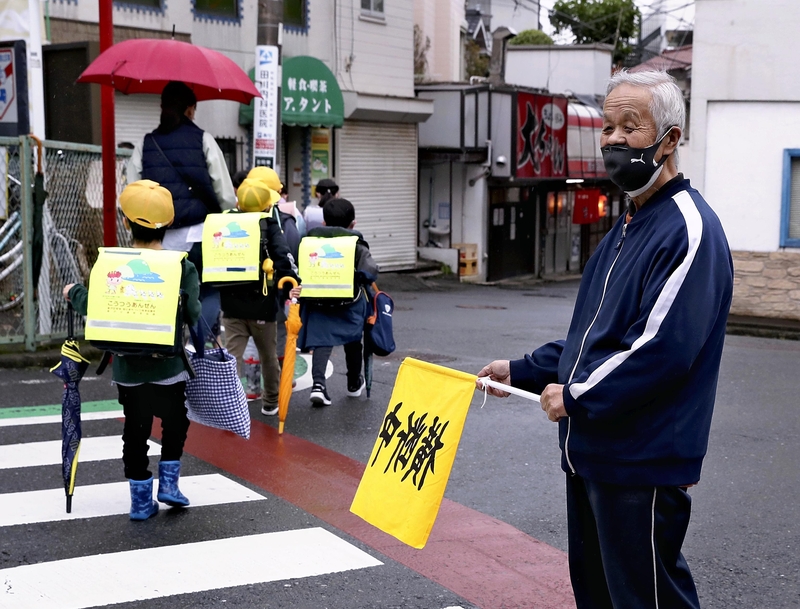
About 27,000 improvement requests were made for elementary school routes -- citing traffic accident risks -- in major cities across the nation over a three-year period, but only about half of them have been addressed, according to a recent survey conducted by The Yomiuri Shimbun.
Safety improvement measures were taken for a total of 14,700 cases, according to the survey. Budget shortfalls were among the reasons cited for the lack of progress.
Comprehensive inspections of school routes had been carried out in the past, but the latest survey highlighted the current situation, in which there are still many dangerous spots left unaddressed.
The survey was conducted from July to October by sending questions to 74 local governments -- prefectural capitals, ordinance-designated cities and Tokyo's 23 wards. The survey asked questions about the situation covering the 2018 to 2020 academic years, such as the number of requests received from parents, residents and others, the number of cases in which safety measures were taken and reasons why they were unable to take measures. Seventy local government provided responses.
With no clear legal definition, the Education, Culture, Sports, Science and Technology Ministry has requested that boards of education, schools and the police jointly set school routes, taking into account traffic conditions. In many cases in Japan, school routes are decided by school principals.
According to the survey, the number of improvement requests totaled as many as 27,000 in the 70 local governments. The improvements included installing guardrails, crosswalks and traffic lights, as well as coloring sidewalks. Suginami and Kita wards in Tokyo and Osaka City did not record the total number of requests.
Safety measures were implemented by 69 local governments for about 14,700 requests, including those that had been made in and before the 2017 academic year.
As for the reasons for the lack of progress in taking safety measures, 25 local governments, including Nagoya City, cited problems with the conditions of roads, such as "roads are too narrow to implement measures."
The cities of Tsu and Naha were among the 21 local governments that cited insufficient budgeting. Eleven local governments, including Tokyo's Toshima Ward, cited the restrictions on installation intervals of traffic lights and crosswalks under the National Police Agency's guidelines based on the Road Traffic Law, among other rules.
In the four cities of Okayama, Matsue, Yokohama and Otsu, seven traffic accidents occurred on school routes for which improvement requests had been made in the past. One child died and six others sustained minor injuries in those accidents.
In 2012, two children were killed in Kameoka, Kyoto Prefecture, when a car plowed into a group of children on their way to school. In response to the accident, the ministry called for safety inspections and measures to be taken on school routes across the nation.
Of 74,000 dangerous spots on school routes, safety measures were taken at about 97% of such places by the end of the 2017 academic year. However in June this year, another accident occurred in Yachimata, Chiba Prefecture, killing two children and inflicting serious injuries on three others.
There had been improvement requests made for the accident site, but no action had been taken. Taking this into consideration, the central government has been carrying out comprehensive inspections of school routes again since July.
Read more from The Japan News at https://japannews.yomiuri.co.jp/