A sharp decline in the number of butterflies in satoyama-satochi, or areas such as fields, rice paddies and forests in close proximity to human settlements, has been noted in a recently released survey. Out of 87 species of butterfly, about 40% were shown to be rapidly decreasing in number.
Drops in the number of species of plants and animals have become a worldwide concern, and the survey's findings, released in November, indicate the trend could be also occurring in places close to human communities in Japan.
In 2002, the Environment Ministry compiled the National Biodiversity Strategy of Japan, under which it started a project to continuously monitor the natural environment, so as to conserve it. The Nature Conservation Society of Japan (NACS-J), based in Tokyo, serves as a secretariat for the project.
About 1,000 people interested in nature conservation activities, including laypersons, students and researchers, participate in the annual monitoring activities.
Titled "Monitoring Sites 1,000 Program," the survey got fully underway in fiscal 2008. Participants recorded the species and populations of living creatures they encountered while walking predetermined routes and using cameras that could take automatic pictures.
Large impact on ecosystem
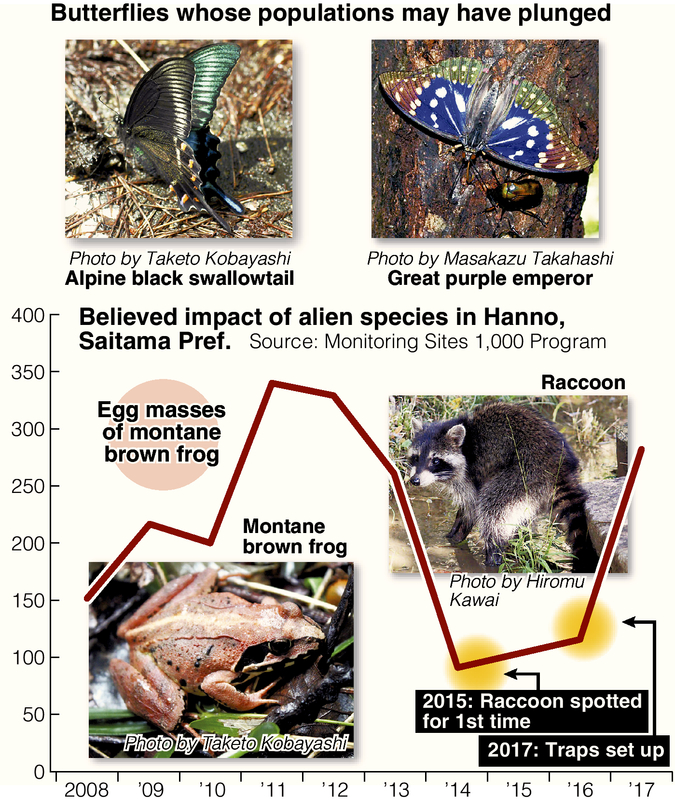
Analysis of the data showed the number of butterflies has been declining considerably. Among 34 species experiencing such drops, the alpine black swallowtail, which can be found in a wide range of regions from Hokkaido to Kyushu, has decreased by an average of 31.4% per year. The number of great purple emperor, which is designated as the national butterfly of Japan, has fallen 16.1% per year.
When compiling its own red list of species threatened with extinction, the ministry categorizes species based on such factors as how fast they are decreasing in number, how wide their area of habitation is, and how high the danger is of their extinction in the immediate future.
Based on the rates of decline found in the survey, about 40% of the monitored butterflies could be considered as endangered species under the red list, according to the NACS-J.
"The survey showed once again how critical the butterflies' situation is," said Minoru Ishii, a professor emeritus of insect ecology at Osaka Prefecture University. "Butterflies support ecosystems through the food chain, as their larvae are eaten by other animals. This means [their decreasing numbers] will have a major impact on other creatures."
In addition to butterflies, the survey found a similar trend among about 20% of bird species covered in the monitoring activities, such as cuckoos. The number of hares also nosedived.
Taku Fujita, an NACS-J official who is an expert on ecology, said it was highly likely that species living in satoyama were shrinking in number "because the environment of satoyama has gone through changes, such as not being well managed by people any more." In fact, 90% of the forests monitored were found not to have been properly managed.
Increasing alien species
The Intergovernmental Science-Policy Platform on Biodiversity and Ecosystem Services (IPBES), an organization consisting mostly of scientists from around the world, released a report in May saying: "Human actions threaten more species with global extinction now than ever before ... Around 1 million species already face extinction."
The IPBES cited the increasing impact of alien species as one of the causes for the extinction of native ones.
The survey also found an increase in the number of alien species, such as raccoon and Chinese thrush. In particular, the population of raccoons increased by about 20% per year.
Forestry areas in Hanno, Saitama Prefecture, are among the sites monitored in the survey. The spawning of montane brown frogs there was found to have shrunk from around 2013. Around the same time, a number of raccoon began to be spotted, and they were eventually confirmed to have inhabited the area in 2015.
By the end of 2017, four raccoon had been captured in traps, and the frogs' egg production was found to have recovered, according to NACS-J.
"Although a causal relationship cannot be determined," Fujita said, "this is a case in which the influence of foreign species is strongly suspected."
It had been difficult in the past to conduct a large-scale survey on satochi-satoyama over a long period of time because these areas are mostly privately owned.
"It's significant that a survey conducted mainly by laypersons found that [many species] were decreasing [their numbers]," said an Environment Ministry official in charge. "I hope the report [of the survey] will be used by municipalities when designing their own environmental conservation projects."
Read more from The Japan News at https://japannews.yomiuri.co.jp/