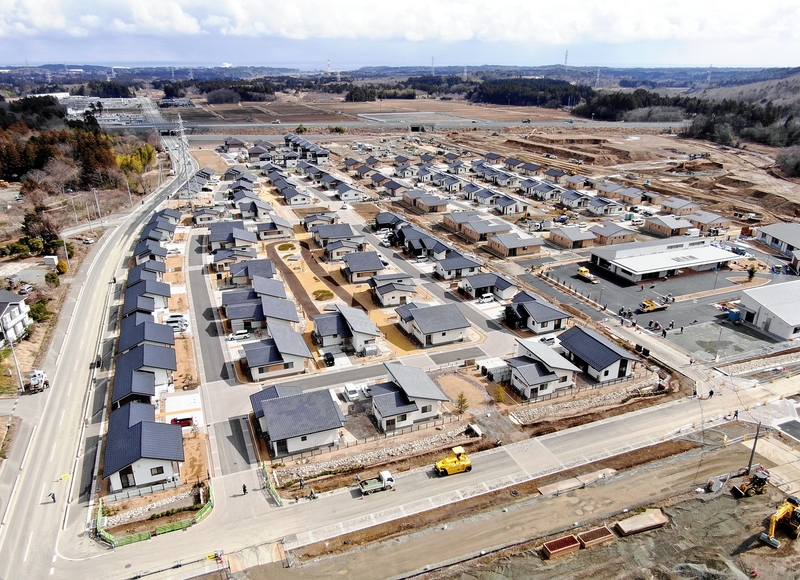
Ahead of the ninth anniversary of the Great East Japan Earthquake on Wednesday, a Yomiuri Shimbun opinion survey found 66% of respondents think the reconstruction of disaster-hit areas has been "progressing," up seven percentage points from 59% in a similar survey a year ago.
Those who answered that reconstruction has been progressing included 4% who said "very much" and 62% who said "more or less." A total of 33% said reconstruction is "not progressing," with 31% saying "not well" and 2% "not at all."
The view that reconstruction is progressing has been increasing as the years go by. In a 2014 survey conducted through interviews three years after the disaster, only 37% gave this response. Since a 2017 postal survey, the figure had remained at around 60%, until this year's rise to 66%.
The increase in the number of people who believe that reconstruction is progressing apparently reflects the fact that evacuation orders for municipalities near the Fukushima No. 1 nuclear power plant have been lifted and that services on the JR Joban Line, which have been partially suspended for years, will be fully resumed this month.
When asked about the most concerning points for reconstruction, with multiple answers allowed, 69% chose "the livelihood of the disaster victims" as one of their answers, followed by 58% who identified "the issue of treated water containing radioactive substances," referring to contaminated water being purified at the Fukushima No. 1 nuclear power plant of Tokyo Electric Power Company Holdings Inc. "The government's reconstruction efforts" was chosen by 49%, and "reputational damage to agricultural and fishery products" by 35%.
When asked about the disposal method for treated water, 68% answered that it "cannot be decided at this time" while 20% said it should be "released" into the ocean and atmosphere, and 10% said the water should "continue to be stored, not released."
Regarding disaster prevention, 41% of respondents said they had checked hazard maps for their area showing where disasters such as floods, landslides and tsunami would be expected to occur, while 58% said they had not checked such maps.
Those who said reconstruction is "not progressing" were asked to give up to three reasons for their answer, with "the effects of the nuclear accident are massive" being chosen by 69%, "the scale and extent of damage from the disaster is large" by 53%, and "the government's response is slow" by 38%.
When asked whether they take an interest in the reconstruction of the disaster-hit areas, 86% answered positively, combining 27% who responded "very much" and 59% who said "to some extent." In last year's survey, a combined 84% gave such responses. Those who answered that they are not interested in reconstruction stood at a combined 13%, down from 16% a year ago, with 12% saying they are "more or less not interested" and 1% "not at all."
The nationwide survey was conducted from Jan. 21 to Feb. 27 through the post, with 2,189 responses, or a rate of 73%.
Read more from The Japan News at https://japannews.yomiuri.co.jp/