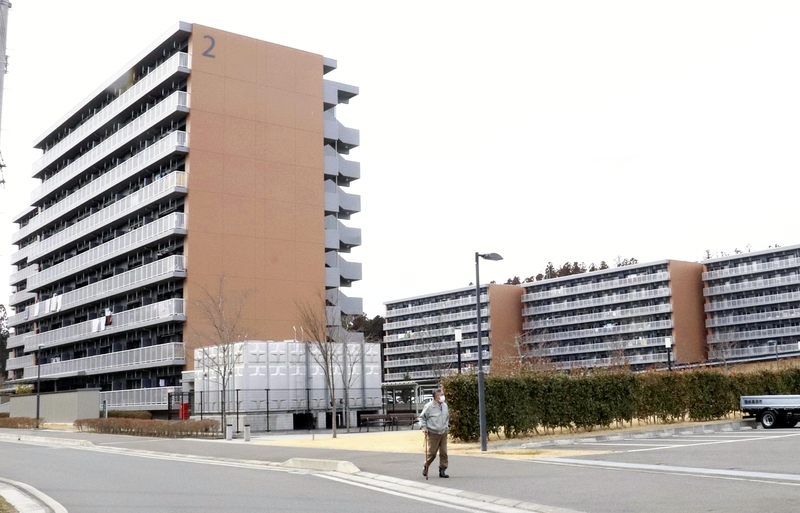
At least 243 died alone in rental accommodation provided by local governments in the wake of the Great East Japan Earthquake, according to a Yomiuri Shimbun survey.
The so-called solitary deaths occurred in the quake-hit prefectures of Iwate, Miyagi and Fukushima. In many cases, the bodies of those who had died were discovered several days after their deaths.
The rental accommodation they had been provided with is considered to be the last resort for displaced residents struggling to rebuild their homes, following periods spent in temporary accommodation.
As many residents in such accommodation are elderly or live alone, efforts to help them connect with others have become a matter of urgency.
The Yomiuri Shimbun surveyed affected prefectural governments and local governments in January and February, ahead of the 9th anniversary of the disaster.
The definition of solitary death is not set in stone. It is defined in Miyagi Prefecture as deaths of people whose bodies were discovered -- regardless of where the person had died -- and includes suicides. In Iwate Prefecture, it is defined as people who were found dead inside their homes and excludes suicides. Meanwhile, in Fukushima Prefecture, it is defined as people who were found dead inside their homes, without reference to suicides.
About 99% of the 29,810 planned reconstruction housing units have been built in three prefectures alone.
The solitary deaths, first recorded in 2013, have so far totaled 164 in Miyagi Prefecture, 49 in Iwate Prefecture and 30 in Fukushima Prefecture.
The number of solitary deaths in reconstruction housing in Miyagi and Iwate prefectures exceeded those of similar deaths confirmed at temporary accommodation units in the two prefectures. From 2011 to 2018, the number of such deaths in temporary housing totaled 109 in Miyagi and 46 in Iwate prefectures.
Men accounted for 70% of the solitary deaths in reconstruction housing: 173 were men, while 70 were women. By age, those in their 70s stood at 87, or 35.8%, and those in their 80s or older stood at 65, or 26.7%. People under 70 accounted for nearly 40% of the total.
In Iwate Prefecture, the bodies of 12 people, about 25% of the total, were not discovered for more than five days.
Behind such a trend is the fact that many residents in reconstruction housing are of advanced age or live alone.
While 42.6% of residents in reconstruction housing are aged 65 or older, the range is from 27.5% to 33.1% for the same demographic across the three prefectures as a whole. Single-occupancy reconstruction housing totaled 12,683, or 46.9%, with occupants aged 65 or older accounting for over half of the total, or 8,017 households.
With the reconstruction of housing progressing in quake-stricken areas, the number of displaced residents in temporary housing has fallen below 4,000.
Reconstruction housing, whose rents are determined by residents' incomes, are considered to be the last resort for elderly pensioners.
However, some residents cannot adapt to living in multi-unit housing complexes in which few acquaintances live. There tend to be fewer support resources for residents in such accommodation, as it is assumed that in most cases the recovery of residents' daily lives is almost complete.
Local governments are reinforcing the activities of support workers in response to the situation. Starting in the coming fiscal year, the Iwate prefectural government will promote opportunities for residents in reconstruction housing to interact, such as by holding local art performances.
Teruo Honma, a Tohoku Gakuin University academic who specializes in welfare, said: "Residents in multi-unit housing complexes can have difficulties connecting with those around them. Public administrative offices should promote the building of communities through such facilities as social spaces rather than leaving such efforts up to residents' associations."
Read more from The Japan News at https://japannews.yomiuri.co.jp/
.jpg?w=600)