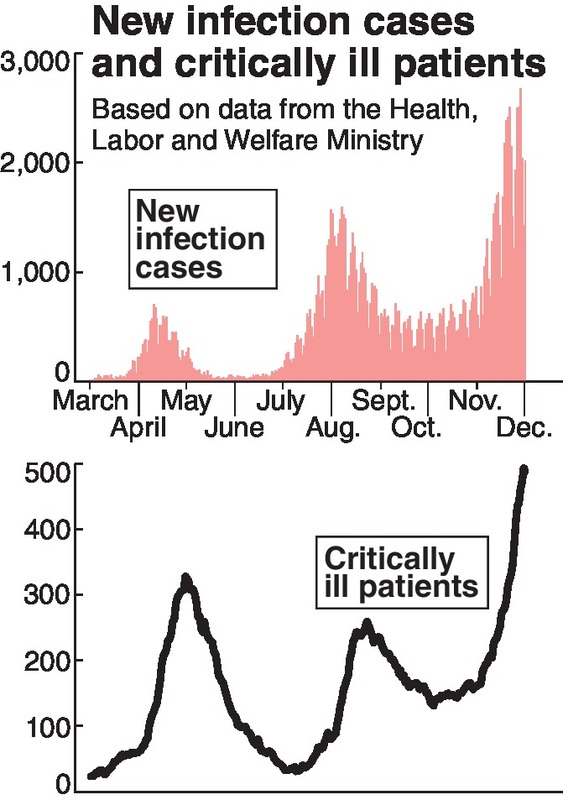
The so-called "third wave" of the coronavirus pandemic has produced a surge in the number of critical cases, with the total nearing 500 nationwide as of Wednesday.
The pace of increase in infections overall has surpassed that of the spring and summer, putting mounting pressure on frontline medical facilities.
In Osaka Prefecture, the number of seriously ill patients increased nearly fivefold in the past month alone, and 58.1% of hospital beds reserved for such patients are filled.
A center set up in the prefectural office in late November, when the surge started, to coordinate the flow of patients to hospitals said the phone has been ringing off the hook and about 15 doctors and other medical personnel have been working late into the night handling cases. "How long is it going to go on like this?" said an exhauted-looking official.
The situation is much the same in other areas. The occupancy rates of hospital beds for critical patients is 50% in Tokyo, 30% in Kanagawa Prefecture, 24.8% in Aichi Prefecture and 28.3% in Hyogo Prefecture -- numbers that are two or three times those just a month before.
As an indicator of the severity of the crunch, both Tokyo and Osaka have reached Stage 4 (50% or above), the worst level of the infection situation.
In summer, it was mainly young people who were being infected, but now cases have also surged among the elderly and those with preexisting medical conditions, who are more prone to develop serious symptoms.
That has led to the surge in critically ill patients, putting pressure on frontline medical facilities. According to statistics compiled by the Tokyo metropolitan government, 31 of 34 deaths reported in November were people aged 60 and over, while 30 had preexisting conditions.
"The timing when patients develop serious symptoms is quite fast," Akifumi Imamura, director at the Tokyo Metropolitan Cancer and Infectious Diseases Center Komagome Hospital and a member of the government's coronavirus task force, told a press conference after a Nov. 25 meeting.
"If the number continues to increase at this rate, local areas where the medical infrastructure is weaker will be severely impacted."
Frontline medical workers are clearly seeing distinctive characteristics of the third wave.
"There seems to be no end in sight to the number of patients who become seriously ill and have to be transferred to advanced medical institutions," said Michihiko Tajiri, director of the Kanagawa Cardiovascular and Respiratory Center in Yokohama.
The center mainly took in patients with mid-level symptoms, the elderly and those with preexisting conditions. As of Wednesday, 28 of 33 beds set aside for coronavirus patients were occupied -- 22 with patients 65 and older. In November, 12 of 60 inpatients became seriously ill and were transferred to another hospital. With hospital beds filling up in Yokohama, a number of patients have had to transferred to hospitals outside of the city.
The situation is stretching the usual medical care system to the brink. Until now, it was common for people aged 65 and over and those with preexisting conditions to be hospitalized, even if they had no symptoms. With the rapid surge in cases, the Health, Labor and Welfare Ministry sent a notice dated Nov. 22 to prefectural governments to allow patients with mild symptoms, for whom hospitalization is deemed unnecessary by a doctor, to stay in lodging facilities provided by local governments or to recuperate at home.
In response, local governments have begun reviewing their criteria for hospitalization. For example, Kanagawa Prefecture is considering a policy of quantifying the patient's condition and assigning a score to determine if they meet the criteria for hospitalization.
"If the situation is left unaddressed, it will hinder our ability to treat usual emergency patients such as heart attacks or victims of traffic accidents," said Ichiro Takeuchi, a professor of emergency medicine at Yokohama City University. "We have to take measures that let us provide medical care for both coronavirus and usual patients."
Read more from The Japan News at https://japannews.yomiuri.co.jp/