PHILADELPHIA — The U.S. Supreme Court on Tuesday rejected a Republican congressman's last-ditch effort to reverse the certification of President-elect Joe Biden's victory in Pennsylvania, delivering what legal experts described as an ominous sign for remaining litigation before the justices pushed by GOP allies of President Donald Trump.
The justices delivered their decision, without comment, in a terse, two-line order dismissing the case brought by U.S. Rep. Mike Kelly, R-Pa. Unlike previous Pennsylvania election challenges that have made their way before the court this year, none of the justices dissented in the decision to disregard the congressman's claims.
The ruling came more than a week after Pennsylvania certified its results, declaring Biden the victor in the state by some 81,000 votes, and just hours before the federal deadline for states to lock in their slate of delegates for the Dec. 14 Electoral College vote.
Kelly had argued that the law that enabled widespread mail voting in Pennsylvania for the first time this year was passed unconstitutionally and should have been subjected to the more rigorous process of an amendment to the constitution.
He had pushed lower courts to throw out every mail ballot cast in the state, disenfranchising 2.5 million voters, or alternatively to set aside the election entirely and to appoint the GOP controlled legislature to choose who won the state — remedies Pennsylvania's highest court flatly rejected last month.
Kelly's appeal before the U.S. Supreme Court had been among the last significant legal challenges left seeking to upset the election in Pennsylvania.
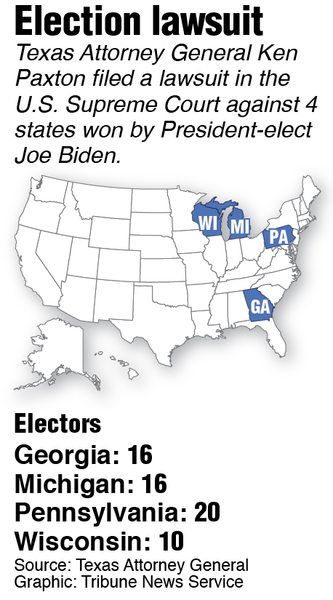
But in a separate bid filed late Monday, the state of Texas asked the court for leave to sue the state as well as Georgia, Michigan and Wisconsin for what Texas Attorney General Ken Paxton called "significant and unconstitutional" irregularities that cast the results into doubt in all four battleground states.
The unprecedented suit — which was riddled with factual errors and breathtakingly audacious arguments — asked the justices to disenfranchise millions of voters and to appoint state legislatures to declare the victors themselves.
It was quickly panned by an array of GOP, Democrat and nonpartisan election law experts.
Stephen Vladeck, an election law scholar at the University of Texas, predicted the court's decision Tuesday in Kelly's case also spelled doom for Texas' efforts.
"If the court had any interest in the issues raised in these cases, it would've stepped in" on Kelly's, he said. "That no justice publicly dissented here is a pretty clear message about where (the Texas) case is going, too."