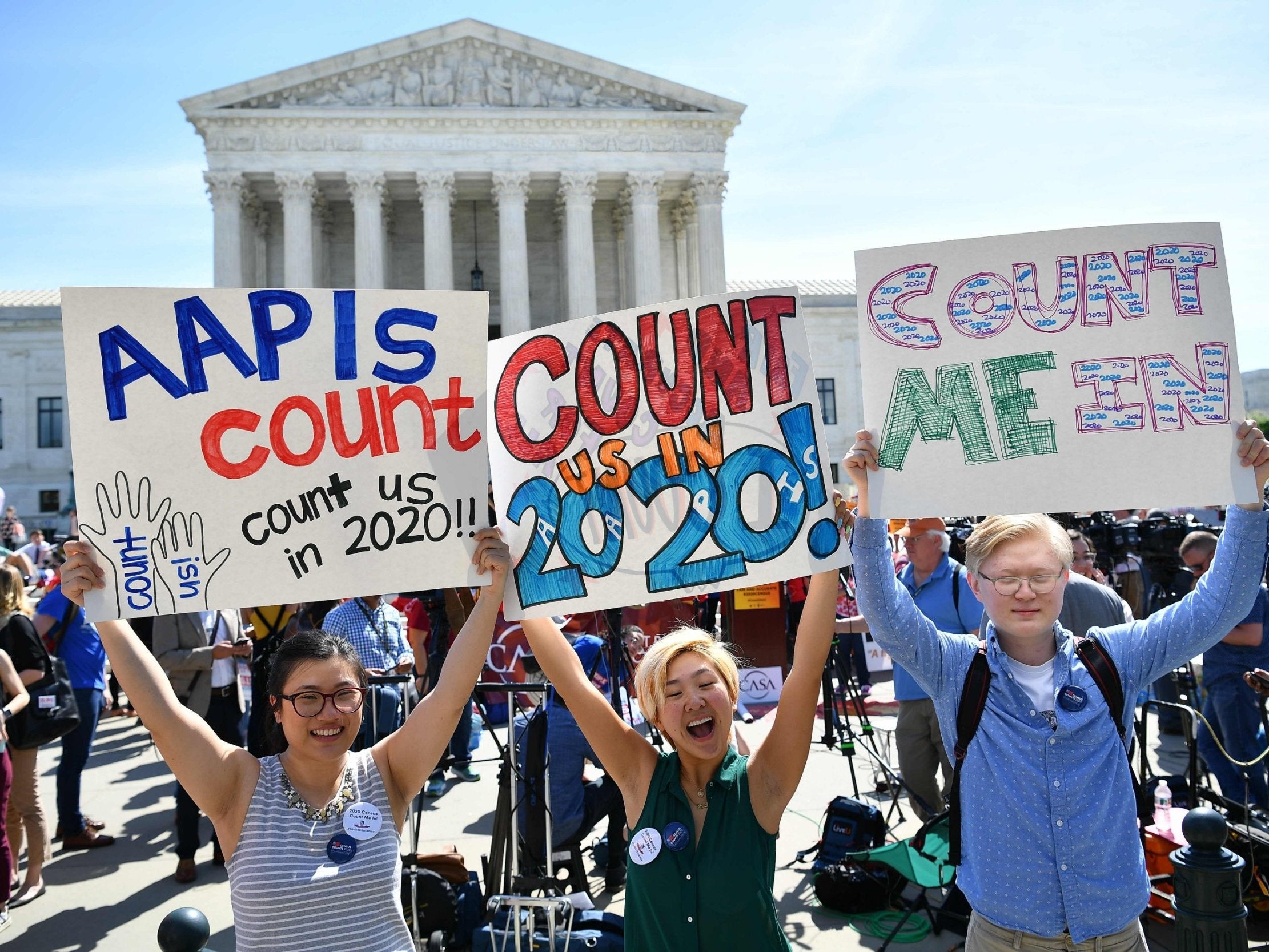
The United States Supreme Court appears poised to allow the Trump administration to include a citizenship question on the 2020 Census, a question that could depress the survey’s outcome and dramatically impact American politics for at least a decade.
America’s highest court heard oral arguments on the case on Tuesday, and questioning appeared to show a court split along ideological lines — with a likely 5-4 decision in favour of the Trump administration expected by observers of the court.
At stake is whether the Trump administration will be allowed to add a question about citizenship onto next year’s national headcount. The question, critics say could lead to an undercount that diverts federal funding and political clout especially from minority communities, and hands that over to whiter, more Republican, areas.
During oral arguments on Tuesday, the court’s liberal justices appeared particularly concerned with those outcomes.
“There's no doubt that people will respond less” to the census if there is a citizenship question, said Justice Sonia Sotomayor, who quickly began questioning US solicitor general Noel Francisco.
Justice Elena Kagan, meanwhile, said that the argument to include the question on the census for the first time since the 1950s was “contrived”.
Conservative justices, meanwhile, highlighted the discretion of US Commerce secretary Wilbur Ross in his oversight of the Census Bureau. Justices Brett Kavanaugh and Neil Gosuch — who were both appointed by Donald Trump — both noted that the question has been included on the census previously.
The citizenship question was before the court after multiple lawsuits were brought against the Trump administration by dozens of states, cities, and other groups concerned with the impact such a question could have.
Judges in New York, Maryland, and California had all ruled that the federal government’s effort violated established procedures for such a question to be added. The judges in Maryland and California also said that the question impacts the federal government’s ability to carry out the census.
The census is used to determine where to allocate $880bn in yearly funding for schools, roads, and other projects, and is used to calculate political representation in the House of Representatives.
The question’s inclusion was opposed by the US Census Bureau itself, which estimated that 6.5 million people may opt out of responding to the survey, which is administered every ten years.
“Given the stakes, the interest in an accurate count is immense,” Judge Jesse Furman of the Southern District of New York wrote in January, marking the first ruling on the question. “Even small deviations from an accurate count can have major implications for states, localities, and the people who live in them—indeed, for the country as a whole.”