Regal and robed, the justices of the US supreme court often cite musty edicts of centuries past and sheaves of legal reasoning accumulated over the decades. On Monday, one added comic books to the index.
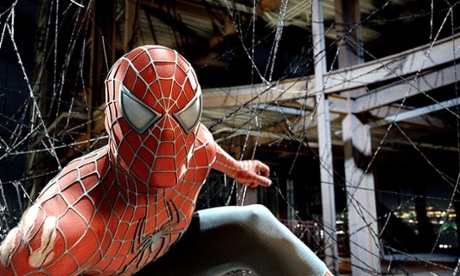
In the majority opinion of Kimble v Marvel Enterprises, justice Elena Kagan sprinkled quotes and allusions to Spider-Man into the court’s decision, using unusually wry language to leaven the ruling about a patent for “web-slinging fun”.
“In 1990, petitioner Stephen Kimble obtained a patent on a toy that allows children (and young-at-heart adults) to role-play as ‘a spider person’ by shooting webs –really, pressurized foam string – ‘from the palm of [the] hand’,” Kagan began.
Kimble met with Marvel’s then-president, and after the company started churning out similar toys, he sued. They settled and arranged an agreement – the subject of his current suit.
But “the parties set no end date for royalties”, Kagan continued, reasoning that they were “apparently contemplating that [the royalties] would continue for as long as kids want to imitate Spider-Man (by doing whatever a spider can).”
Unfortunately for Kimble, she found, “patents endow their holders with certain superpowers, but only for a limited time” – a 20-year period whose expiration also ends a patent holder’s right to collect royalties, according to a controversial 1964 supreme court decision. Kimble had asked the court to reject that decision, known as Brulotte.
Even if the court had made a poor decision in 1964, Kagan reasoned, the legal principle known as stare decisis – “to stand by things decided” – holds that the court should usually defer to precedent, especially in statutory cases like this one, in which Congress could rewrite the rulebook and overturn the court’s decisions.
Kagan summoned up Spider-Man to explain. “What we can decide, we can undecide,” she wrote. “But stare decisis teaches that we should exercise that authority sparingly.”
Compare with the words of Stan Lee and Steve Ditko, she continued, from Amazing Fantasy No15: Spider-Man, p13 (1962): ‘[I]n this world, with great power there must also come great responsibility’.
The justices would need “special justification” of more than the belief “that the precedent was wrongly decided”, she wrote, if they were to scrap the precedent.
She wove a web of reasons to support her argument, while conceding that the Brulotte decision might be a “wrong decision” that the court would have to stick to for the foreseeable future.
Overturning it could destabilize other patent or antitrust law, she reasoned, and patent holders and companies could write their agreements around Brulotte. The factors and others helped give the decision a “superpowered form” of precedent protection that would “need a superspecial justification” to overturn, she concluded.
Brulotte is not “the kind of doctrinal dinosaur or legal last-man-standing for which we sometimes depart from” precedent, she wrote.
The court’s four liberal justices were joined by Antonin Scalia and Anthony Kennedy, while conservatives Samuel Alito, John Roberts and Clarence Thomas dissented. Alito was not amused by Kagan’s jocular stand for precedent, and declared the original Brulotte “a bald act of policymaking”.
Alito expressed little faith that Congress could correct any mistakes it or the court had made, and argued that Brulotte already causes problems in contracts and licensing agreements. “In the end, Brulotte’s only virtue is that we decided it,” he wrote. “But that does not render it invincible.”
“As an initial matter, we do not give superduper protection to decisions that do not actually interpret a statute.”
“The court calls this a ‘superpowered form of stare decisis’ that renders statutory interpretation decisions nearly impervious to challenge,” he wrote in the dissent. “I think this goes a bit too far.”