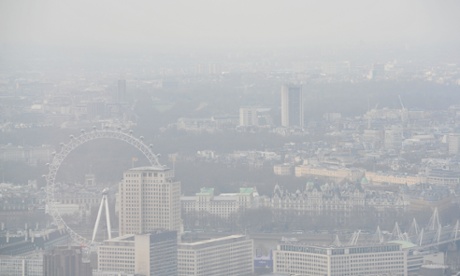
The Supreme Court has been asked to issue a legal order forcing the British government to comply with European air quality limits intended to curb the 29,000 deaths that are caused by pollution every year.
A 2015 deadline set by the EU to reduce concentrations of nitrogen dioxide (NO2), sulphur dioxide and particulate matter has already been missed, and the government has refused to guarantee that an alternative plan it is working on will be ready before the year’s end.
The Supreme Court had previously ruled that the UK was in breach of its obligations under the EU’s air quality directive in a long-running case brought by the environmental attorneys ClientEarth.
Asked in court on Thursday by Lord Sumption what more the plaintiffs hoped to get, ClientEarth’s appellant Ben Jaffey replied: “What I can get in addition is a mandatory order requiring preparation of a new air quality plan that complies with the law.”
ClientEarth wants measures such as low emissions zones, road pricing and congestion charging introduced in the shortest timeframe possible, preferably three months.
The government argues that it is already preparing a “game-changing” alternative plan and that with an upcoming election, such deadlines would be impossible to meet.
For the UK’s Department for Environment, Food and Rural Affairs (Defra), Kassie Smith QC said that cutting NO2 emissions was “extremely complicated” and that the government believed it had been left discretion to determine appropriate measures for doing so.
“Reducing nitrogen dioxide levels is neither easy nor quick and so plans will be focused and detailed,” she told the court. “These are issues that take a great deal of time to address because of the nature of the pollutant and the nature of the sources of the pollutant.”
Last year 700 police officers were deployed on the streets of Paris to enforce an alternating ban on cars with odd or even license plates, in a bid to cut the city’s air pollution by one half.
The government halted the scheme after one day, claiming success, although studies have questioned the effectiveness of such heavy-handed measures.
Defra plans to carry out consultations on potential measures that could be introduced in the autumn, before submitting a new air quality plan to Brussels by the end of the year. But this would be both “a very tight timetable,” and “difficult to do,” Smith said.
Such talk raises suspicions for the environmental law lobby, partly because a previous air quality plan devised by Defra in 2011 did not envision full compliance with the EU limits until an unspecified time before 2030.
“We can’t just take Defra’s word for it,” Alan Andrews, a lawyer for ClientEarth told the Guardian. “The court needs to step in and force Defra to come up with a new plan that complies with EU law in the shortest timespan possible. We can’t rely on vague assurances given by the government.”
The issue could have far-reaching public health effects. A survey in 2010 found that safe levels had been breached in 40 out of 43 areas for emissions of nitrogen dioxide (NOx), which is produced by cars and power stations. Levels were four times over the legal limit in choked London thoroughfares like Lambeth Road in Brixton and Putney High Street in Wandsworth.
A green light for plans to expand Heathrow airport could lead to even greater breaches of EU and UK air quality laws, according to a report published by environmental consulting firms, Clean Air Thinking and Environmental Resources Management, and highlighted by Gatwick airport on Thursday.
But after ping-ponging between the British legal system and the European Court of Justice, ClientEarth says that its current attempt to impel government action has reached the end of the road.
The supreme court justices are expected to deliver their verdict before the end of the year and the green law group’s minimum expectations are settling on a cautionary order or declaration of the mandatory nature of key elements of the air quality directive.
“The government’s plans should then be overturned as unlawful, so that would require a new plan anyway, but we don’t think that would be good enough,” Andrews said. “A mandatory order is urgently needed.”