The Supreme Court stuck up for congressional power in a ruling Friday invalidating most of President Donald Trump’s worldwide tariffs, a decision that gave insight into where the justices stand when it comes to how much presidents can do without getting lawmakers involved.
The justices in the 6-3 majority showed that most of the court wants Congress to be explicit when it gives away its powers such as taxation, although there was a split on how to arrive at the conclusion that Trump overstepped his emergency powers that he claimed were in a 1977 law.
Michael Thorning, director of the Structural Democracy Project, called the majority opinion “a bit of a Venn diagram of which members of the court believe what about how Congress can delegate that authority.”
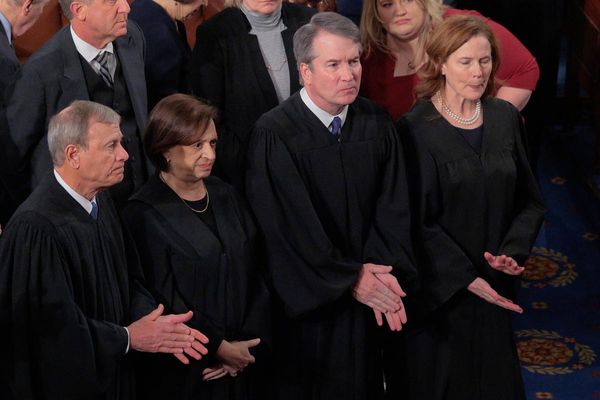
Three justices — Justice John G. Roberts Jr., Neil M. Gorsuch and Amy Coney Barrett — signed on to parts of the opinion that said that for such a “major question” Congress did not clearly give away tariff power to a president in the International Emergency Economic Powers Act of 1977, or IEEPA.
That’s building on a series of decisions by the Roberts court, where the conservative majority has said Congress must be explicit when answering “major questions” of political and economic significance.
Even among those three, Gorsuch and Barrett disagreed about exactly what the doctrine is and how to apply it. Barrett described her idea of the doctrine as more “context-based” than Gorsuch’s, and Gorsuch argued that “common sense” approach would miss the complexity of some the Supreme Court’s cases.
The other three justices in the majority, Justices Elena Kagan, Sonia Sotomayor and Ketanji Brown Jackson, wrote separately that they would have decided against Trump without using the “major questions” doctrine, which all three have criticized as a subjective tool for judges to make their own decisions about what Congress meant in law.
Although the six justices in the majority split along ideological lines on the specifics, they generally agreed that Congress didn’t grant Trump the authority he claimed in IEEPA, Thorning said.
“The court seems to be coalesced around a conceptual idea that it will look for pretty clear signs that Congress meant for the executive to have and exercise authority in the way it purports to,” Thorning said.
Thorning pointed out that Friday’s decision built on a series of cases in the past five years where a majority of the court has shown skepticism about how much power presidents have claimed, even if the justices haven’t always agreed on the specifics.
“That’s responding to or a consequence of a succession of presidential administrations over the last 30 or 40 years really claiming expansive powers and looking to old laws to find new powers,” Thorning said.
Harold Krent, a law professor at the Chicago-Kent College of Law specializing in separation of powers issues, said the opinion was an important marker about the limits of presidential power absent Congress.
“The court is reminding the country, maybe finally, that there are three branches of government, and if the president wants to have certain powers whether they are emergency powers or not he should seek them from Congress,” Krent said.
At the same time, he said the decision effectively put Congress on notice that it would have to start legislating.
“We have a Congress and Congress hasn’t been doing what it has been designed to do,” Krent said. “It has been hands off and hands off in letting the president take the power from Congress and take the initiative.”
Gorsuch, one of the justices who wrote separately in support of the majority decision, emphasized that Congress would need to act to impose the sort of tariffs Trump imposed.
“Yes, legislating can be hard and take time. And, yes, it can be tempting to bypass Congress when some pressing problem arises,” Gorsuch wrote. “But the deliberative nature of the legislative process was the whole point of its design. Through that process, the Nation can tap the combined wisdom of the people’s elected representatives, not just that of one faction or man.”
Several lawmakers, including several Republicans, pointed to Gorsuch’s writings as a central takeaway. Rep. Thomas Massie, R-Ky., one of the critics of the president’s trade strategy in the House, asked on social media Friday: “Why should I comment when Gorsuch has already nailed it right here?”
Gorsuch also sympathized with those who may be disappointed by the decision, writing that “if history is any guide, the tables will turn and the day will come when those disappointed by today’s result will appreciate the legislative process for the bulwark of liberty it is.”
Sen. Rand Paul, R-Ky., praised the decision Friday as a “defense of our Republic” on social media and raised the idea of Rep. Alexandria Ocasio-Cortez, D-N.Y., someday being in the White House.
“This ruling will also prevent a future President such as AOC from using emergency powers to enact socialism,” Paul said.
Lawmaker power
Republican leaders, including Senate Majority Leader John Thune, R-S.D., and Speaker Mike Johnson, R-La., pledged to work with the administration on trade issues.
Sen. Mitch McConnell, R-Ky., one of the handful of Republicans who voted to end the national emergency declarations that the administration used to justify the tariffs, said in a statement that the decision buttressed Congress’ authority over tariffs.
“Congress’ role in trade policy, as I have warned repeatedly, is not an inconvenience to avoid. If the executive would like to enact trade policies that impact American producers and consumers, its path forward is crystal clear: convince their representatives under Article 1,” McConnell’s statement said.
But Trump, at a news conference after the ruling, indicated he doesn’t intend to seek out new legislation from Congress and would instead rely on existing tariff authorizations from laws other than IEEPA. He acknowledged that doing so would be “a little more complicated” than the emergency powers he asserted under IEEPA.
Sen. Charles E. Grassley, R-Iowa, the Senate Judiciary Chairman and one of the few members of Congress who was in office when the 1977 trade law passed, said in a statement that “since then, I’ve made clear Congress needs to reassert its constitutional role over commerce.”
Grassley also spotlighted legislation he sponsored alongside Sen. Maria Cantwell, D-Wash., to rein in the president’s trade authority. The sponsor of the House version of that legislation, Rep. Don Bacon, R-Neb., posted on social media an illustration of him and the justices looking at a framed display of the Constitution.
“This was a common-sense and straightforward ruling by the Supreme Court. I feel vindicated as I’ve been saying this for the last 12 months. In the future, Congress should defend its own authorities and not rely on the Supreme Court,” Bacon posted.
Some of the congressional reactions showed frustration with the legislative branch, though. Sen. Ron Johnson, R-Wis., criticized Friday’s decision on social media, saying the justices “decided nothing and created a HUGE mess” and lumped in some criticism for his own branch as well.
“But the underlying mess is created by sloppy congressional language in bills that are not adequately thought through — the half-assed and unprofessional process that I witness daily,” Johnson said on social media.
The post Supreme Court backs congressional power in tariff ruling appeared first on Roll Call.