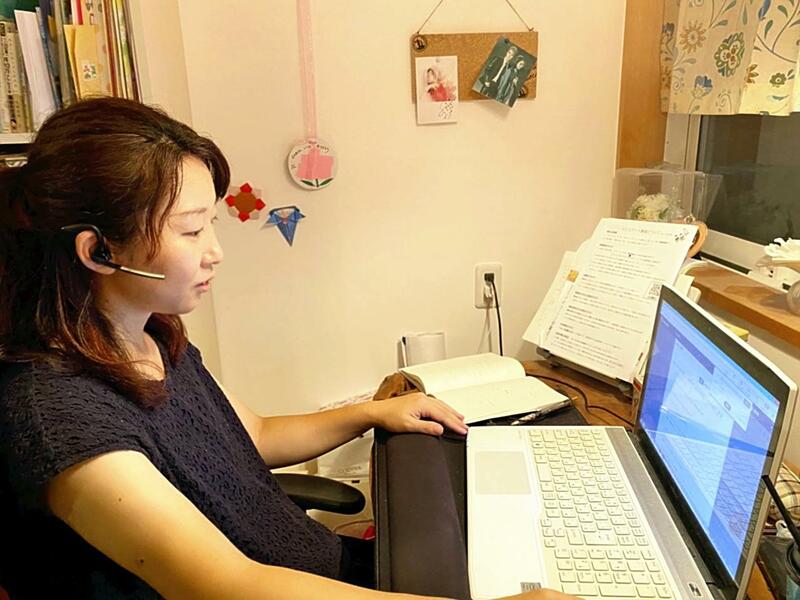
Efforts are being made to increase the number of female information technology engineers. Online learning programs that are easy to attend attract many women, and online communities targeting them serve as platforms for exchanging information where women seek and give advice about work-related problems in the male-dominated IT industry.
-- Developing talent
The percentage of female IT engineers was 13.1% in 2016 and 21.1% in 2020, according to the Japan Information Technology Services Industry Association, a group of companies in the information and communications industry.
Among the programs that support female IT engineers is Menta, an online service started in 2018 that connects IT professionals willing to teach their skills with people wanting to learn them.
The company that runs Menta says about 30,000 people have registered with the service and about half of them may be women. The monthly fee starts at 3,000 yen.
Mari Adachi, 31, of Kyoto, is learning how to build websites and other skills at Menta. Adachi, who is a single mother, left the company that she had worked for in the fall last year and became a freelancer so she could better care for her child, especially when a sudden illness occurs, for example.
"I need to learn more to be a pro. I can't rely only on the knowledge I learned at the company," Adachi said. "And Menta is less expensive than online schools."
Aoi Kida registered with Menta as an instructor in March and teaches users how to build websites. Kida is often asked for advice not only on work-related technical matters, but also on problems regarding working as a female IT engineer, the 33-year-old from Kakogawa, Hyogo Prefecture, said.
As a mother herself, Kida knows how much time it takes to raise a child and understands the difficulty of balancing work and family life. Based on her own child-rearing experience, she advises others to "look at things over the long run and don't be impatient," Kida said. "Also, don't compare yourself with others too much."
Progate, an online computer programming learning system, is said to be attracting an increasing number of female users. Although computer programming is often thought to be difficult to learn, Progate tries to make its system more accessible by, for example, using animated characters.
-- Increasing diversity
Code Polaris is an online community with about 500 participants that supports female IT engineers by providing advice. The free service started in July last year and is run by three women, including Kazumi Ohira, a freelance IT engineer.
An online study session is held once every two months, and the topics include fielding questions on work-related technical matters, problems related to households in which both the husband and wife work, and behavior in a workplace where there are no other or few women.
"There is a wide range of work for IT engineers, and it's possible to work from home, too," Ohira said. "To encourage more women to join the workforce, I want to help create a work environment where they can have peace of mind."
Yuka Iwasaki, president and founder of Youtrust, Inc., a company providing information on changing jobs and having side jobs using social media, established the firm after learning computer programming online while working as a company employee.
"There are few women in engineering-related industries due to the stereotype that men are supposed to major in science and women in liberal arts," Iwasaki said. "There is no gender difference regarding skills. It would be beneficial for the industry to have more female workers, who will make it more diverse."
Read more from The Japan News at https://japannews.yomiuri.co.jp/