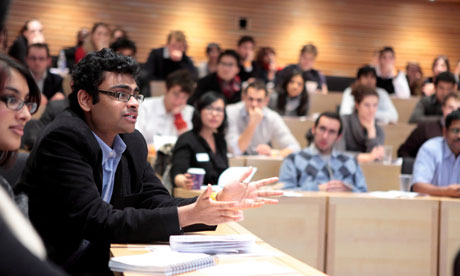
First, the good news. Over the last few years, interest in social enterprise amongst UK university students has grown significantly. Student societies engaging with social entrepreneurship have been established across the country as the number of SIFE UK societies has risen from three to 45 in under ten years. Attendance at the annual Emerge conference on social entrepreneurship has increased by six-fold in three years. Students who are passionate about social enterprise are even beginning to infiltrate conventional enterprise competitions – three of the eight finalists at this year's National Varsity Pitch Competition run by the National Consortium of University Entrepreneurs were ventures with an explicitly social goal.
Much of this growth in interest has been propelled by many of the UK's field-building social enterprise organisations actively reaching out to universities. For example, a recent partnership between UnLtd and the Higher Education Funding Council for England engaged and supported hundreds of student social entrepreneurs at 70 higher education institutions. The report on the programme found that after six months, the average venture supported through the programme had served 500 beneficiaries and created two jobs and 12 volunteering opportunities.
Although not often perceived as the most entrepreneurial of institutions, universities themselves are now also contributing to this trend, capitalising on the groundswell of enthusiasm. Our partners at the Skoll Centre for Social Entrepreneurship are witnessing their brightest and best MBA students, looking to use their talents to turn today's biggest global threats into the tomorrow's greatest opportunities. Top academic institutions are establishing courses and qualifications in social entrepreneurship whilst enterprise societies are building their knowledge on how to support social ventures.
Despite these advances, there are still challenges that currently prevent the social enterprise movement on UK campuses from reaching an exponential level of growth. A core of students are actively engaging with social enterprise – for example, at the universities in which Student Hubs works, groups of students on our committees are beginning to run conferences and networking events to link their peers with social entrepreneurs working in their local communities. However, more needs to be done to make the field feel more accessible to students across a range of subjects if we are to reach the similar tipping point as has been achieved in universities across America.
So why the roadblocks? We believe that development is hampered by silos of academic learning and theory. We've witnessed how academically inclined students can all too often get caught up in circular debates about how best to define social enterprise, when ultimately, wouldn't we prefer them to just "do" social enterprise?
Our undergraduate membership at Student Hubs, for example, is fully engaged in "social action" in providing training to student campaigners, setting up community allotments and holding speaker events on a variety of social and environmental issues. This involvement, though, is often limited to more traditional charitable activities such as volunteering and overseas development projects, and the notion that one can combine doing social good with making money is viewed with suspicion by some. If these students were given more of an opportunity to directly engage with the social enterprise sector, then more would realise that what matters is an organisation's ability to drive markets that create impact and shared value, rather than the boxes it ticks in relation to sector or form.
We believe that part of the way to fix this is to connect students directly to social entrepreneurs, and intrapreneurs who are working within government and private sector organisations to help effect positive social change. Students should be supported to learn by doing, so that students interested in both charitable and business activities can use their skills for good. There are some great examples of practical programmes developing in the UK.
For example, Northampton University complements modules in social enterprise that are integrated into the majority of courses with work placements and volunteering opportunities so that students can take part in the growth of local social enterprises. The Emerge conference, run each autumn, provides practical workshops and facilitated networking opportunities to connect students to practitioners. The Emerge Venture Lab that launches at this conference provides a six-month programme of incubation and support to early-stage student-led ventures, all so that they can develop their ideas while they study. Taken together, these activities are beginning to form a supportive ecosystem for student social enterprise to allow students to actively use their time and talents to help move the sector forward.
Anna and Freddie are leading the social enterprise initiatives at Student Hubs, a UK charity working with 16,000 students across the UK.
The 2011 Emerge Conference is taking place 29 and 30 October 2011 at Said Business School, University of Oxford.
This content is brought to you by Guardian Professional. To join the social enterprise network, click here