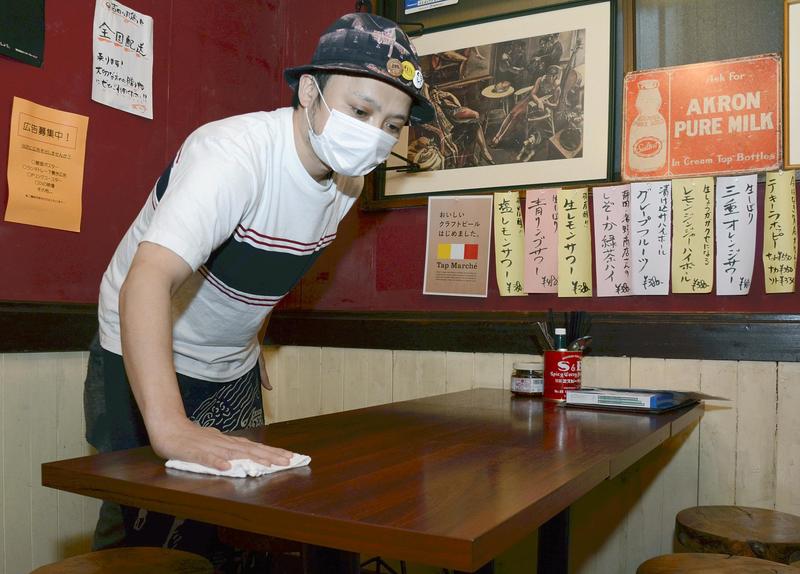
Amid the sluggish economy caused by the novel coronavirus pandemic, concerns over the funding of small and midsize enterprises grow. Although the government has initiated financial aid measures such as paying benefits and covering rent, some point out the complicated nature of these procedures. Here is a list of ways the management of small and midsize companies can be supported.
The "subsidy program for the sustainment of businesses," in which the government provides up to 2 million yen, is an effective initiative for small and midsize business owners whose sales have dropped by 50% or more. Unlike subsidies from capital investments, the program has no constraints on usage; funds can be utilized for anything including paying for raw materials or office supplies. Additionally, there is no need to pay back the funds.
In the case of small and midsize firms, the difference between last year's sales and the assumed amount of one year of decreased monthly sales will be paid, up to a maximum of 2 million yen. If sales totaling 1 million yen a month are halved, the difference will be 6 million yen as a result of the annual sales of 12 million yen being offset by the assumed amount of 6 million yen. In this case, the maximum of 2 million yen will be provided.
If a company submits information including sales ledgers and copies of tax return documents via the designated government website launched on May 1, the funds will be transferred to their bank accounts in two weeks on average, or roughly one week at the earliest.
In addition to benefits from the central government, there are cases in which local governments, such as the Tokyo metropolitan government, that requested temporary business closures will supply their own cooperation funds.
However, it must be noted that some claim that because the two main expenses for the management of small and midsize businesses -- salaries and rent -- are a heavy burden, 2 million yen is not enough. Although a system is in place to provide support, the procedures are likely to be complicated because these costs vary depending on each company's business conditions.
A case in point is the "employment adjustment subsidy," which subsidizes a portion of the leave allowance paid by companies to employees. Ordinarily, there are roughly 10 kinds of documents required to prevent fraudulence, including attendance records and wage ledgers. Currently, the procedures have been streamlined by reducing the number of documents.
The subsidy rate was two-thirds of the amount of leave payments for small and midsize companies, but the full amount is subsidized for restaurants and other businesses that heeded requests to close. In the second supplementary budget for fiscal 2020, the government decided on a policy to double the maximum daily subsidy to 15,000 yen.
If a company dismisses experienced employees, fully resuming operations will be difficult. It is important for companies to be able to apply without feeling burdened. However, the government has yet to deal with the issues, as troubles with the online application process that began Wednesday have risen.
Support for rent is likely to be provided after June. The government is considering providing the equivalent of two-thirds of the rent for six months after a company borrows a virtually interest-free loan without collateral from government-affiliated or private financial institutions.
It is also possible to apply for a grace period for the payment of fees.
Major power and gas companies have extended the deadline for payment of electricity charges for meter readings from March and gas charges from February by up to three months.
The consulting service of each company can be contacted to apply, and there are some circumstances in which an extension on the payment of water or mobile phone bills will be accepted.
Paying yearly taxes will be difficult for businesses as most companies, which close their books in March, pay taxes at the end of May. Due to tax payment amounts being determined by last fiscal year's income -- when the company's businesses were stable -- tax payments will be burdensome under the current situation. The tax office offers a grace period of up to one year. Similar measures apply to social insurance premiums and local taxes such as fixed property tax.
Read more from The Japan News at https://japannews.yomiuri.co.jp/