An initiative to support agricultural and marine product producers is growing in the wake of closures within the restaurant industry to prevent infection of the new coronavirus. Some of these producers, which supply foods used as ingredients at these establishments have been going through challenging times.
Amid such harsh situations, more and more companies and other related bodies have offered their support by either introducing sales methods designed to curb infection or enhancing the value of the ingredients by teaching how to cook them.
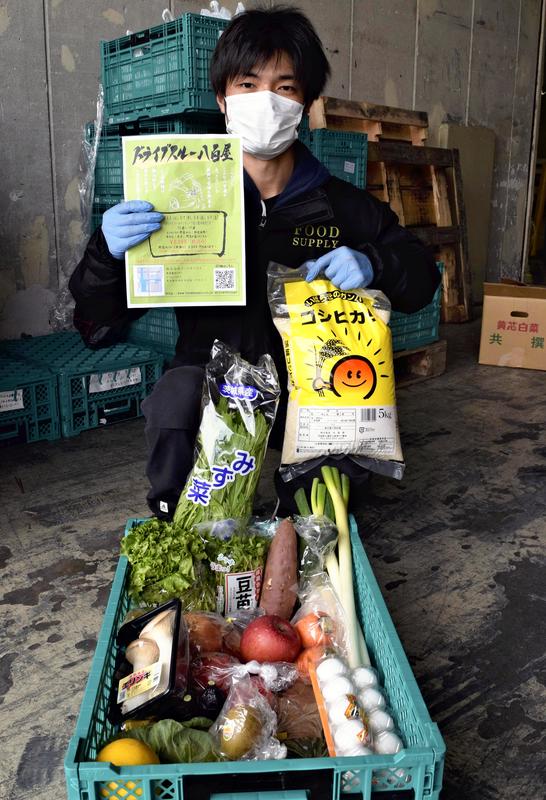
In late April, customers came in droves to visit a "drive-through vegetable store" opened by Food Supply, a produce wholesaler in Ota Ward, Tokyo.
As each car arrived, employees would load it with cardboard boxes filled with fresh produce. With entering the store no longer being necessary, the Three Cs -- closed spaces, crowded places and close-contact settings -- that would help spread the infectious disease can be avoided. "It's safe because we can avoid contact with people," said a 52-year-old local housewife.
The Tokyo-based company also launched drive-through-style sales in Noda, Chiba Prefecture in early April, preparing boxes that contained roughly 20 various types of produce for 3,500 yen each, including tax, and some that also included 5 kilograms of rice for 5,000 yen. The company has expanded the similar sales method to cities such as Sapporo, Osaka and Fukuoka.
"This business was started in response to reports from our contracted farmers that demand had decreased due to the closures of restaurants and shops," company president Atsushi Takekawa said. "We would like to continue sales while making sure to avoid the Three Cs."
Fisherman Japan Marketing Co., a seafood sales company in Ishinomaki, Miyagi Prefecture, began online sales of boxes of locally caught fish in mid-April. According to the company, with fewer orders from the restaurant industry and sluggish sales of both the company and local fishermen, the internet provided a new path to sales.
The boxes are priced at 3,240 yen for 2 kilograms and 4,860 yen for 3 kilograms. The prices include tax and exclude transportation costs. As the company would like customers to fillet a fish at home given that there is more time available for them to do so, their assortment of fish has only had the scales and internal organs removed.
Additionally, the company holds classes on the proper way to dress a fish via video conference system on a regular basis and invites those who purchase their products to join.
During a class held in late April with eleven participants, the manager of a izakaya Japanese-style bar located in Nakano Ward, Tokyo, worked as a lecturer and explained how to dress a fish while giving a demonstration on how to cut a fish into three pieces, the way to dress a fish most efficiently. "We hope that consumers will become familiar with fish dining culture by shortening the mental distance between producers and consumers," said a representative of the company.
Since mid-April, Tabe Choku, a direct sales website, has sold ingredients, which have seen a fall in demand, along with recipes invented by chefs of restaurants currently undergoing closures. For every product sold, the chef is paid 300 yen.
Kenchan Farm, an agricultural corporation that mainly produces and sells onions in Minami-Awaji, Hyogo Prefecture, has increased the volume of its sales on its website by attaching a recipe for fresh onion tarts created by a Japanese chef who operates a restaurant in southern France. "Although seasonal onions cannot be stored for very long, we were able to ship them without the prices falling," said Noriko Amano, the company's president.
AP Company Co., in Tokyo, which operates shops including the Japanese-style pub Tsukada Nojo, sold a set of ingredients for shabushabu hot pot dish including regionally farmed chicken, as well as shelled oysters through its website in mid-April, to support producers.
"Devising new effective sales methods makes agriculture or fisheries sustainable," said Koichi Hosokawa, professor of Japan Women's University, who is well versed in consumption and distribution. "It is, however, important to implement these methods based not only on goodwill but also on good business sense. Establishing a system in which producers, consumers and intermediary companies mutually benefit is necessary."
Read more from The Japan News at https://japannews.yomiuri.co.jp/