Farmers across the country are suffering from a shortage of workers this harvest season due to the coronavirus crisis, which has depleted the foreign labor force.
The situation has lead to an increase in the hiring of workers furloughed from jobs in industries that have halted operations during the pandemic, to replace the foreign laborers who, because of travel restrictions, are unable to enter Japan.
However, the future remains uncertain.
After the Golden Week Holidays, a 40-year-old farmer had to discard the komatsuna Japanese mustard spinach he had cultivated in 18 greenhouses in Kurume, Fukuoka Prefecture.
"I had no choice but to throw them away," he said, bemoaning the loss, which amounted to 3 million yen.
Two Filipino laborers who had been due to work on the farm during the harvest season were unable to travel to Japan.
"Even if we try to find replacements, the work in the greenhouses is so demanding that we can't expect to get any applications," he said.
Farmers are in a bind, having lost their main source of labor: foreign workers.
The coronavirus epidemic has made it impossible for foreigners to come to Japan under the technical intern training program from Asian countries, which send many such workers to Japan. According to the Agriculture, Forestry and Fisheries Ministry, 2,400 foreign trainees in the agriculture sector and 900 in the fishing industry had canceled trips to Japan as of May 21.
Amid this predicament, the agriculture sector has seen an influx of workers from industries including tourism and hospitality, which have been effectively "closed for business."
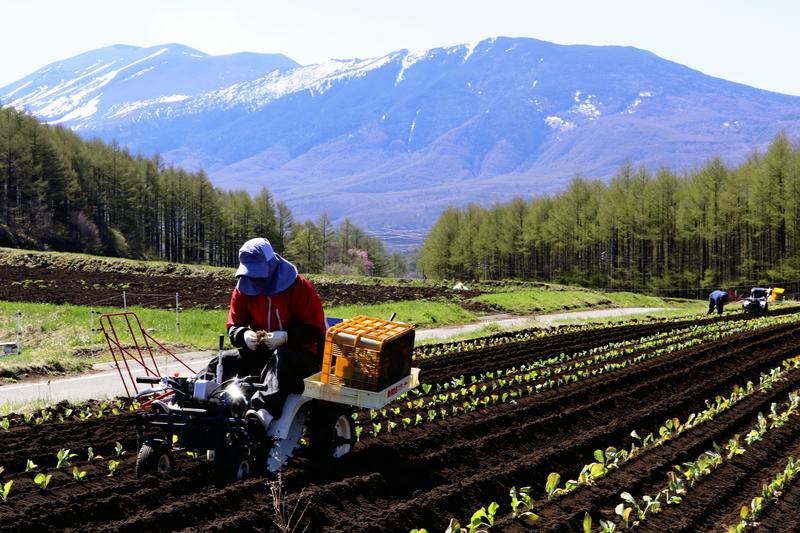
Cabbage planting is underway in the village of Tsumagoi, a major producer of cabbage, in Gunma Prefecture.
Two Chinese laborers who had been scheduled to work on one of the cabbage farms in the village could not travel to Japan because of the coronavirus pandemic.
When a local agricultural association and neighboring chamber of commerce sought recruits among workers in the tourism industry who had been furloughed, two people applied for temporary employment.
One of them was a 30-year-old who was grateful for the opportunity as he lost a job that he had expected to start in April at a hotel in Nagano Prefecture.
Without them, "our incomes would've halved," said the farmer who hired them.
The labor shortage problem is not limited to the lack of foreign trainees.
There have also been cases of farmers having to stop work to look after children amid the prolonged period of school closures in the wake of the coronavirus epidemic.
As a result, there has been a sudden surge in agencies specializing in finding temporary placements for furloughed workers.
Tokyo-based agency Sharagri Co., which introduces workers furloughed from jobs in the tourism industry to farms, has found placements for about 20 people.
"It's a 'win-win' situation because furloughed workers can earn an income and farmers can source laborers," said Sharagri President Hiyuto Ide.
Farmers who recruit workers to replace the foreign trainees who would've been employed will be subsidized up to 500 yen per hour for each person they hire under a system newly established by the agriculture ministry.
The agricultural population has declined by 40% over the past 10 years, and aging has progressed. "Ironically, the coronavirus crisis has given farmers an inkling of how to solve labor shortages," a ministry official said.
However, challenges remain.
While farmers will have demand for workers until the harvest peak ends in autumn, people from other industries hired by farms tend to think of the positions as temporary, lasting for about one month, according to an association that has found farm work for furloughed employees.
Agricultural work isn't something that can be learned overnight. While there is a need for experienced hands who are able to instruct other workers, if labor turnover is high, it is difficult to create an environment in which skills can be developed.
The government has allocated about 1 billion yen in the supplementary budget for coronavirus measures for so-called smart agriculture, which utilizes such labor-saving innovations as artificial intelligence and robots. Many of the related projects, however, are at an experimental stage.
"The government should improve financial supports to agricultural schools or enterprises that can play a role in the cultivation of human resources. A system to develop human resources from a long-term perspective should be established,"
according to Prof. Teruaki Nanseki of Kyushu University, an expert in agricultural management.
Closures of schools and restaurants in the wake of the coronavirus epidemic left farmers with a shortage of demand for their produce.
According to the Agriculture, Forestry and Fisheries Ministry, businesses such as restaurants account for about 20% of the consumption of major domestic vegetables. Demand fell sharply in response to requests to suspend operations following the declaration of a nationwide state emergency.
In particular, sales of such premium food products as wagyu beef and melons have been sluggish due to a sharp drop in the number of foreign visitors to Japan and cancellations of large gatherings, among other reasons. The ministry has started a program to provide subsidies for the use of premium ingredients in school lunches to boost consumption.
The lack of demand for raw milk, which is used to make milk for drinking, has also been problematic. The suspension of school lunch orders decreased the demand for raw milk about 1,900 tons, 10%, of the national daily production of 20,000 tons. The temporary closures of coffee chain stores also reduced the demand for commercial milk by 50-70%.
Domestic production of raw milk peaks in June. To avoid waste, dairy manufacturers are producing more butter and powdered milk, which can be stored for a long time. A factory in Iwate Prefecture is producing two to three times more powdered milk than usual, but "inventory keeps on increasing," a company official said.
Read more from The Japan News at https://japannews.yomiuri.co.jp/