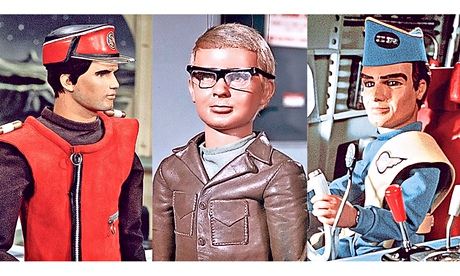
Gerry Anderson dreamed big. He wanted to make fabulous, mega-budget, live-action adventure movies, but circumstances forced him to think smaller, condemning him to a career in TV largely involving those most difficult and unresponsive of performers: marionettes. His loss is very much our gain as this lavish box set proves, covering his years working in “supermarionation” – a fancy term Anderson coined to signify that his puppet shows were bigger, better and more spectacular than anyone else’s.
Rather than the complete works, the box set offers a selection of two or three episodes from each of Anderson’s marionette shows. It’s just as well in some cases, as the crude, lumpy-faced characters of such early offerings as Twizzle and Torchy the Battery Boy are, especially in HD, less likely to enchant young minds than cause them nightmares. The cowboy series Four Feather Falls (with sheriff Tex Tucker voiced by Nicholas Parsons) and the self-explanatory Supercar were relatively slow, formulaic affairs you only need to check out once; and The Secret Service, his final and frankly bizarre supermarionation show about a nonsense-spouting priest/spy who could shrink to fit inside a briefcase seems more a cry for help than a legitimate slice of TV.
But bookended between those, Anderson’s run – from Fireball XL5 to Joe 90 – is pretty much all gold. The episodes selected are usually the series opener and one standout. With Stingray, the first British TV show shot entirely in colour, you get the hilarious episode Titan Goes Pop, in which the security of the titular combat submarine’s base is threatened by screaming fans when pop star Duke Dexter drops by for a visit. Meanwhile, the Thunderbirds offering, Terror in New York City, is a perfect example of how overloaded with disasters the weekly show could be: after putting out a fire in an oil refinery, Thunderbird 2 is shot down during a navy missile test – on the very same day that an audacious plan to move the Empire State Building goes horribly awry. No wonder it’s the most popular of Anderson’s shows, with a remake by Peter Jackson imminent.
Two subsequent series – the strangely morbid war-with-Mars-epic Captain Scarlet and the Mysterons and the schoolkid superspy Joe 90 – never quite reached the popularity of Thunderbirds, despite being more technically refined. They’re still great to watch, very stylish with plenty of explosions, though the best scenes may well be the ones in which the characters are off duty: we see these little puppet people sitting around smoking, reading magazines and listening to lounge piano music.
Of course Anderson, who died in 2012, can’t take all the credit. Composer Barry Gray came up with some of TV’s most exciting and memorable theme tunes, sometimes recording them in the living room of his suburban home; and special effects director Derek Meddings provided the spectacle, creating and filming the (seemingly) huge vehicles that were always blowing things up or getting blown up themselves. Meddings also had a strange genius for devising all those ritualistic launch sequences, as well as an unerring eye for the most dynamic camera angle.
Anderson’s mini-Hollywood, working out of an industrial estate in Slough, proved a great training ground. His graduates litter the credits of blockbusters, from Star Wars to Alien, James Bond and Superman; while his supermarionations were admired by the likes of George Lucas, James Cameron and Stanley Kubrick (who poached some of his crew to work on 2001: A Space Odyssey). You can see why. Almost every frame of these shows is a mini-marvel of ingenuity, creativity and style. They are pop culture classics, British TV at its best – and, more importantly, they are still massively entertaining.