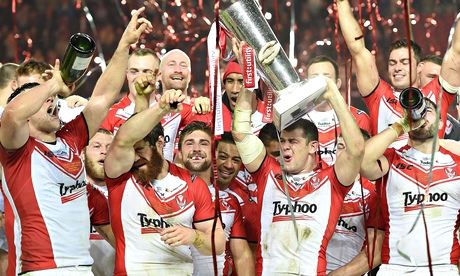
It was at Wembley Stadium on Thursday lunchtime, just as mardy skies gave way to an unseasonable warmth and lustre, that the Super League’s general manager, Blake Solly, made a pronouncement as startling as the weather. The forthcoming rugby league season would, he said, be “the most hotly contested of all time”.
And three weeks away from the Super League’s 20th season, which kicks off on 5 February when Wigan face Widnes, Solly went further still, saying he could hear the sound of a sport growing again after years of stasis.
“Anyone who is around rugby league realises it is on the march,” he told the Guardian after the draw for the first round of the Challenge Cup. “Last year the Grand Final was the most watched of all time with over 440,000 viewers. Our audience on Sky was 5% up. And the Magic Weekend had the most ticket sales ever.”
A preternatural spring was in the air and in Solly’s step. “We know the next year will be the best ever commercially,” he continued. “And there is a renewed enthusiasm for the sport with the new structure we have put in place.”
This is bold talk. For a few years now rugby league has too often been background noise in the sporting calendar – the Challenge Cup final, Grand Final and international matches aside. And in a year featuring an Ashes summer and a rugby union World Cup autumn, most expect the sport to be barged to the margins again.
Not Solly, though. “The rugby World Cup is a challenge but it is also an opportunity,” he says. “It’s a great tournament and there will be a lot of attention on it – which means people who probably wouldn’t be interested in either rugby code become interested in rugby in that period.”
Whether those new fans will gravitate to the Super League is an open question but this year’s competition will benefit from a much-needed trimming of excess fat.
The number of teams has been reduced from 14 to 12 for Super League XX. The bloated eight-team play-off format, which too readily rewarded mediocrity, has also been hacked down to a straight four-team semi-final and Grand Final. And, most radically of all, after 23 games (each v all, home and away, plus one for the Magic Weekend) the Super League will be chopped up – with the top eight sides settling the play-off positions among themselves while the remaining four sides enter a mini-tournament against the top four in the Championship to decide promotion and relegation.
No one is quite sure how it will work – as one below-the-line commenter on the Super League website put it: “I’ve been watching rugby league since 1955, I now have to go to an Open University course to understand who wins and loses. Help!” – but the reception has been broadly favourable.
Not everything in rugby league’s garden is rosy, however. There are question marks about whether the wide gap in resources between Super League and Championship teams will perhaps make the promotion/relegation play-offs a little one-sided, while the sight of Sam Burgess playing union for Bath is a stark reminder about the relative strength of each code’s finances.
As Brian Noble, who coached the Bradford Bulls to three Super League titles and brought a young Burgess to the club, admitted: “Unfortunately Sam was one of league’s X-factor players. But I’m a firm believer that there is a heck of a lot of talent out there for the England team.”
Noble cited the St Helens full-back Jonny Lomax, who has recovered from the knee injury that ended his 2014 season in June, and last year’s man of steel Daryl Clark, who has moved from Castleford to Warrington, as two names who could break through into the mainstream.
Meanwhile a happy consequence of the reduced number of overseas players – largely because the Australian game is so flush with money – has led to a seemingly endless flow of domestic young talent. The Leeds stand-off Liam Sutcliffe, Ben Currie at Warrington and Wigan’s George Williams, Joe Burgess and Ryan Hampshire are only 20, which bodes well for the national team and the game.
So does the fact that the six teams at the top of the Super League last season were separated by only six points. As Noble explained: “Things have changed because of the parity that’s been created with various rules and regulations and the talent being spread around.”
So is Solly really right to say that this season will be even closer and more dramatic? Perhaps even the most hotly contested of all time?
He nods his head. “I think we have probably got six, seven, eight teams who can make the Super League Grand Final and win the Challenge Cup,” he said. “Which compares favourably to other sports, when you can probably pick the winner amongst four.
“And we’ve got 12 teams who can make that top eight and save themselves from having to go through the relegation qualifiers. So from February through to October the season is jam-packed with exciting rugby league.”